Thank you for visiting SNEWPapers!
Sign up free
Danbury Times
Danbury, Fairfield County, Connecticut
What is this article about?
Reports from the Mexican-American War front: Texan Rangers under Capt. McCullogh conduct reconnaissance near Reynosa, gathering intel on Mexican forces at Linares and Monterey; Gen. Taylor's army stalled at Matamoros due to lack of transport; rumors of Paredes advancing; passive Mexicans along Rio Grande; Santa Anna to embark from Havana for Veracruz.
Clipping
OCR Quality
Full Text
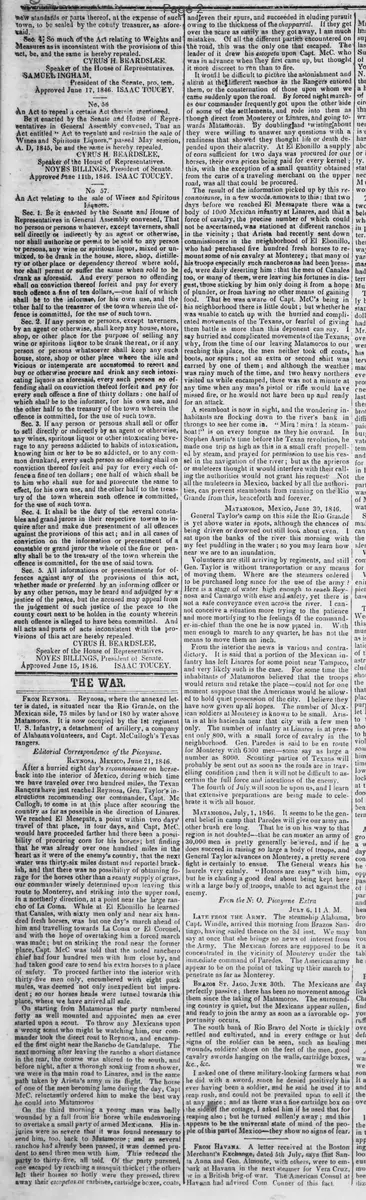
From Reynosa.
Reynosa, where the annexed letter is dated, is situated near the Rio Grande, on the Mexican side, 75 miles by land or 180 by water above Matamoros. It is now occupied by the 1st regiment U. S. Infantry, a detachment of artillery, a company of Alabama volunteers, and Capt. McCullogh's Texas Rangers.
Editorial Correspondence of the Picayune.
REYNOSA, MEXICO, June 21, 1846.
After a hurried eight day's reconnoisance on horseback into the interior of Mexico, during which time we have traveled over two hundred miles, the Texan Rangers have just reached Reynosa, Gen. Taylor's instructions recommending our commander, Capt. McCullogh, to come in at this place after scouring the country as far as possible in the direction of Linares.
We reached El Mesquite, a point within two days' travel of that place, in four days, and Capt. McC. would have proceeded farther had there been a possibility of procuring corn for his horses; but finding that he was already over one hundred miles in the heart as it were of the enemy's country, that the next water was thirty-six miles distant and reported brackish, and that there was no possibility of obtaining forage for the horses other than a scanty supply of grass, our commander wisely determined upon leaving this route to Monterey, and striking into the upper road, in a northerly direction, at a point near the large rancho of La Coma. While at El Ebonillo he learned that Canales, with sixty men only and near six hundred fresh horses, was but one day's march ahead of him and travelling towards La Coma or El Coronel, and with the hope of overtaking him a forced march was made; but on striking the road near the former place, Capt. McC was told that the noted ranchero chief had four hundred men with him close by, and had taken good care to send his extra horses to a place of safety. To proceed farther into the interior with thirty-five men only, encumbered with eight pack mules, was deemed not only inexpedient but imprudent; so our horses heads were turned towards this place, where we have arrived all safe.
On starting from Matamoros the party numbered forty as well mounted and appointed men as ever started upon a scout. To throw any Mexicans upon a wrong scent who might be watching him, our commander took the direct road to Reynosa, and encamped the first night near the Rancho de Guadalupe. The next morning after leaving the rancho a short distance in the rear, the course was altered to the south, and before night, after a thorough soaking from a shower, we were in the main road to Linares, and in the same path taken by Arista's army in its flight. The horse of one of the men becoming lame during the day, Capt. McC. reluctantly ordered him to make the best way he could into Matamoros.
On the third morning a young man was badly wounded by a fall from his horse while endeavoring to overtake a small party of armed Mexicans. His injuries were so severe that it was found necessary to send him, too, back to Matamoror; and as several ranchos had already been passed, it was deemed prudent to send three men with him. This reduced the party to thirty-five, all told. Of the party pursued, one escaped by reaching a mesquit thicket; the others left their horses so hotly were they pressed, threw away their escopetas or carbines, cartridge boxes, coats, and even their spurs, and succeeded in eluding pursuit owing to the thickness of the chapparral. If they get over the scare as easily as they got away, I am much mistaken. Of all the different parties encountered on the road, this was the only one that escaped. The leader of it drew his escopeta upon Capt. McC. who was in advance when they first came up, but thought it more discreet to run than to fire.
It would be difficult to picture the astonishment and alarm at the different ranchos as the Rangers entered them, or the consternation of those upon whom we came suddenly upon the road. By forced night marches our commander frequently got upon the other side of some of the settlements, and rode into them as though direct from Monterey or Linares, and going towards Matamoros. By doubling and twisting about they were willing to answer any questions with a readiness that showed they thought life or death depended upon their alacrity. At El Ebonillo a supply of corn sufficient for two days was procured for our horses, their own prices being paid for every kernel; this, with the exception of a small quantity obtained from the carts of a traveling merchant on the upper road, was all that could be procured.
The result of the information picked up by this reconnoisance, in a few words, amounts to this: that two days before we reached El Mesquite there was a body of 1000 Mexican infantry at Linares, and that a force of cavalry, the precise number of which could not be ascertained, was stationed at different ranchos in the vicinity; that Arista had recently sent down commissioners in the neighborhood of El Ebonillo, who had purchased five hundred fresh horses to remount some of his cavalry at Monterey; that many of his troops especially such rancheros as had been pressed, were daily deserting him: that the men of Canales too, or many of them, were leaving his fortunes in disgust, those sticking by him only doing it from a hope of plunder, or from having no other means of gaining food. That he was aware of Capt. McC's being in his neighborhood there is little doubt; but whether he was unable to catch up with the hurried and complicated movements of the Texans, or fearful of giving them battle is more than this deponent can say.
Say hurried and complicated movements of the Texans; why, from the time of our leaving Matamoros to our reaching this place, the men neither took off coats, boots, nor spurs; not an extra or second shirt was carried by one of them; and although the weather was rainy much of the time, and two heavy northers visited us while encamped, there was not a minute at any time when any man's pistol or rifle would have missed fire, or he would not have been up and ready for an attack.
A steamboat is now in sight, and the wondering inhabitants are flocking down to the river's bank in throngs to see her come in. "Mira! mira! la steamboat!" is on every tongue as they hie onward. In Stephen Austin's time before the Texan revolution, he made one trip as high as this in a small craft propelled by steam, and prayed for permission to use his vessel in the navigation of the river; but as the arrieros or muleteers thought it would interfere with their calling the authorities would not grant his request. Not all the muleteers in Mexico, backed by all the authorities, can prevent steamboats from running on the Rio Grande from this, henceforth and forever.
MATAMOROS, MEXICO, June 30, 1846.
General Taylor's camp on this side the Rio Grande is yet above water in spots, although the chances of being driven or drowned out still look about even. I sat upon the banks of the river this morning with my feet puddling in the water; so you may learn how near we are to an inundation.
Volunteers are still arriving by regiments, and still Gen. Taylor is without transportation or any means of moving them. Where are the steamers ordered to be purchased long since for the use of the army? Here is a stage of water high enough to reach Reynosa and Camargo with ease and safety, yet there is not a safe conveyance even across the river. I cannot conceive a situation more trying to the patience and more mortifying to the feelings of the commander-in-chief than the one he is now placed in. With men enough to march to any quarter, he has not the means to move them an inch.
From the interior the news is various and contradictory. It is said that a portion of the Mexican infantry has left Linares for some point near Tampico, and very likely such is the case. For some time the inhabitants of Matamoros believed that the troops would return and retake the place—could not for one moment suppose that the Americans would be allowed to hold quiet possession of the city. I believe they have now given up all hopes. The number of Mexican soldiers at Monterey is known to be small. Arista is at his hacienda near that city with a few men only. The number of infantry at Linares is at present only 800, with a small force of cavalry in the neighborhood. Gen. Paredes is said to be en route for Monterey with 6000 men—some say as large a number as 8000. Scouting parties of Texans will probably be sent out as soon as the roads are in travelling condition; and then it will not be difficult to ascertain the full force and intentions of the enemy.
The fourth of July will soon be upon us, and I learn that extensive preparations are being made to celebrate it with all honor.
Matamoros, July 1, 1846. It seems to be the general belief in camp that Paredes will give our army another brush ere long. That he is on his way to that region is not doubted—that he can muster an army of 30,000 men is pretty generally believed, and if he does succeed in raising so large a body of troops, and General Taylor advances on Monterey, a pretty severe fight is certainly to ensue. The General wears his laurels very calmly. "Honors are easy" with him, but he is chafing a good deal about being kept here with a large body of troops, unable to act against the enemy.
From the N. O. Picayune Extra
July 6, 11 A. M.
LATE FROM THE ARMY. The steamship Alabama, Capt. Windle, arrived this morning from Brazos Santiago, having sailed thence on the 3d inst. We may say at once that she brings no news of interest from the Army. The Mexican forces are supposed to be concentrated in the vicinity of Monterey under the immediate command of Paredes. The American army appear to be on the point of taking up their march to penetrate as far as Monterey.
Brazos St. Jago, June 30th. The Mexicans are perfectly passive; there has been no movement among them since the taking of Matamoros. The surrounding country is quiet, but the Mexicans appear sullen, and ready to join the army as soon as a favorable opportunity occurs.
The south bank of Rio Bravo del Norte is thickly settled and cultivated, and in every cottage or hut signs of the soldier can be seen, such as healing wounds, soldiers' shoes on the feet of the men, good cavalry swords hanging on the walls, cartridge boxes, &c., &c.
I asked one of these military-looking farmers what he did with a sword, since he denied positively his ever having been a soldier, and he said he used it to reap rush, and could not be prevailed upon to sell it at any price; and as there was a fine cartridge box on the side of the cottage, I asked him if he used that for reaping also; but he turned sullenly away; and this appears to be the universal state of mind of the people of this part of Mexico—they show no signs of fear.
From Havana. A letter received at the Boston Merchant's Exchange, dated 5th July, says that Santa Anna and Gen. Almonte, with others, were to embark at Havana in the next steamer for Vera Cruz, or in a British brig-of-war. The American Consul at Havana had advised Com. Conner of this fact.
What sub-type of article is it?
What keywords are associated?
What entities or persons were involved?
Where did it happen?
Foreign News Details
Primary Location
Reynosa And Matamoros, Mexico
Event Date
June 21 July 6, 1846
Key Persons
Outcome
texan rangers pursue but fail to capture canales; one ranger wounded in fall; intel reveals 1000 mexican infantry at linares, 800 later; desertions from mexican forces; us army stalled without transport; mexicans passive and sullen; santa anna to sail for veracruz.
Event Details
Texan Rangers under Capt. McCullogh conduct eight-day reconnaissance from Matamoros into Mexican interior toward Linares, traveling 200 miles, pursuing Mexican parties and gathering intelligence on enemy forces, supplies, and desertions. Party reduced to 35 men after injuries. At Matamoros, Gen. Taylor's camp faces flooding risks and lacks transportation despite arriving volunteers. Rumors of Mexican troop movements from Linares to Tampico and Paredes advancing on Monterey with 6000-8000 men. Brazos Santiago reports passive Mexicans. Havana letter indicates Santa Anna and Almonte embarking for Veracruz.