Thank you for visiting SNEWPapers!
Sign up free
Editorial
August 28, 1810
The Rhode Island American, And General Advertiser
Providence, Providence County, Rhode Island
What is this article about?
An editorial in the Rhode-Island American critiques Mr. Prinman's speech to the Tammany Society, denying any historical or traditional basis for claims that Indian chief Tammany was the order's virtuous patron, accusing the speaker of deliberate falsehood to mislead audiences.
Clipping
OCR Quality
95%
Excellent
Full Text
miscellany.
FOR THE RHODE-ISLAND AMERICAN.
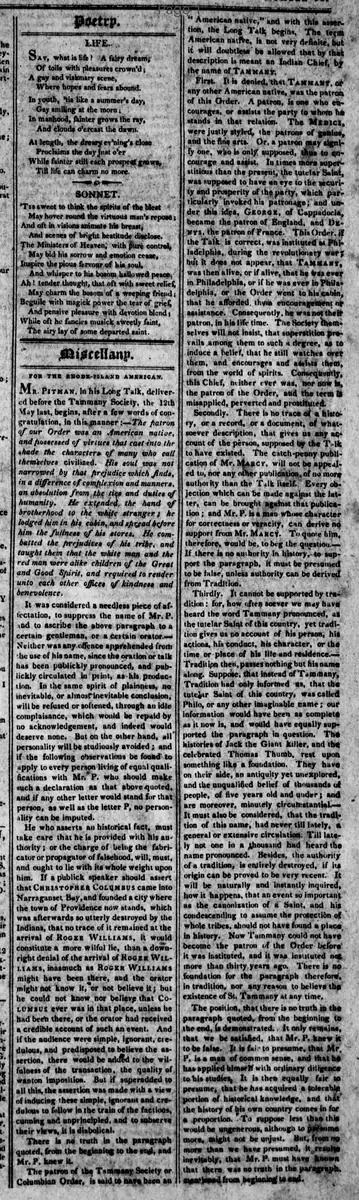
Mr. PRINMAN, in his Long Talk, delivered before the Tammany Society, the 12th May last, begins, after a few words of congratulation, in this manner: The patron of our Order was an American native, and possessed of virtues that cast into the shade the characters of many who call themselves civilized. His soul was not narrowed by that prejudice which finds, in a difference of complexion and manners, an absolution from the ties and duties of humanity. He extended the hand of brotherhood to the white stranger; he lodged him in his cabin, and shared before him the fulness of his stores. He combatted the prejudices of his tribe, and taught them that the white man and the red man were alike children of the Great and Good Spirit, and required to render unto each other offices of kindness and benevolence.
It was considered a needless piece of affectation, to suppress the name of Mr. P. and to ascribe the above paragraph to a certain gentleman, or a certain orator. Neither was any offence apprehended from the use of his name, since the oration or talk has been publickly pronounced, and publickly circulated in print, as his production. In the same spirit of plainness, no inevitable, or almost inevitable conclusion, will be refused or softened, through an idle complaisance, which would be repaid by no acknowledgement, and indeed would deserve none. But on the other hand, all personality will be studiously avoided; and if the following observations be found to apply to every person living of equal qualifications with Mr. P. who should make such a declaration as that above quoted, and if any other letter would stand for that person, as well as the letter P, no personality can be imputed.
He who asserts an historical fact, must take care that he is provided with his authority; or the charge of being the fabricator or propagator of falsehood, will, must, and ought to lie with its whole weight upon him. If a publick speaker should assert that CHRISTOPHER COLUMBUS came into Narraganset Bay, and founded a city where the town of Providence now stands, which was afterwards so utterly destroyed by the Indians, that no trace of it remained at the arrival of ROGER WILLIAMS, it would constitute a more wilful lie, than a downright denial of the arrival of ROGER WILLIAMS, inasmuch as ROGER WILLIAMS might have been there, and the orator might not know it, or not believe it; but he could not know nor believe that COLUMBUS ever was in that place, unless he had been there, or the orator had received a credible account of such an event. And if the audience were simple, ignorant, credulous, and predisposed to believe the assertion, there would be added to the wilfulness of the transaction, the quality of wanton imposition. But if superadded to all this, the assertion was made with a view of inducing these simple, ignorant and credulous to follow in the train of the factious cunning and unprincipled, and to subserve their views, it is diabolical.
There is no truth in the paragraph quoted, from the beginning to the end, and Mr. P. knew it.
The patron of the Tammany Society or Columbian Order, is said to have been an "American native," and with this assertion, the Long Talk begins. The term American native, is not very definite but it will doubtless be allowed that by that description is meant an Indian Chief, by the name of TAMMANY.
First. It is denied, that TAMMANY, or any other American native, was the patron of this Order. A patron, is one who encourages, or assists the party to whom he stands in that relation. The Mæcenas, were justly styled, the patrons of genius and the fine arts. Or, a patron may signify one, who is only supposed, thus to encourage and assist. In times more superstitious than the present the tutelar Saint, was supposed to have an eye to the security and prosperity of the party, which particularly invoked his patronage; and under this idea, GEORGE, of Cappadocia, became the patron of England, and DENYS, the patron of France. This Order, if the Talk is correct, was instituted at Philadelphia, during the revolutionary war but it does not appear, that TAMMANY, was then alive, or if alive, that he was ever in Philadelphia, or if he was ever in Philadelphia, or the Order went to his cabin that he afforded, them encouragement or assistance. Consequently, he was not their patron, in his life time. The Society themselves will not insist, that superstition prevails among them to such a degree, as to induce a belief, that he still watches over them, and encourages and assists them, from the world of spirits. Consequently this Chief, neither ever was, nor now is the patron of the Order, and the term is misapplied, perverted and prostituted.
Secondly. There is no trace of a history, or a record, or a document, of whatsoever description, that gives us any account of the person, supposed by the Talk to have existed. The catch-penny publication of Mr. MARCY, will not be appealed to, nor any other publication, of no more authority than the Talk itself. Every objection which can be made against the latter, can be brought against that publication; and Mr. P. is a man—whose character for correctness or veracity, can derive no support from Mr. MARCY. To quote him, therefore, would be, to beg the question.
If there is no authority in history, to support the paragraph, it must be presumed to be false, unless authority can be derived from Tradition.
Thirdly. It cannot be supported by tradition: for, how often soever we may have heard the word Tammany pronounced, as the tutelar Saint of this country, yet tradition gives us no account of his person; his actions, his conduct, his character, or the time or place of his life and residence. Tradition then, passes nothing but his name along. Suppose, that instead of Tammany Tradition had only informed us, that the tutelar Saint of this country, was called Philo, or any other imaginable name; our information would have been as complete as it now is, and would have equally supported the paragraph in question. The histories of Jack the Giant Killer, and the celebrated Thomas Thumb, rest upon something like a foundation. They have on their side, an antiquity yet unexplored, and the unqualified belief of thousands of people, of five years old and under; and are moreover, minutely circumstantial.
It must also be considered, that the tradition of this name, had never till lately, general or extensive circulation: Till lately not one in a thousand had heard the name pronounced. Besides, the authority of a tradition, is entirely destroyed, if its origin can be proved to be very recent. It will be naturally and instantly inquired, how it happens, that an event so important as the canonization of a Saint, and his condescending to assume the protection of whole tribes, should not have found a place in history. Now Tammany could not have become the patron of the Order before it was instituted, and it was instituted not more than thirty years ago. There is no foundation for the paragraph therefore in tradition, nor any reason to believe the existence of St. Tammany at any time,
The position, that there is no truth in the paragraph quoted, from the beginning to the end, is demonstrated. It only remains, that we be satisfied, that Mr. P. knew it to be false. It is fair to presume, that Mr. P. is a man of common sense, and that he has applied himself with ordinary diligence to his studies. It is then equally fair to presume, that he has acquired a tolerable portion of historical knowledge, and that the history of his own country comes in for a proportion. To suppose less than this would be ungenerous, although to presume more, might not be unjust. But, from no more than we have presumed, it results inevitably, that Mr. P. must have known that there, was no truth in the paragraph mentioned from beginning to end.
FOR THE RHODE-ISLAND AMERICAN.
Mr. PRINMAN, in his Long Talk, delivered before the Tammany Society, the 12th May last, begins, after a few words of congratulation, in this manner: The patron of our Order was an American native, and possessed of virtues that cast into the shade the characters of many who call themselves civilized. His soul was not narrowed by that prejudice which finds, in a difference of complexion and manners, an absolution from the ties and duties of humanity. He extended the hand of brotherhood to the white stranger; he lodged him in his cabin, and shared before him the fulness of his stores. He combatted the prejudices of his tribe, and taught them that the white man and the red man were alike children of the Great and Good Spirit, and required to render unto each other offices of kindness and benevolence.
It was considered a needless piece of affectation, to suppress the name of Mr. P. and to ascribe the above paragraph to a certain gentleman, or a certain orator. Neither was any offence apprehended from the use of his name, since the oration or talk has been publickly pronounced, and publickly circulated in print, as his production. In the same spirit of plainness, no inevitable, or almost inevitable conclusion, will be refused or softened, through an idle complaisance, which would be repaid by no acknowledgement, and indeed would deserve none. But on the other hand, all personality will be studiously avoided; and if the following observations be found to apply to every person living of equal qualifications with Mr. P. who should make such a declaration as that above quoted, and if any other letter would stand for that person, as well as the letter P, no personality can be imputed.
He who asserts an historical fact, must take care that he is provided with his authority; or the charge of being the fabricator or propagator of falsehood, will, must, and ought to lie with its whole weight upon him. If a publick speaker should assert that CHRISTOPHER COLUMBUS came into Narraganset Bay, and founded a city where the town of Providence now stands, which was afterwards so utterly destroyed by the Indians, that no trace of it remained at the arrival of ROGER WILLIAMS, it would constitute a more wilful lie, than a downright denial of the arrival of ROGER WILLIAMS, inasmuch as ROGER WILLIAMS might have been there, and the orator might not know it, or not believe it; but he could not know nor believe that COLUMBUS ever was in that place, unless he had been there, or the orator had received a credible account of such an event. And if the audience were simple, ignorant, credulous, and predisposed to believe the assertion, there would be added to the wilfulness of the transaction, the quality of wanton imposition. But if superadded to all this, the assertion was made with a view of inducing these simple, ignorant and credulous to follow in the train of the factious cunning and unprincipled, and to subserve their views, it is diabolical.
There is no truth in the paragraph quoted, from the beginning to the end, and Mr. P. knew it.
The patron of the Tammany Society or Columbian Order, is said to have been an "American native," and with this assertion, the Long Talk begins. The term American native, is not very definite but it will doubtless be allowed that by that description is meant an Indian Chief, by the name of TAMMANY.
First. It is denied, that TAMMANY, or any other American native, was the patron of this Order. A patron, is one who encourages, or assists the party to whom he stands in that relation. The Mæcenas, were justly styled, the patrons of genius and the fine arts. Or, a patron may signify one, who is only supposed, thus to encourage and assist. In times more superstitious than the present the tutelar Saint, was supposed to have an eye to the security and prosperity of the party, which particularly invoked his patronage; and under this idea, GEORGE, of Cappadocia, became the patron of England, and DENYS, the patron of France. This Order, if the Talk is correct, was instituted at Philadelphia, during the revolutionary war but it does not appear, that TAMMANY, was then alive, or if alive, that he was ever in Philadelphia, or if he was ever in Philadelphia, or the Order went to his cabin that he afforded, them encouragement or assistance. Consequently, he was not their patron, in his life time. The Society themselves will not insist, that superstition prevails among them to such a degree, as to induce a belief, that he still watches over them, and encourages and assists them, from the world of spirits. Consequently this Chief, neither ever was, nor now is the patron of the Order, and the term is misapplied, perverted and prostituted.
Secondly. There is no trace of a history, or a record, or a document, of whatsoever description, that gives us any account of the person, supposed by the Talk to have existed. The catch-penny publication of Mr. MARCY, will not be appealed to, nor any other publication, of no more authority than the Talk itself. Every objection which can be made against the latter, can be brought against that publication; and Mr. P. is a man—whose character for correctness or veracity, can derive no support from Mr. MARCY. To quote him, therefore, would be, to beg the question.
If there is no authority in history, to support the paragraph, it must be presumed to be false, unless authority can be derived from Tradition.
Thirdly. It cannot be supported by tradition: for, how often soever we may have heard the word Tammany pronounced, as the tutelar Saint of this country, yet tradition gives us no account of his person; his actions, his conduct, his character, or the time or place of his life and residence. Tradition then, passes nothing but his name along. Suppose, that instead of Tammany Tradition had only informed us, that the tutelar Saint of this country, was called Philo, or any other imaginable name; our information would have been as complete as it now is, and would have equally supported the paragraph in question. The histories of Jack the Giant Killer, and the celebrated Thomas Thumb, rest upon something like a foundation. They have on their side, an antiquity yet unexplored, and the unqualified belief of thousands of people, of five years old and under; and are moreover, minutely circumstantial.
It must also be considered, that the tradition of this name, had never till lately, general or extensive circulation: Till lately not one in a thousand had heard the name pronounced. Besides, the authority of a tradition, is entirely destroyed, if its origin can be proved to be very recent. It will be naturally and instantly inquired, how it happens, that an event so important as the canonization of a Saint, and his condescending to assume the protection of whole tribes, should not have found a place in history. Now Tammany could not have become the patron of the Order before it was instituted, and it was instituted not more than thirty years ago. There is no foundation for the paragraph therefore in tradition, nor any reason to believe the existence of St. Tammany at any time,
The position, that there is no truth in the paragraph quoted, from the beginning to the end, is demonstrated. It only remains, that we be satisfied, that Mr. P. knew it to be false. It is fair to presume, that Mr. P. is a man of common sense, and that he has applied himself with ordinary diligence to his studies. It is then equally fair to presume, that he has acquired a tolerable portion of historical knowledge, and that the history of his own country comes in for a proportion. To suppose less than this would be ungenerous, although to presume more, might not be unjust. But, from no more than we have presumed, it results inevitably, that Mr. P. must have known that there, was no truth in the paragraph mentioned from beginning to end.
What sub-type of article is it?
Indian Affairs
Partisan Politics
What keywords are associated?
Tammany Society
Indian Chief Myth
Historical Inaccuracy
Tutelary Saint
Partisan Oratory
What entities or persons were involved?
Mr. Prinman
Tammany
Tammany Society
Mr. Marcy
Christopher Columbus
Roger Williams
Editorial Details
Primary Topic
Debunking Myth Of Tammany As Patron Of Tammany Society
Stance / Tone
Critical And Accusatory Of Historical Falsehood
Key Figures
Mr. Prinman
Tammany
Tammany Society
Mr. Marcy
Christopher Columbus
Roger Williams
Key Arguments
No Historical Evidence Supports Tammany As Patron Of The Order
Tammany's Existence Lacks Any Record Or Document
Tradition Provides Only The Name Without Details Or Actions
The Claim Is A Recent Fabrication, Not Ancient
Mr. Prinman Knew The Paragraph Was False Given His Presumed Knowledge