Thank you for visiting SNEWPapers!
Sign up free
Editorial
October 26, 1822
Edwardsville Spectator
Edwardsville, Madison County, Illinois
What is this article about?
An essay in the American Farmer argues that improving agricultural land morally benefits society by increasing food production and population, contrasting virtuous, profitable farming (exemplified by N—) with destructive practices (F—). It critiques poor laws and policies that hinder productivity, urging soil enhancement for national welfare.
Clipping
OCR Quality
95%
Excellent
Full Text
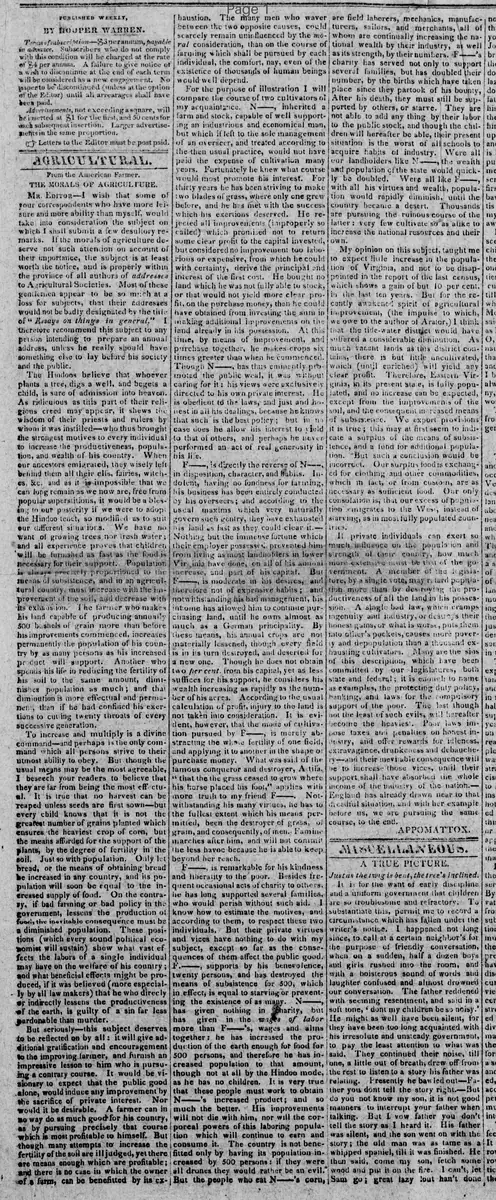
AGRICULTURAL.
From the American Farmer.
THE MORALS OF AGRICULTURE.
Mr. Editor—I wish that some of your correspondents who have more leisure and more ability than myself, would take into consideration the subject on which I shall submit a few desultory remarks. If the morals of agriculture deserve not such attention on account of their importance, the subject is at least worth the notice, and is properly within the province of all authors of addresses to Agricultural Societies. Most of these gentlemen appear to be so much at a loss for subjects, that their addresses would not be badly designated by the title of 'Essays on things in general.' I therefore recommend this subject to any person intending to prepare an annual address, unless he really should have something else to lay before his society and the public.
The Hindoos believe that whoever plants a tree, digs a well, and begets a child, is sure of admission into heaven. As ridiculous as this part of their religious creed may appear, it shows the wisdom of their priests and rulers by whom it was instilled—who thus brought the strongest motives to every individual to increase the productiveness, population, and wealth of his country. When our ancestors emigrated, they wisely left behind them all their elves, fairies, witches, &c. and as it is impossible that we can long remain as we now are, free from popular superstitions, it would be a blessing to our posterity if we were to adopt the Hindoo tenet, so modified as to suit our different situations. We have no want of growing trees nor fresh water; and all experience proves that children will be furnished as fast as the food is necessary for their support. Population is always precisely proportioned to the means of subsistence, and in an agricultural country, must increase with the improvement of the soil, and decrease with its exhaustion. The farmer who makes his land capable of producing annually 500 bushels of grain more than before his improvements commenced, increases permanently the population of his country by as many persons as his increased product will support. Another who spends his life in reducing the fertility of his soil to the same amount, diminishes population as much; and that diminution is more effectual and permanent, than if he had confined his exertions to cutting twenty throats of every successive generation.
To increase and multiply is a divine command—and perhaps is the only command which all persons strive to their utmost ability to obey. But though the usual means may be the most agreeable, I beseech your readers to believe that they are far from being the most effectual. It is true that no harvest can be reaped unless seeds are first sown—but every child knows that it is not the greatest number of grains planted which ensures the heaviest crop of corn, but the means afforded for the support of the plants, by the degree of fertility in the soil. Just so with population. Only let bread, or the means of obtaining bread be increased in any country, and its population will soon be equal to the increased supply of food. On the contrary, if bad farming or bad policy in the government, lessens the production of food, the inevitable consequence must be a diminished population. These positions (which every sound political economist will sustain) show what vast effects the labors of a single individual may have on the welfare of his country; and what beneficial effects might be produced, if it was believed (more especially by all law makers) that he who directly or indirectly lessens the productiveness of the earth, is guilty of a sin far less pardonable than murder.
But seriously—this subject deserves to be reflected on by all: it will give additional gratification and encouragement to the improving farmer, and furnish an impressive lesson to him who is pursuing a contrary course. It would be visionary to expect that the public good alone, would induce any improvement by the sacrifice of private interest. Nor would it be desirable. A farmer can in no way do as much good for his country, as by pursuing precisely that course which is most profitable to himself. But though many attempts to increase the fertility of the soil are ill-judged, yet there are means enough which are profitable; and there is no case in which the owner of a farm, can be benefitted by its exhaustion. The many men who waver between the two opposite courses, could scarcely remain uninfluenced by the moral consideration, than on the course of farming which shall be pursued by each individual, the comfort, nay, even of the existence of thousands of human beings would well depend.
For the purpose of illustration I will compare the course of two cultivators of my acquaintance. N—, inherited a farm and stock, capable of well supporting an industrious and economical man, but which if let to the sole management of an overseer, and treated according to the then usual practice, would not have paid the expense of cultivation many years. Fortunately he knew what course would most promote his interest. For thirty years he has been striving to make two blades of grass, where only one grew before, and he has met with the success which his exertions deserved. He rejected all improvements (improperly so called) which promised not to return some clear profit to the capital invested, but considered no improvement too laborious or expensive, from which he could with certainty, derive the principal and interest of the first cost. He bought no land which he was not fully able to stock, or that would not yield more clear profit, on the purchase money, than he could have obtained from investing the sum in making additional improvements on the land already in his possession. At this time, by means of improvement, and purchase together, he makes crops six times greater than when he commenced. Though N—, has thus eminently promoted the public weal, it was without caring for it: his views were exclusively directed to his own private interest. He is obedient to the laws, and just and honest in all his dealings, because he knows that such is the best policy; but in no case does he allow his interest to yield to that of others, and perhaps he never performed an act of real generosity in his life.
F—, is directly the reverse of N—. in disposition, character, and habits. Indolent, having no fondness for farming, his business has been entirely conducted by his overseers; and according to the usual maxims which very naturally govern such gentry, they have exhausted his land as fast as they could clear it.—Nothing but the immense fortune which their employer possesses, prevented him from living as most landholders in lower Virginia have done, on all of his annual increase, and part of his capital. But F—, is moderate in his desires, and therefore not of expensive habits; and notwithstanding his bad management, his income has allowed him to continue purchasing land, until he owns almost as much as a German principality. By these means, his annual crops are not materially lessened, though every field is in its turn destroyed, and deserted for a new one. Though he does not obtain two per cent. from his capital, yet as less suffices for his support, he considers his wealth increasing as rapidly as the number of his acres. 'According to the usual calculation of profit, injury to the land is not taken into consideration. It is evident, however, that the mode of cultivation pursued by F—, is merely abstracting the whole fertility of one field, and applying it to another in the shape of purchase money. What was said of the famous conqueror and destroyer, Attila. "that the grass ceased to grow where his horse placed his foot," applies with more truth to my friend F. Notwithstanding his many virtues, he has to the fullest extent which his means permitted, been the destroyer of grass, of grain, and consequently, of men. Famine marches after him, and will not commit the less havoc because he is able to keep beyond her reach.
F—, is remarkable for his kindness and liberality to the poor. Besides frequent occasional acts of charity to others, he has long supported several families, who would perish without such aid. I know how to estimate the motives, and according to them, to respect these two individuals. But their private virtues and vices have nothing to do with my subject, except so far as the consequences of them affect the public good. F—, supports by his benevolence, twenty persons, and has destroyed the means of subsistence for 500, which in effect, is equal to starving or preventing the existence of as many. N—, has given nothing in charity, but has given in the wages of labor more than F—'s, wages and alms together: he has increased the production of the earth enough for food for 500 persons, and therefore he has increased population to that amount, though not at all by the Hindoo mode, as he has no children. It is very true that these people must work to obtain N's increased product; and so much the better. His improvements will not die with him, nor will the corporeal powers of this laboring population which will continue to earn and consume it. The country is not benefitted only by having its population increased by 500 persons: if they were all drones they would rather be an evil. But the people who eat N 's corn, are field laborers, mechanics, manufacturers, sailors, and merchants, all of whom are continually increasing the national wealth by their industry, as well as its strength, by their numbers. F—'s charity has served not only to support several families, but has doubled their number, by the births which have taken place since they partook of his bounty. After his death, they must still be supported by others, or starve. They are not able to add any thing by their labor to the public stock, and though the children will hereafter be able, their present situation is the worst of all schools to acquire habits of industry. (Were all our landholders like N—, the wealth and population of the state would quickly be doubled.' Were all like F—, with all his virtues and wealth, population would rapidly diminish, until the country became a desert. Thousands are pursuing the ruinous course of the latter: very few cultivate so as alike to increase the national resources and their own.
My opinion on this subject, taught me to expect little increase in the population of Virginia, and not to be disappointed in the report of the last census, which shows a gain of but 10 per cent. in the last ten years. But for the recently awakened spirit of agricultural improvement, (the impulse to which, we owe to the author of Arator.) I think that the tide-water district would have suffered a considerable diminution. As much vacant lands as this district contains, there is but little uncultivated, which (until enriched) will yield any clear profit. Therefore, Eastern Virginia, in its present state, is fully populated, and no increase can be expected, except from the improvements of the soil, and the consequent increased means of subsistence. We export provisions it is true; this may at first seem to indicate a surplus of the means of subsistence, and a fund for additional population. But such a conclusion would be incorrect. Our surplus food is exchanged for clothing and other commodities, which in fact, or from custom, are as necessary as sufficient food. Our only consolation is, that our excess of population emigrates to the West, instead of starving, as in most fully populated countries.
If private individuals can exert so much influence on the population and strength of their country, how much more extensive must be that of the government. A member of the legislature, by a single vote, may retard population more than by destroying the productiveness of all the land in his possession. A single bad law, which cramps ingenuity and industry, or destroys their honest gains, or what is worst, puts them into others' pockets, causes more poverty and depopulation than a thousand exhausting cultivators. Many are the sins of this description, which have been committed by our legislatures, both state and federal; it is enough to name as examples, the protecting duty policy, banking, and laws for the compulsory support of the poor. The last though not the least of such evils, will hereafter become the heaviest. Poor laws impose taxes and penalties on honest industry, and offer rewards for idleness, extravagance, drunkenness and debauchery—and their inevitable consequence will be to increase those vices, until their support shall have absorbed the whole income of the industry of the nation.—England has already drawn near to that dreadful situation, and with her example before us, we are pursuing the same course, to the end.
From the American Farmer.
THE MORALS OF AGRICULTURE.
Mr. Editor—I wish that some of your correspondents who have more leisure and more ability than myself, would take into consideration the subject on which I shall submit a few desultory remarks. If the morals of agriculture deserve not such attention on account of their importance, the subject is at least worth the notice, and is properly within the province of all authors of addresses to Agricultural Societies. Most of these gentlemen appear to be so much at a loss for subjects, that their addresses would not be badly designated by the title of 'Essays on things in general.' I therefore recommend this subject to any person intending to prepare an annual address, unless he really should have something else to lay before his society and the public.
The Hindoos believe that whoever plants a tree, digs a well, and begets a child, is sure of admission into heaven. As ridiculous as this part of their religious creed may appear, it shows the wisdom of their priests and rulers by whom it was instilled—who thus brought the strongest motives to every individual to increase the productiveness, population, and wealth of his country. When our ancestors emigrated, they wisely left behind them all their elves, fairies, witches, &c. and as it is impossible that we can long remain as we now are, free from popular superstitions, it would be a blessing to our posterity if we were to adopt the Hindoo tenet, so modified as to suit our different situations. We have no want of growing trees nor fresh water; and all experience proves that children will be furnished as fast as the food is necessary for their support. Population is always precisely proportioned to the means of subsistence, and in an agricultural country, must increase with the improvement of the soil, and decrease with its exhaustion. The farmer who makes his land capable of producing annually 500 bushels of grain more than before his improvements commenced, increases permanently the population of his country by as many persons as his increased product will support. Another who spends his life in reducing the fertility of his soil to the same amount, diminishes population as much; and that diminution is more effectual and permanent, than if he had confined his exertions to cutting twenty throats of every successive generation.
To increase and multiply is a divine command—and perhaps is the only command which all persons strive to their utmost ability to obey. But though the usual means may be the most agreeable, I beseech your readers to believe that they are far from being the most effectual. It is true that no harvest can be reaped unless seeds are first sown—but every child knows that it is not the greatest number of grains planted which ensures the heaviest crop of corn, but the means afforded for the support of the plants, by the degree of fertility in the soil. Just so with population. Only let bread, or the means of obtaining bread be increased in any country, and its population will soon be equal to the increased supply of food. On the contrary, if bad farming or bad policy in the government, lessens the production of food, the inevitable consequence must be a diminished population. These positions (which every sound political economist will sustain) show what vast effects the labors of a single individual may have on the welfare of his country; and what beneficial effects might be produced, if it was believed (more especially by all law makers) that he who directly or indirectly lessens the productiveness of the earth, is guilty of a sin far less pardonable than murder.
But seriously—this subject deserves to be reflected on by all: it will give additional gratification and encouragement to the improving farmer, and furnish an impressive lesson to him who is pursuing a contrary course. It would be visionary to expect that the public good alone, would induce any improvement by the sacrifice of private interest. Nor would it be desirable. A farmer can in no way do as much good for his country, as by pursuing precisely that course which is most profitable to himself. But though many attempts to increase the fertility of the soil are ill-judged, yet there are means enough which are profitable; and there is no case in which the owner of a farm, can be benefitted by its exhaustion. The many men who waver between the two opposite courses, could scarcely remain uninfluenced by the moral consideration, than on the course of farming which shall be pursued by each individual, the comfort, nay, even of the existence of thousands of human beings would well depend.
For the purpose of illustration I will compare the course of two cultivators of my acquaintance. N—, inherited a farm and stock, capable of well supporting an industrious and economical man, but which if let to the sole management of an overseer, and treated according to the then usual practice, would not have paid the expense of cultivation many years. Fortunately he knew what course would most promote his interest. For thirty years he has been striving to make two blades of grass, where only one grew before, and he has met with the success which his exertions deserved. He rejected all improvements (improperly so called) which promised not to return some clear profit to the capital invested, but considered no improvement too laborious or expensive, from which he could with certainty, derive the principal and interest of the first cost. He bought no land which he was not fully able to stock, or that would not yield more clear profit, on the purchase money, than he could have obtained from investing the sum in making additional improvements on the land already in his possession. At this time, by means of improvement, and purchase together, he makes crops six times greater than when he commenced. Though N—, has thus eminently promoted the public weal, it was without caring for it: his views were exclusively directed to his own private interest. He is obedient to the laws, and just and honest in all his dealings, because he knows that such is the best policy; but in no case does he allow his interest to yield to that of others, and perhaps he never performed an act of real generosity in his life.
F—, is directly the reverse of N—. in disposition, character, and habits. Indolent, having no fondness for farming, his business has been entirely conducted by his overseers; and according to the usual maxims which very naturally govern such gentry, they have exhausted his land as fast as they could clear it.—Nothing but the immense fortune which their employer possesses, prevented him from living as most landholders in lower Virginia have done, on all of his annual increase, and part of his capital. But F—, is moderate in his desires, and therefore not of expensive habits; and notwithstanding his bad management, his income has allowed him to continue purchasing land, until he owns almost as much as a German principality. By these means, his annual crops are not materially lessened, though every field is in its turn destroyed, and deserted for a new one. Though he does not obtain two per cent. from his capital, yet as less suffices for his support, he considers his wealth increasing as rapidly as the number of his acres. 'According to the usual calculation of profit, injury to the land is not taken into consideration. It is evident, however, that the mode of cultivation pursued by F—, is merely abstracting the whole fertility of one field, and applying it to another in the shape of purchase money. What was said of the famous conqueror and destroyer, Attila. "that the grass ceased to grow where his horse placed his foot," applies with more truth to my friend F. Notwithstanding his many virtues, he has to the fullest extent which his means permitted, been the destroyer of grass, of grain, and consequently, of men. Famine marches after him, and will not commit the less havoc because he is able to keep beyond her reach.
F—, is remarkable for his kindness and liberality to the poor. Besides frequent occasional acts of charity to others, he has long supported several families, who would perish without such aid. I know how to estimate the motives, and according to them, to respect these two individuals. But their private virtues and vices have nothing to do with my subject, except so far as the consequences of them affect the public good. F—, supports by his benevolence, twenty persons, and has destroyed the means of subsistence for 500, which in effect, is equal to starving or preventing the existence of as many. N—, has given nothing in charity, but has given in the wages of labor more than F—'s, wages and alms together: he has increased the production of the earth enough for food for 500 persons, and therefore he has increased population to that amount, though not at all by the Hindoo mode, as he has no children. It is very true that these people must work to obtain N's increased product; and so much the better. His improvements will not die with him, nor will the corporeal powers of this laboring population which will continue to earn and consume it. The country is not benefitted only by having its population increased by 500 persons: if they were all drones they would rather be an evil. But the people who eat N 's corn, are field laborers, mechanics, manufacturers, sailors, and merchants, all of whom are continually increasing the national wealth by their industry, as well as its strength, by their numbers. F—'s charity has served not only to support several families, but has doubled their number, by the births which have taken place since they partook of his bounty. After his death, they must still be supported by others, or starve. They are not able to add any thing by their labor to the public stock, and though the children will hereafter be able, their present situation is the worst of all schools to acquire habits of industry. (Were all our landholders like N—, the wealth and population of the state would quickly be doubled.' Were all like F—, with all his virtues and wealth, population would rapidly diminish, until the country became a desert. Thousands are pursuing the ruinous course of the latter: very few cultivate so as alike to increase the national resources and their own.
My opinion on this subject, taught me to expect little increase in the population of Virginia, and not to be disappointed in the report of the last census, which shows a gain of but 10 per cent. in the last ten years. But for the recently awakened spirit of agricultural improvement, (the impulse to which, we owe to the author of Arator.) I think that the tide-water district would have suffered a considerable diminution. As much vacant lands as this district contains, there is but little uncultivated, which (until enriched) will yield any clear profit. Therefore, Eastern Virginia, in its present state, is fully populated, and no increase can be expected, except from the improvements of the soil, and the consequent increased means of subsistence. We export provisions it is true; this may at first seem to indicate a surplus of the means of subsistence, and a fund for additional population. But such a conclusion would be incorrect. Our surplus food is exchanged for clothing and other commodities, which in fact, or from custom, are as necessary as sufficient food. Our only consolation is, that our excess of population emigrates to the West, instead of starving, as in most fully populated countries.
If private individuals can exert so much influence on the population and strength of their country, how much more extensive must be that of the government. A member of the legislature, by a single vote, may retard population more than by destroying the productiveness of all the land in his possession. A single bad law, which cramps ingenuity and industry, or destroys their honest gains, or what is worst, puts them into others' pockets, causes more poverty and depopulation than a thousand exhausting cultivators. Many are the sins of this description, which have been committed by our legislatures, both state and federal; it is enough to name as examples, the protecting duty policy, banking, and laws for the compulsory support of the poor. The last though not the least of such evils, will hereafter become the heaviest. Poor laws impose taxes and penalties on honest industry, and offer rewards for idleness, extravagance, drunkenness and debauchery—and their inevitable consequence will be to increase those vices, until their support shall have absorbed the whole income of the industry of the nation.—England has already drawn near to that dreadful situation, and with her example before us, we are pursuing the same course, to the end.
What sub-type of article is it?
Agriculture
Moral Or Religious
Economic Policy
What keywords are associated?
Agricultural Morals
Soil Improvement
Population Growth
Farming Practices
Poor Laws
Virginia Agriculture
National Welfare
What entities or persons were involved?
N—
F—
Arator
Hindoos
Attila
Editorial Details
Primary Topic
Morals Of Agriculture And Its Impact On Population
Stance / Tone
Advocacy For Soil Improving Farming As Morally Superior And Beneficial To Society
Key Figures
N—
F—
Arator
Hindoos
Attila
Key Arguments
Improving Soil Fertility Increases Population And National Welfare More Than Charity
Exhausting Land Diminishes Population Permanently, Worse Than Murder
Population Grows With Food Supply, Not Just Births
Farmers Benefit Society Most By Pursuing Profitable Improvements
Bad Government Policies Like Poor Laws Hinder Productivity And Encourage Vice
Contrast Between Diligent Improver N— And Indolent Exhaustor F—
Agricultural Improvement In Virginia Spurred By Arator
Export Of Provisions Does Not Indicate Surplus For Population Growth