Thank you for visiting SNEWPapers!
Sign up free
Literary
March 6, 1833
Republican Herald
Providence, Providence County, Rhode Island
What is this article about?
Discussion on optimizing velocity in manual labor and machinery for efficiency. Covers Coulomb's findings on porters, hammer mechanisms in iron forging for faster strokes, tilt-hammers achieving hundreds of blows per minute, suspended seats in scythe manufacture, and recent applications in anchor production.
Clipping
OCR Quality
98%
Excellent
Full Text
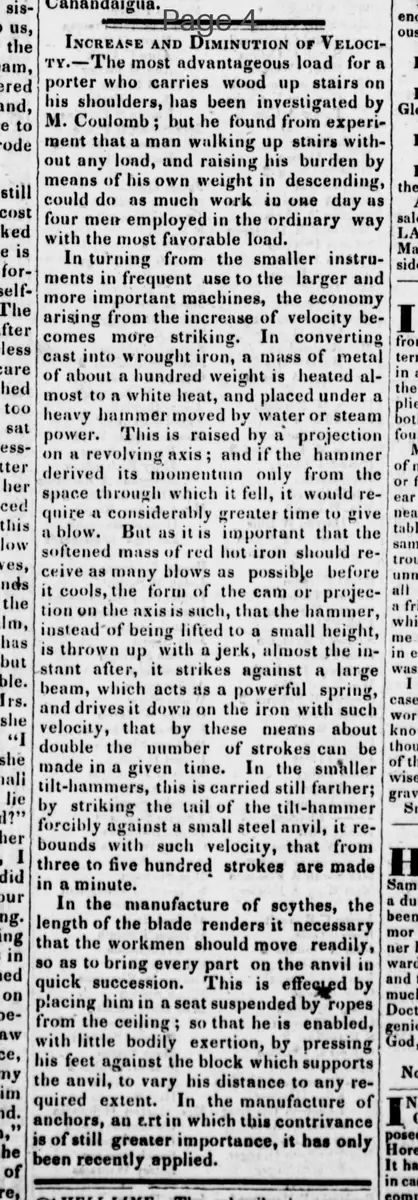
Increase and Diminution of Velocity.—The most advantageous load for a porter who carries wood up stairs on his shoulders, has been investigated by M. Coulomb : but he found from experiment that a man walking up stairs without any load, and raising his burden by means of his own weight in descending, could do as much work in one day as four men employed in the ordinary way with the most favorable load. In turning from the smaller instruments in frequent use to the larger and more important machines, the economy arising from the increase of velocity becomes more striking. In converting cast into wrought iron, a mass of metal of about a hundred weight is heated almost to a white heat, and placed under a heavy hammer moved by water or steam power. This is raised by a projection on a revolving axis; and if the hammer derived its momentum only from the space through which it fell, it would require a considerably greater time to give a blow. But as it is important that the softened mass of red hot iron should receive as many blows as possible before it cools, the form of the cam or projection on the axis is such, that the hammer, instead of being lifted to a small height, is thrown up with a jerk, almost the instant after, it strikes against a large beam, which acts as a powerful spring, and drives it down on the iron with such velocity, that by these means about double the number of strokes can be made in a given time. In the smaller tilt-hammers, this is carried still farther; by striking the tail of the tilt-hammer forcibly against a small steel anvil, it rebounds with such velocity, that from three to five hundred strokes are made in a minute. In the manufacture of scythes, the length of the blade renders it necessary that the workmen should move readily, so as to bring every part on the anvil in quick succession. This is effected by placing him in a seat suspended by ropes from the ceiling; so that he is enabled, with little bodily exertion, by pressing his feet against the block which supports the anvil, to vary his distance to any required extent. In the manufacture of anchors, an art in which this contrivance is of still greater importance, it has only been recently applied.
What sub-type of article is it?
Essay
What themes does it cover?
Commerce Trade
What keywords are associated?
Velocity
Hammers
Manufacturing
Iron Forging
Tilt Hammers
Scythes
Anchors
Coulomb
Literary Details
Title
Increase And Diminution Of Velocity.
Form / Style
Prose Reflection On Mechanical Efficiency
Key Lines
The Most Advantageous Load For A Porter Who Carries Wood Up Stairs On His Shoulders, Has Been Investigated By M. Coulomb : But He Found From Experiment That A Man Walking Up Stairs Without Any Load, And Raising His Burden By Means Of His Own Weight In Descending, Could Do As Much Work In One Day As Four Men Employed In The Ordinary Way With The Most Favorable Load.
In The Smaller Tilt Hammers, This Is Carried Still Farther; By Striking The Tail Of The Tilt Hammer Forcibly Against A Small Steel Anvil, It Rebounds With Such Velocity, That From Three To Five Hundred Strokes Are Made In A Minute.
In The Manufacture Of Scythes, The Length Of The Blade Renders It Necessary That The Workmen Should Move Readily, So As To Bring Every Part On The Anvil In Quick Succession.