Thank you for visiting SNEWPapers!
Sign up free
Constitutional Whig
Richmond, Virginia
What is this article about?
On March 3, 1832, in Washington, the U.S. Supreme Court ruled in Worcester v. Georgia, reversing the conviction of Cherokee missionaries under a Georgia law deemed unconstitutional and void, conflicting with federal treaties. Judges M'Lean concurred, Baldwin dissented technically; implications for federal enforcement and Union discussed.
Clipping
OCR Quality
Full Text
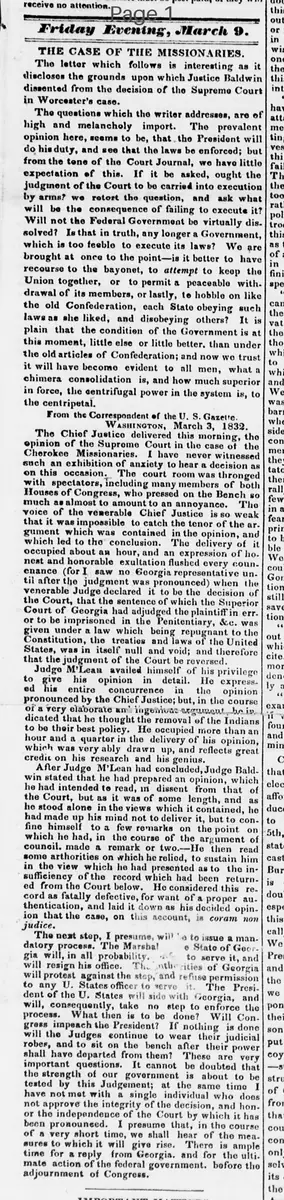
THE CASE OF THE MISSIONARIES.
The letter which follows is interesting as it discloses the grounds upon which Justice Baldwin dissented from the decision of the Supreme Court in Worcester's case.
The questions which the writer addresses, are of high and melancholy import. The prevalent opinion here, seems to be that the President will do his duty, and see that the laws be enforced; but from the tone of the Court Journal, we have little expectation of this. If it be asked, ought the judgment of the Court to be carried into execution by arms? we retort the question, and ask what will be the consequence of failing to execute it?
Will not the Federal Government be virtually dissolved? Is that in truth, any longer a Government, which is too feeble to execute its laws? We are brought at once to the point—is it better to have recourse to the bayonet, to attempt to keep the Union together, or to permit a peaceable withdrawal of its members, or lastly, to hobble on like the old Confederation, each State obeying such laws as she liked, and disobeying others? It is plain that the condition of the Government is at this moment, little else or little better, than under the old articles of Confederation; and now we trust it will have become evident to all men, what a chimera consolidation is, and how much superior in force, the centrifugal power in the system is, to the centripetal.
From the Correspondent of the U. S. Gazette.
WASHINGTON, March 3, 1832.
The Chief Justice delivered this morning, the opinion of the Supreme Court in the case of the Cherokee Missionaries. I have never witnessed such an exhibition of anxiety to hear a decision as on this occasion. The court room was thronged with spectators, including many members of both Houses of Congress, who pressed on the Bench so much as almost to amount to an annoyance. The voice of the venerable Chief Justice is so weak that it was impossible to catch the tenor of the argument which was contained in the opinion, and which led to the conclusion. The delivery of it occupied about an hour, and an expression of honest and honorable exultation flushed every countenance (for I saw no Georgia representative until after the judgment was pronounced) when the venerable Judge declared it to be the decision of the Court, that the sentence of which the Superior Court of Georgia had adjudged the plaintiff in error to be imprisoned in the Penitentiary, &c. was given under a law which being repugnant to the Constitution, the treaties and laws of the United States, was in itself null and void; and therefore that the judgment of the Court be reversed.
Judge M'Lean availed himself of his privilege to give his opinion in detail. He expressed his entire concurrence in the opinion pronounced by the Chief Justice; but, in the course of a very elaborate and ingenious argument he indicated that he thought the removal of the Indians to be their best policy. He occupied more than an hour and a quarter in the delivery of his opinion, which was very ably drawn up, and reflects great credit on his research and his genius.
After Judge M'Lean had concluded, Judge Baldwin stated that he had prepared an opinion, which he had intended to read, in dissent from that of the Court, but as it was of some length, and as he stood alone in the views which it contained, he had made up his mind not to deliver it, but to confine himself to a few remarks on the point on which he had, in the course of the argument of counsel, made a remark or two.—He then read some authorities on which he relied, to sustain him in the view which he had presented as to the insufficiency of the record which had been returned from the Court below. He considered this record as fatally defective, for want of a proper authentication, and laid it down as his decided opinion that the case, on this account, is coram non judice.
The next step, I presume, will be to issue a mandatory process. The Marshal of the State of Georgia will, in all probability, refuse to serve it, and will resign his office. The authorities of Georgia will protest against the step, and refuse permission to any U. States officer to serve it. The President of the U. States will side with Georgia, and will, consequently, take no step to enforce the process. What then is to be done? Will Congress impeach the President? If nothing is done will the Judges continue to wear their judicial robes, and to sit on the bench after their power shall have departed from them? These are very important questions. It cannot be doubted that the strength of our government is about to be tested by this Judgment; at the same time I have not met with a single individual who does not approve the integrity of the decision, and honor the independence of the Court by which it has been pronounced. I presume that, in the course of a very short time, we shall hear of the measures to which it will give rise. There is ample time for a reply from Georgia, and for the ultimate action of the federal government, before the adjournment of Congress.
What sub-type of article is it?
What keywords are associated?
What entities or persons were involved?
Where did it happen?
Domestic News Details
Primary Location
Washington
Event Date
March 3, 1832
Key Persons
Outcome
the supreme court reversed the judgment of the superior court of georgia, declaring the georgia law repugnant to the constitution, treaties, and laws of the united states, and thus null and void.
Event Details
The Supreme Court delivered its opinion in the case of the Cherokee Missionaries, reversing the Georgia court's sentence of imprisonment due to the law being unconstitutional. Chief Justice pronounced the decision; Judge M'Lean concurred with an elaborate opinion favoring Indian removal; Judge Baldwin dissented on grounds of defective record authentication, considering the case coram non judice.