Thank you for visiting SNEWPapers!
Sign up free
Story
August 28, 1914
Eagle River Review
Eagle River, Vilas County, Wisconsin
What is this article about?
In Wellington, Colorado, a flock of blackbirds saves C. O. Culver's sugar beet farm by devouring a horde of webworms that threatened to destroy ten acres of crops in just two days.
Clipping
OCR Quality
95%
Excellent
Full Text
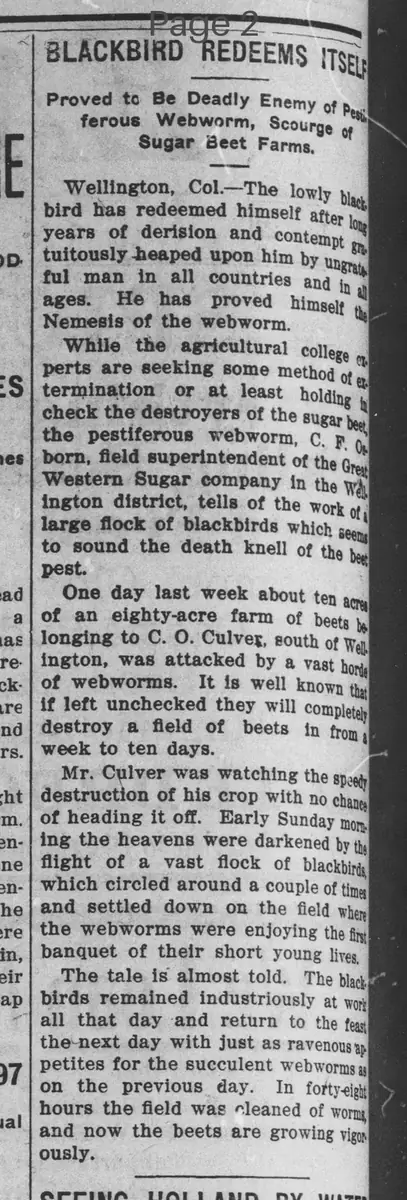
BLACKBIRD REDEEMS ITSELF
Proved to Be Deadly Enemy of Pestiferous Webworm, Scourge of Sugar Beet Farms.
Wellington, Col.-The lowly blackbird has redeemed himself after long years of derision and contempt gratuitously heaped upon him by ungrateful man in all countries and in ages. He has proved himself the Nemesis of the webworm.
While the agricultural college experts are seeking some method of extermination or at least holding check the destroyers of the sugar beet the pestiferous webworm, C. F. Orborn, field superintendent of the Great Western Sugar company in the Wellington district, tells of the work of a large flock of blackbirds which seem to sound the death knell of the beet pest.
One day last week about ten acres of an eighty-acre farm of beets belonging to C. O. Culver, south of Wellington, was attacked by a vast horde of webworms. It is well known that if left unchecked they will completely destroy a field of beets in from a week to ten days.
Mr. Culver was watching the speedy destruction of his crop with no chance of heading it off. Early Sunday morning the heavens were darkened by the flight of a vast flock of blackbirds which circled around a couple of times and settled down on the field where the webworms were enjoying the first banquet of their short young lives.
The tale is almost told. The blackbirds remained industriously at work all that day and returned to the feast the next day with just as ravenous appetites for the succulent webworms as on the previous day. In forty-eight hours the field was cleaned of worms and now the beets are growing vigorously.
Proved to Be Deadly Enemy of Pestiferous Webworm, Scourge of Sugar Beet Farms.
Wellington, Col.-The lowly blackbird has redeemed himself after long years of derision and contempt gratuitously heaped upon him by ungrateful man in all countries and in ages. He has proved himself the Nemesis of the webworm.
While the agricultural college experts are seeking some method of extermination or at least holding check the destroyers of the sugar beet the pestiferous webworm, C. F. Orborn, field superintendent of the Great Western Sugar company in the Wellington district, tells of the work of a large flock of blackbirds which seem to sound the death knell of the beet pest.
One day last week about ten acres of an eighty-acre farm of beets belonging to C. O. Culver, south of Wellington, was attacked by a vast horde of webworms. It is well known that if left unchecked they will completely destroy a field of beets in from a week to ten days.
Mr. Culver was watching the speedy destruction of his crop with no chance of heading it off. Early Sunday morning the heavens were darkened by the flight of a vast flock of blackbirds which circled around a couple of times and settled down on the field where the webworms were enjoying the first banquet of their short young lives.
The tale is almost told. The blackbirds remained industriously at work all that day and returned to the feast the next day with just as ravenous appetites for the succulent webworms as on the previous day. In forty-eight hours the field was cleaned of worms and now the beets are growing vigorously.
What sub-type of article is it?
Animal Story
Curiosity
What themes does it cover?
Nature
Triumph
What keywords are associated?
Blackbirds
Webworms
Sugar Beets
Pest Control
Wellington Colorado
What entities or persons were involved?
C. F. Orborn
C. O. Culver
Where did it happen?
Wellington, Col., South Of Wellington
Story Details
Key Persons
C. F. Orborn
C. O. Culver
Location
Wellington, Col., South Of Wellington
Event Date
One Day Last Week, Early Sunday Morning
Story Details
A flock of blackbirds descends on a webworm-infested sugar beet field owned by C. O. Culver, devouring the pests over two days and saving the crop from destruction.