Thank you for visiting SNEWPapers!
Sign up free
Literary
February 11, 1898
Gulf Coast Breeze
Crawfordville, Wakulla County, Florida
What is this article about?
A man experiences confusion upon arriving unannounced at the Torrington home due to a mailed wrong invitation note, leading to awkward rivalry with suitor Dick Brooks for Maria's affections. They agree to a lottery of acceptance/refusal notes for her hand, but another mix-up favors the protagonist.
Clipping
OCR Quality
98%
Excellent
Full Text
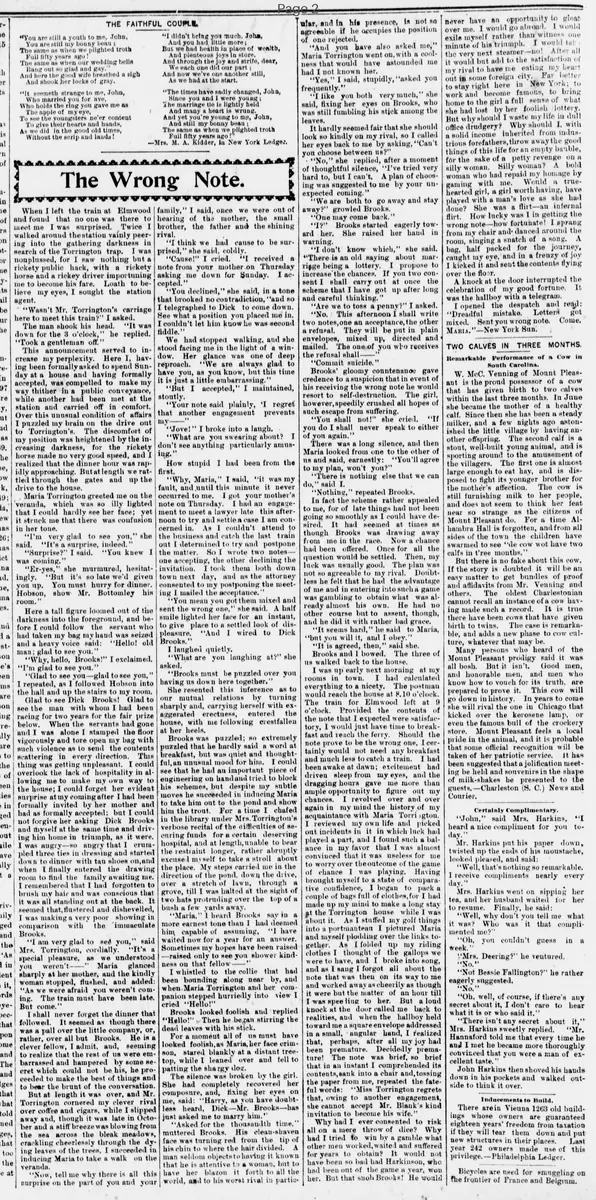
The Wrong Note.
When I left the train at Elmwood and found that no one was there to meet me I was surprised. Twice I walked around the station vainly peering into the gathering darkness in search of the Torrington trap. I was nonplussed, for I saw nothing but a rickety public hack, with a rickety horse and a rickety driver importuning me to become his fare. Loath to believe my eyes, I sought the station agent.
"Wasn't Mr. Torrington's carriage here to meet this train?" I asked.
The man shook his head. "It was down for the 3 o'clock," he replied. "Took a gentleman off."
This announcement served to increase my perplexity. Here I, having been formally asked to spend Sunday at a house and having formally accepted, was compelled to make my way thither in a public conveyance, while another had been met at the station and carried off in comfort. Over this unusual condition of affairs I puzzled my brain on the drive out to Torrington's. The discomfort of my position was heightened by the increasing darkness, for the rickety horse made no very good speed, and I realized that the dinner hour was rapidly approaching. But at length we rattled through the gates and up the drive to the house.
Maria Torrington greeted me on the veranda, which was so ill lighted that I could hardly see her face; yet it struck me that there was confusion in her tone.
"I'm very glad to see you," she said. "It's a surprise, indeed."
"Surprise?" I said. "You knew I was coming."
"Er—yes," she murmured, hesitatingly. "But it's so late we'd given you up. You must hurry for dinner. Hobson, show Mr. Bottomley his room."
Here a tall figure loomed out of the darkness into the foreground, and before I could follow the servant who had taken my bag my hand was seized and a heavy voice said:
"Hello! old man; glad to see you."
"Why, hello, Brooks!" I exclaimed. "I'm glad to see you."
"Glad to see you—glad to see you," I repeated, as I followed Hobson into the hall and up the stairs to my room.
Glad to see Dick Brooks! Glad to see the man with whom I had been racing for two years for the fair prize below. When the servants had gone and I was alone I stamped the floor vigorously and tore open my bag with such violence as to send the contents scattering in every direction. This thing was getting unpleasant. I could overlook the lack of hospitality in allowing me to make my own way to the house; I could forget her evident surprise at my coming after I had been formally invited by her mother and had as formally accepted: but I could not forgive her asking Dick Brooks and myself at the same time and driving him home in triumph, as it were. I was angry—so angry that I crumpled three ties in dressing and started down to dinner with tan shoes on, and when I finally entered the drawing room to find the family awaiting me, I remembered that I had forgotten to brush my hair and was conscious that it was all standing out at the back. It seemed that, flustered and dishevelled, I was making a very poor showing in comparison with the immaculate Brooks.
"I am very glad to see you," said Mrs. Torrington, cordially. "It's a special pleasure, as we understood you weren't coming."
Maria glanced sharply at her mother, and the kindly woman stopped, flushed, and added "As we were afraid you weren't coming. The train must have been late. But come."
I shall never forget the dinner that followed. It seemed as though there was a pall over the little company, or, rather, over all but Brooks. He is a clever fellow, I admit, and, seeming to realize that the rest of us were embarrassed and hampered by some secret which could not be his, he proceeded to make the best of things and to bear the brunt of the conversation. But at length it was over, and Mr. Torrington cornered my clever rival over coffee and cigars, while I slipped away and, though it was late in October and a stiff breeze was blowing from the sea across the bleak meadows, crackling cheerlessly through the dying leaves of the trees, I succeeded in inducing Maria to take a walk on the veranda.
"Now, tell me why there is all this surprise on the part of you and your family," I said, once we were out of hearing of the mother, the small brother, the father and the shining rival.
"I think we had cause to be surprised," she said, coldly.
"Cause!" I cried. "I received a note from your mother on Thursday asking me down for Sunday. I accepted."
"You declined," she said, in a tone that brooked no contradiction, "and so I telegraphed to Dick to come down. See what a position you placed me in. I couldn't let him know he was second fiddle."
We had stopped walking, and she stood facing me in the light of a window. Her glance was one of deep reproach.
"We are always glad to have you, as you know, but this time it is just a little embarrassing."
"But I accepted," I maintained, stoutly.
"Your note said plainly, 'I regret that another engagement prevents my—'
"By Jove!" I broke into a laugh.
"What are you swearing about? I don't see anything particularly amusing."
How stupid I had been from the first.
"Why, Maria," I said, "it was my fault, and until this minute it never occurred to me. I got your mother's note on Thursday. I had an engagement to meet a lawyer late this afternoon to try and settle a case I am concerned in. As I couldn't attend to the business and catch the last train out I determined to try and postpone the matter. So I wrote two notes—one accepting, the other declining the invitation. I took them both down town next day, and as the attorney consented to my postponing the meeting I mailed the acceptance."
"You mean you got them mixed and sent the wrong one," she said. A half smile lighted her face for an instant, to give place to a settled look of displeasure.
"And I wired to Dick Brooks."
I laughed quietly.
"What are you laughing at?" she asked.
"Brooks must be puzzled over you having us down here together."
She resented this inference as to our mutual relations by turning sharply and, carrying herself with exaggerated erectness, entered the house, with me following crestfallen at her heels.
Brooks was puzzled: so extremely puzzled that he hardly said a word at breakfast, but was quiet and thoughtful, an unusual mood for him. I could see that he had an important piece of engineering on hand and tried to block his schemes, but despite my subtle moves he succeeded in inducing Maria to take him out to the pond and show him the trout. For a time I chafed in the library under Mrs. Torrington's verbose recital of the difficulties of securing funds for a certain deserving hospital, and at length, unable to bear the restraint longer, rather abruptly excused myself to take a stroll about the place. My steps carried me in the direction of the pond, down the drive, over a stretch of lawn, through a grove, till I was halted at the sight of two hats protruding over the top of a bush a few yards away.
"Maria," I heard Brooks say in a more earnest tone than I had deemed him capable of assuming, "I have waited now for a year for an answer. Sometimes my hopes have been raised—raised only to see you shower kindness on that fellow—"
I whistled to the collie that had been bounding along near by, and when Maria Torrington and her companion stepped hurriedly into view I cried "Hello!"
Brooks looked foolish and replied "Hello!" Then he began stirring the dead leaves with his stick.
For a moment all of us must have looked foolish, as Maria, her face crimson, stared blankly at a distant tree-top, while I leaned over and fell to patting the shaggy dog.
The silence was broken by the girl. She had completely recovered her composure, and, fixing her eyes on me, said: "Harry, as you have doubtless heard, Dick—Mr. Brooks—has just asked me to marry him."
"Asked for the thousandth time," muttered Brooks. His clean-shaven face was turning red from the tip of his chin to where the hair divided. A man seldom objects to having it known that he is attentive to a woman, but to have her blazon it forth to all the world, and to his worst rival in particular, and in his presence, is not so agreeable if he occupies the position of one rejected.
"And you have also asked me," Maria Torrington went on, with a coolness that would have astounded me had I not known her.
"Yes," I said, stupidly, "asked you frequently."
"I like you both very much," she said, fixing her eyes on Brooks, who was still fumbling his stick among the leaves.
It hardly seemed fair that she should look so kindly on my rival, so I called her eyes back to me by asking, "Can't you choose between us?"
"No," she replied, after a moment of thoughtful silence, "I've tried very hard to, but I can't. A plan of choosing was suggested to me by your unexpected coming."
"We are both to go away and stay away?" growled Brooks.
"One may come back."
"I?" Brooks started eagerly toward her. She raised her hand in warning.
"I don't know which," she said. "There is an old saying about marriage being a lottery. I propose to increase the chances. If you two consent I shall carry out at once the scheme that I have got up after long and careful thinking."
"Are we to toss a penny?" I asked.
"No. This afternoon I shall write two notes, one an acceptance, the other a refusal. They will be put in plain envelopes, mixed up, directed and mailed. The one of you who receives the refusal shall—"
"Commit suicide."
Brooks' gloomy countenance gave credence to a suspicion that in event of his receiving the wrong note he would resort to self-destruction. The girl, however, speedily crushed all hopes of such escape from suffering.
"You shall not!" she cried. "If you do I shall never speak to either of you again."
There was a long silence, and then Maria looked from one to the other of us and said, earnestly: "You'll agree to my plan, won't you?"
"There is nothing else that we can do," said I.
"Nothing," repeated Brooks.
In fact the scheme rather appealed to me, for of late things had not been going so smoothly as I could have desired. It had seemed at times as though Brooks was drawing away from me in the race. Now a chance had been offered. Once for all the question would be settled. Then, my luck was usually good. The plan was not so agreeable to my rival. Doubtless he felt that he had the advantage of me and in entering into such a game was gambling to obtain what was already almost his own. He had no other course but to assent, though, and he did it with rather bad grace.
"It seems hard," he said to Maria "but you will it, and I obey."
"It is agreed, then," said she.
Brooks and I bowed. The three of us walked back to the house.
I was up early next morning at my rooms in town. I had calculated everything to a nicety. The postman would reach the house at 8.10 o'clock. The train for Elmwood left at 9 o'clock. Provided the contents of the note that I expected were satisfactory, I would just have time to breakfast and reach the ferry. Should the note prove to be the wrong one, I certainly would not need any breakfast and much less to catch a train. I had been awake at dawn; excitement had driven sleep from my eyes, and the dragging hours gave me more than ample opportunity to figure out my chances. I revolved over and over again in my mind the history of my acquaintance with Maria Torrington. I reviewed my own life and picked out incidents in it in which luck had played a part, and I found such a balance in my favor that I was almost convinced that it was useless for me to worry over the outcome of the game of chance I was playing. Having brought myself to a state of comparative confidence, I began to pack a couple of bags full of clothes, for I had made up my mind to make a long stay at the Torrington house while I was about it. As I stuffed my golf things into a portmanteau I pictured Maria and myself plodding over the links together. As I folded up my riding clothes I thought of the gallops we were to have, and I broke into song, and as I sang I forgot all about the note that was then on its way to me and worked away as cheerily as though it were but the matter of an hour till I was speeding to her. But a loud knock at the door called me back to realities, and when the hallboy held toward me a square envelope addressed in a small, angular hand, I realized that, perhaps, after all my joy had been premature. Decidedly premature! The note was brief, so brief that in an instant I comprehended its contents, sank into a chair and, tossing the paper from me, repeated the fatal words: "Miss Torrington regrets that, owing to another engagement, she cannot accept Mr. Blank's kind invitation to become his wife."
Why had I ever consented to risk all on a mere throw of dice? Why had I tried to win by a gamble what other men worked, waited and suffered for years to obtain? It would not have been so bad had Harkinson, who had been out of the game a year, won her. But that snob Brooks! He would never have an opportunity to gloat over me. I would go abroad. I would exile myself rather than witness one minute of his triumph. I would take the very next steamer—no! After all it would but add to the satisfaction of my rival to have me eating my heart out in some foreign city. Far better to stay right here in New York; to work and become famous, to bring home to the girl a full sense of what she had lost by her foolish lottery. But why should I waste my life in dull office drudgery? Why should I, with a solid income inherited from industrious forefathers, throw away the good things of this life for an empty bauble, for the sake of a petty revenge on a silly woman. Silly woman? A bold woman who had repaid my homage by gaming with me. Would a true-hearted girl, a girl worth having, have played with a man's love as she had done? She was a flirt—an infernal flirt. How lucky was I in getting the wrong note—how fortunate! I sprang from my chair and danced around the room, singing a snatch of a song. A bag, half packed for the journey, caught my eye, and in a frenzy of joy I kicked it and sent the contents flying over the floor.
A knock at the door interrupted the celebration of my good fortune. It was the hallboy with a telegram.
I opened the despatch and read:
"Dreadful mistake. Letters got mixed. Sent you wrong note. Come.
MARIA."
—New York Sun.
When I left the train at Elmwood and found that no one was there to meet me I was surprised. Twice I walked around the station vainly peering into the gathering darkness in search of the Torrington trap. I was nonplussed, for I saw nothing but a rickety public hack, with a rickety horse and a rickety driver importuning me to become his fare. Loath to believe my eyes, I sought the station agent.
"Wasn't Mr. Torrington's carriage here to meet this train?" I asked.
The man shook his head. "It was down for the 3 o'clock," he replied. "Took a gentleman off."
This announcement served to increase my perplexity. Here I, having been formally asked to spend Sunday at a house and having formally accepted, was compelled to make my way thither in a public conveyance, while another had been met at the station and carried off in comfort. Over this unusual condition of affairs I puzzled my brain on the drive out to Torrington's. The discomfort of my position was heightened by the increasing darkness, for the rickety horse made no very good speed, and I realized that the dinner hour was rapidly approaching. But at length we rattled through the gates and up the drive to the house.
Maria Torrington greeted me on the veranda, which was so ill lighted that I could hardly see her face; yet it struck me that there was confusion in her tone.
"I'm very glad to see you," she said. "It's a surprise, indeed."
"Surprise?" I said. "You knew I was coming."
"Er—yes," she murmured, hesitatingly. "But it's so late we'd given you up. You must hurry for dinner. Hobson, show Mr. Bottomley his room."
Here a tall figure loomed out of the darkness into the foreground, and before I could follow the servant who had taken my bag my hand was seized and a heavy voice said:
"Hello! old man; glad to see you."
"Why, hello, Brooks!" I exclaimed. "I'm glad to see you."
"Glad to see you—glad to see you," I repeated, as I followed Hobson into the hall and up the stairs to my room.
Glad to see Dick Brooks! Glad to see the man with whom I had been racing for two years for the fair prize below. When the servants had gone and I was alone I stamped the floor vigorously and tore open my bag with such violence as to send the contents scattering in every direction. This thing was getting unpleasant. I could overlook the lack of hospitality in allowing me to make my own way to the house; I could forget her evident surprise at my coming after I had been formally invited by her mother and had as formally accepted: but I could not forgive her asking Dick Brooks and myself at the same time and driving him home in triumph, as it were. I was angry—so angry that I crumpled three ties in dressing and started down to dinner with tan shoes on, and when I finally entered the drawing room to find the family awaiting me, I remembered that I had forgotten to brush my hair and was conscious that it was all standing out at the back. It seemed that, flustered and dishevelled, I was making a very poor showing in comparison with the immaculate Brooks.
"I am very glad to see you," said Mrs. Torrington, cordially. "It's a special pleasure, as we understood you weren't coming."
Maria glanced sharply at her mother, and the kindly woman stopped, flushed, and added "As we were afraid you weren't coming. The train must have been late. But come."
I shall never forget the dinner that followed. It seemed as though there was a pall over the little company, or, rather, over all but Brooks. He is a clever fellow, I admit, and, seeming to realize that the rest of us were embarrassed and hampered by some secret which could not be his, he proceeded to make the best of things and to bear the brunt of the conversation. But at length it was over, and Mr. Torrington cornered my clever rival over coffee and cigars, while I slipped away and, though it was late in October and a stiff breeze was blowing from the sea across the bleak meadows, crackling cheerlessly through the dying leaves of the trees, I succeeded in inducing Maria to take a walk on the veranda.
"Now, tell me why there is all this surprise on the part of you and your family," I said, once we were out of hearing of the mother, the small brother, the father and the shining rival.
"I think we had cause to be surprised," she said, coldly.
"Cause!" I cried. "I received a note from your mother on Thursday asking me down for Sunday. I accepted."
"You declined," she said, in a tone that brooked no contradiction, "and so I telegraphed to Dick to come down. See what a position you placed me in. I couldn't let him know he was second fiddle."
We had stopped walking, and she stood facing me in the light of a window. Her glance was one of deep reproach.
"We are always glad to have you, as you know, but this time it is just a little embarrassing."
"But I accepted," I maintained, stoutly.
"Your note said plainly, 'I regret that another engagement prevents my—'
"By Jove!" I broke into a laugh.
"What are you swearing about? I don't see anything particularly amusing."
How stupid I had been from the first.
"Why, Maria," I said, "it was my fault, and until this minute it never occurred to me. I got your mother's note on Thursday. I had an engagement to meet a lawyer late this afternoon to try and settle a case I am concerned in. As I couldn't attend to the business and catch the last train out I determined to try and postpone the matter. So I wrote two notes—one accepting, the other declining the invitation. I took them both down town next day, and as the attorney consented to my postponing the meeting I mailed the acceptance."
"You mean you got them mixed and sent the wrong one," she said. A half smile lighted her face for an instant, to give place to a settled look of displeasure.
"And I wired to Dick Brooks."
I laughed quietly.
"What are you laughing at?" she asked.
"Brooks must be puzzled over you having us down here together."
She resented this inference as to our mutual relations by turning sharply and, carrying herself with exaggerated erectness, entered the house, with me following crestfallen at her heels.
Brooks was puzzled: so extremely puzzled that he hardly said a word at breakfast, but was quiet and thoughtful, an unusual mood for him. I could see that he had an important piece of engineering on hand and tried to block his schemes, but despite my subtle moves he succeeded in inducing Maria to take him out to the pond and show him the trout. For a time I chafed in the library under Mrs. Torrington's verbose recital of the difficulties of securing funds for a certain deserving hospital, and at length, unable to bear the restraint longer, rather abruptly excused myself to take a stroll about the place. My steps carried me in the direction of the pond, down the drive, over a stretch of lawn, through a grove, till I was halted at the sight of two hats protruding over the top of a bush a few yards away.
"Maria," I heard Brooks say in a more earnest tone than I had deemed him capable of assuming, "I have waited now for a year for an answer. Sometimes my hopes have been raised—raised only to see you shower kindness on that fellow—"
I whistled to the collie that had been bounding along near by, and when Maria Torrington and her companion stepped hurriedly into view I cried "Hello!"
Brooks looked foolish and replied "Hello!" Then he began stirring the dead leaves with his stick.
For a moment all of us must have looked foolish, as Maria, her face crimson, stared blankly at a distant tree-top, while I leaned over and fell to patting the shaggy dog.
The silence was broken by the girl. She had completely recovered her composure, and, fixing her eyes on me, said: "Harry, as you have doubtless heard, Dick—Mr. Brooks—has just asked me to marry him."
"Asked for the thousandth time," muttered Brooks. His clean-shaven face was turning red from the tip of his chin to where the hair divided. A man seldom objects to having it known that he is attentive to a woman, but to have her blazon it forth to all the world, and to his worst rival in particular, and in his presence, is not so agreeable if he occupies the position of one rejected.
"And you have also asked me," Maria Torrington went on, with a coolness that would have astounded me had I not known her.
"Yes," I said, stupidly, "asked you frequently."
"I like you both very much," she said, fixing her eyes on Brooks, who was still fumbling his stick among the leaves.
It hardly seemed fair that she should look so kindly on my rival, so I called her eyes back to me by asking, "Can't you choose between us?"
"No," she replied, after a moment of thoughtful silence, "I've tried very hard to, but I can't. A plan of choosing was suggested to me by your unexpected coming."
"We are both to go away and stay away?" growled Brooks.
"One may come back."
"I?" Brooks started eagerly toward her. She raised her hand in warning.
"I don't know which," she said. "There is an old saying about marriage being a lottery. I propose to increase the chances. If you two consent I shall carry out at once the scheme that I have got up after long and careful thinking."
"Are we to toss a penny?" I asked.
"No. This afternoon I shall write two notes, one an acceptance, the other a refusal. They will be put in plain envelopes, mixed up, directed and mailed. The one of you who receives the refusal shall—"
"Commit suicide."
Brooks' gloomy countenance gave credence to a suspicion that in event of his receiving the wrong note he would resort to self-destruction. The girl, however, speedily crushed all hopes of such escape from suffering.
"You shall not!" she cried. "If you do I shall never speak to either of you again."
There was a long silence, and then Maria looked from one to the other of us and said, earnestly: "You'll agree to my plan, won't you?"
"There is nothing else that we can do," said I.
"Nothing," repeated Brooks.
In fact the scheme rather appealed to me, for of late things had not been going so smoothly as I could have desired. It had seemed at times as though Brooks was drawing away from me in the race. Now a chance had been offered. Once for all the question would be settled. Then, my luck was usually good. The plan was not so agreeable to my rival. Doubtless he felt that he had the advantage of me and in entering into such a game was gambling to obtain what was already almost his own. He had no other course but to assent, though, and he did it with rather bad grace.
"It seems hard," he said to Maria "but you will it, and I obey."
"It is agreed, then," said she.
Brooks and I bowed. The three of us walked back to the house.
I was up early next morning at my rooms in town. I had calculated everything to a nicety. The postman would reach the house at 8.10 o'clock. The train for Elmwood left at 9 o'clock. Provided the contents of the note that I expected were satisfactory, I would just have time to breakfast and reach the ferry. Should the note prove to be the wrong one, I certainly would not need any breakfast and much less to catch a train. I had been awake at dawn; excitement had driven sleep from my eyes, and the dragging hours gave me more than ample opportunity to figure out my chances. I revolved over and over again in my mind the history of my acquaintance with Maria Torrington. I reviewed my own life and picked out incidents in it in which luck had played a part, and I found such a balance in my favor that I was almost convinced that it was useless for me to worry over the outcome of the game of chance I was playing. Having brought myself to a state of comparative confidence, I began to pack a couple of bags full of clothes, for I had made up my mind to make a long stay at the Torrington house while I was about it. As I stuffed my golf things into a portmanteau I pictured Maria and myself plodding over the links together. As I folded up my riding clothes I thought of the gallops we were to have, and I broke into song, and as I sang I forgot all about the note that was then on its way to me and worked away as cheerily as though it were but the matter of an hour till I was speeding to her. But a loud knock at the door called me back to realities, and when the hallboy held toward me a square envelope addressed in a small, angular hand, I realized that, perhaps, after all my joy had been premature. Decidedly premature! The note was brief, so brief that in an instant I comprehended its contents, sank into a chair and, tossing the paper from me, repeated the fatal words: "Miss Torrington regrets that, owing to another engagement, she cannot accept Mr. Blank's kind invitation to become his wife."
Why had I ever consented to risk all on a mere throw of dice? Why had I tried to win by a gamble what other men worked, waited and suffered for years to obtain? It would not have been so bad had Harkinson, who had been out of the game a year, won her. But that snob Brooks! He would never have an opportunity to gloat over me. I would go abroad. I would exile myself rather than witness one minute of his triumph. I would take the very next steamer—no! After all it would but add to the satisfaction of my rival to have me eating my heart out in some foreign city. Far better to stay right here in New York; to work and become famous, to bring home to the girl a full sense of what she had lost by her foolish lottery. But why should I waste my life in dull office drudgery? Why should I, with a solid income inherited from industrious forefathers, throw away the good things of this life for an empty bauble, for the sake of a petty revenge on a silly woman. Silly woman? A bold woman who had repaid my homage by gaming with me. Would a true-hearted girl, a girl worth having, have played with a man's love as she had done? She was a flirt—an infernal flirt. How lucky was I in getting the wrong note—how fortunate! I sprang from my chair and danced around the room, singing a snatch of a song. A bag, half packed for the journey, caught my eye, and in a frenzy of joy I kicked it and sent the contents flying over the floor.
A knock at the door interrupted the celebration of my good fortune. It was the hallboy with a telegram.
I opened the despatch and read:
"Dreadful mistake. Letters got mixed. Sent you wrong note. Come.
MARIA."
—New York Sun.
What sub-type of article is it?
Prose Fiction
What themes does it cover?
Love Romance
What keywords are associated?
Wrong Note
Romantic Mix Up
Love Triangle
Proposal Lottery
Invitation Error
Literary Details
Title
The Wrong Note.
Key Lines
"You Mean You Got Them Mixed And Sent The Wrong One," She Said. A Half Smile Lighted Her Face For An Instant, To Give Place To A Settled Look Of Displeasure.
"I Like You Both Very Much," She Said, Fixing Her Eyes On Brooks, Who Was Still Fumbling His Stick Among The Leaves.
"No. This Afternoon I Shall Write Two Notes, One An Acceptance, The Other A Refusal. They Will Be Put In Plain Envelopes, Mixed Up, Directed And Mailed. The One Of You Who Receives The Refusal Shall—"
Miss Torrington Regrets That, Owing To Another Engagement, She Cannot Accept Mr. Blank's Kind Invitation To Become His Wife.
"Dreadful Mistake. Letters Got Mixed. Sent You Wrong Note. Come. Maria."