Thank you for visiting SNEWPapers!
Sign up free
Domestic News
July 11, 1811
Virginia Argus
Richmond, Virginia
What is this article about?
In the U.S. Senate, Mr. Brent concludes his speech on the Bank of the United States, arguing that extensive banking prevents favoritism and political influence, promotes economic development, and contrasts with Virginia's limited banking system that leads to usury. Mr. Giles interjects to defend Richmond's bank.
Clipping
OCR Quality
95%
Excellent
Full Text
CONGRESS.
SENATE.
United States Bank.
MR. BRENT'S SPEECH (concluded.)
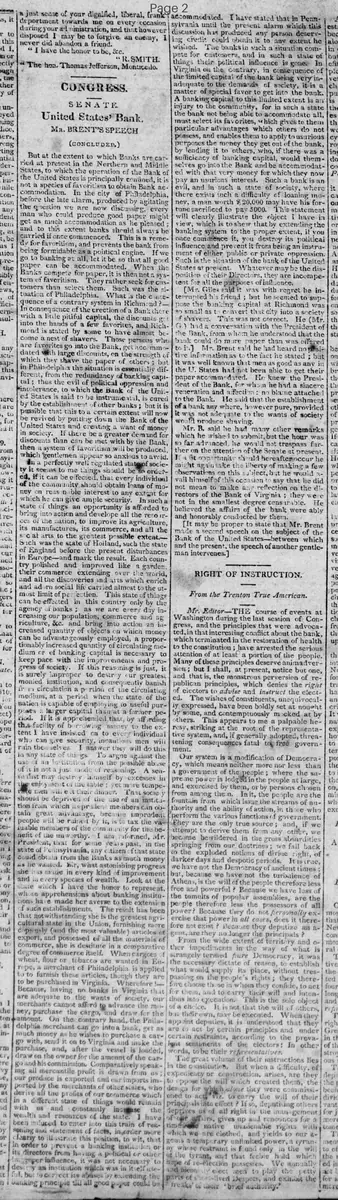
But at the extent to which Banks are carried at present in the Northern and Middle States, to which the operation of the Bank of the United States is principally confined, it is not a species of favoritism to obtain Bank accommodation. In the city of Philadelphia, before the late alarm, produced by agitating the question we are now discussing, every man who could produce good paper might get as much accommodation as he pleased; and to this extent banks should always be carried if once commenced. This is a remedy for favoritism, and prevents the bank from being formidable as a political engine. If we go to banking at all, let it be so that all good paper can be accommodated. When the Banks compete for paper, it is then not a system of favoritism. They rather seek for customers than select them. Such was the situation of Philadelphia. What is the Consequence of a contrary system in Richmond ?— In consequence of the erection of a Bank there with a little pitiful capital, the discounts go to the hands of a few favorites, and Richmond is stated by some to have almost become a nest of shavers. Those persons who are favorites go into the Bank, get accommodated with large discounts, on the strength of which they shave the paper of others; but in Philadelphia this situation is essentially different, from the redundancy of banking capital; thus the evil of political oppression and intolerance, to which the Bank of the United States is said to be instrumental, is cured by the establishment of other banks; but it is possible that this to a certain extent will now be revived by putting down the Bank of the United States and creating a want of money in society. If there be a greater demand for discounts than can be met with by the Bank, then a system of favoritism will be produced, which gentlemen appear so anxious to avoid.
In a perfectly well regulated state of society it seems to me things should be so ordered, if it can be effected, that every individual of the community should obtain loans of money on reasonable interest to any extent for which he can give ample security. In such a state of things an opportunity is afforded to bring into action and develope all the resources of the nation, to improve its agriculture, its manufactures, its commerce, and all the social arts to the greatest possible extent.-- Such was the state of Holland, such the state of England before the present disturbances in Europe--and mark the result. Each country polished and improved like a garden, their commerce extending over the world, and all the discoveries and arts which enrich and adorn social life carried almost to the utmost limit of perfection. This state of things can be effected in this country only by the agency of banks; as we are every day increasing our population, commerce and agriculture, &c. and bring into action an increased quantity of objects on which money can be advantageously employed, a proportionally increased quantity of circulating medium or of banking capital is necessary to keep pace with the improvements and progress of society. If this reasoning is just, it is surely improper to destroy our greatest monied institution, and consequently banish from circulation a portion of the circulating medium, at a period when the state of the nation is capable of employing to useful purposes a larger capital than at a former period. If it is apprehended that, by affording this facility of borrowing money to the extent I have insisted on to every individual who can give security, incautious men will ruin themselves. I answer they will do this in any state of things. To argue against the use of an institution from the possible abuse of it is not a just mode of reasoning. A sensualist may destroy himself by excesses in the enjoyment of the table; yet more temperate men will eat their dinner. That society should be deprived of the use of an institution from which its prudent members can obtain great advantage, because imprudent people will be ruined by it, is to tax the valuable members of the community for the benefit of the unworthy. I am informed, Mr. President, that for some years past, in the state of Pennsylvania, any citizen of that state could obtain from the Banks as much money as he wanted. Sir, what astonishing progress she has made in every kind of improvement and in every species of wealth. Look at the state which I have the honor to represent, whose apprehensions about banking institutions have made her averse to the extension of such establishments. The result has been that notwithstanding she is the greatest agricultural state in the Union, furnishing more copiously (and the most valuable) articles of export, and possessed of all the materials of commerce, she is destitute in a comparative degree of commerce itself. When cargoes of wheat, flour or tobacco are wanted in Europe, a merchant of Philadelphia is applied to to furnish these articles, though they are to be purchased in Virginia. Wherefore!— Because, having no banks in Virginia that are adequate to the wants of society, our merchants cannot afford to advance the money, purchase the cargo, and draw on the amount. On the contrary hand, the Philadelphia merchant can go into a bank, get as much money as he wishes to purchase a cargo with, send it on to Virginia and make the purchase, and, after the vessel is loaded, draw on the owner for the amount of the cargo and his commission. Comparatively speaking all mercantile profit is drawn from us; our produce is exported and our imports imported by the merchants of other states, who derive all the profits of our commerce which in a different state of things would remain with us and constantly increase the wealth and resources of the state. I have been induced to enter into this train of reasoning and statement of facts, in order more clearly to illustrate this position, to wit, that in order to prevent a banking institution or its directors from having a political or other improper influence, it was not necessary to destroy an institution which was in itself useful, but to correct its abuses by extending the banking principle til all good paper could be accommodated.
Accommodated. I have stated that in Pennsylvania until the present alarm which this discussion has produced any person deserving credit could obtain it to any extent he wished. The banks in such a situation compete for customers, and in such a state of things their political influence is gone. In Virginia on the contrary, in Consequence of the limited capital of the bank being very inadequate to the demands of society, it is a matter of special favor to get into the bank. A banking capital to this limited extent is an injury to the community, for in such a state the bank not being able to accommodate all, must select its favorites, which gives to them particular advantages which others do not possess, and enables them to apply to usurious purposes the money they get out of the bank, by lending it to others, who, if there was a sufficiency of banking capital, would themselves go into the Bank and be accommodated with that very money for which they now pay an usurious interest. Such a bank is an evil, and in such a state of society, where there exists such a difficulty of loaning money, a man worth 20,000 may have his fortune sacrificed to pay 5000. This statement will clearly illustrate the object I have in view, which is to shew that by extending the banking system to the proper extent, if you once commence it, you destroy its political influence and prevent it from being an instrument of either public or private oppression. Such is the situation of the bank of the United States at present. Whatever may be the disposition of their Directors. they are incompetent for all the purposes of influence.
[Mr. Giles said it was with regret he interrupted his friend ; but he seemed to suppose the banking capital at Richmond was so small as to convert that city into a society of shavers. This was not correct. He (Mr. G.) had a conversation with the President of the Bank, from whom he understood that the bank could do more paper than was offered to it.] Mr. Brent said he had heard no positive information as to the fact he stated : but it was well known that men as good as any in the U. States had not been able to get their paper accommodated. He knew the President of the Bank. for whom he had a sincere veneration and affection : no blame attached to the Bank. He said that the establishment of a bank any where, however pure, provided it was not adequate to the wants of society would produce shaving.
Mr. B. said he had many other remarks which he wished to submit, but the hour was so far advanced. he would not trespass further on the attention of the Senate at present. If a fit opportunity should hereafter occur he might again take the liberty of making a few observations on this subject, but he would avail himself of this occasion to say that he did not mean to make any reflection on the directors of the Bank of Virginia ; they were not in the smallest degree censurable. He believed the affairs of the bank were ably and honorably conducted by them.
[It may be proper to state that Mr. Brent made a second speech on the subject of the Bank of the United States-between which and the present, the speech of another gentleman intervenes.]
SENATE.
United States Bank.
MR. BRENT'S SPEECH (concluded.)
But at the extent to which Banks are carried at present in the Northern and Middle States, to which the operation of the Bank of the United States is principally confined, it is not a species of favoritism to obtain Bank accommodation. In the city of Philadelphia, before the late alarm, produced by agitating the question we are now discussing, every man who could produce good paper might get as much accommodation as he pleased; and to this extent banks should always be carried if once commenced. This is a remedy for favoritism, and prevents the bank from being formidable as a political engine. If we go to banking at all, let it be so that all good paper can be accommodated. When the Banks compete for paper, it is then not a system of favoritism. They rather seek for customers than select them. Such was the situation of Philadelphia. What is the Consequence of a contrary system in Richmond ?— In consequence of the erection of a Bank there with a little pitiful capital, the discounts go to the hands of a few favorites, and Richmond is stated by some to have almost become a nest of shavers. Those persons who are favorites go into the Bank, get accommodated with large discounts, on the strength of which they shave the paper of others; but in Philadelphia this situation is essentially different, from the redundancy of banking capital; thus the evil of political oppression and intolerance, to which the Bank of the United States is said to be instrumental, is cured by the establishment of other banks; but it is possible that this to a certain extent will now be revived by putting down the Bank of the United States and creating a want of money in society. If there be a greater demand for discounts than can be met with by the Bank, then a system of favoritism will be produced, which gentlemen appear so anxious to avoid.
In a perfectly well regulated state of society it seems to me things should be so ordered, if it can be effected, that every individual of the community should obtain loans of money on reasonable interest to any extent for which he can give ample security. In such a state of things an opportunity is afforded to bring into action and develope all the resources of the nation, to improve its agriculture, its manufactures, its commerce, and all the social arts to the greatest possible extent.-- Such was the state of Holland, such the state of England before the present disturbances in Europe--and mark the result. Each country polished and improved like a garden, their commerce extending over the world, and all the discoveries and arts which enrich and adorn social life carried almost to the utmost limit of perfection. This state of things can be effected in this country only by the agency of banks; as we are every day increasing our population, commerce and agriculture, &c. and bring into action an increased quantity of objects on which money can be advantageously employed, a proportionally increased quantity of circulating medium or of banking capital is necessary to keep pace with the improvements and progress of society. If this reasoning is just, it is surely improper to destroy our greatest monied institution, and consequently banish from circulation a portion of the circulating medium, at a period when the state of the nation is capable of employing to useful purposes a larger capital than at a former period. If it is apprehended that, by affording this facility of borrowing money to the extent I have insisted on to every individual who can give security, incautious men will ruin themselves. I answer they will do this in any state of things. To argue against the use of an institution from the possible abuse of it is not a just mode of reasoning. A sensualist may destroy himself by excesses in the enjoyment of the table; yet more temperate men will eat their dinner. That society should be deprived of the use of an institution from which its prudent members can obtain great advantage, because imprudent people will be ruined by it, is to tax the valuable members of the community for the benefit of the unworthy. I am informed, Mr. President, that for some years past, in the state of Pennsylvania, any citizen of that state could obtain from the Banks as much money as he wanted. Sir, what astonishing progress she has made in every kind of improvement and in every species of wealth. Look at the state which I have the honor to represent, whose apprehensions about banking institutions have made her averse to the extension of such establishments. The result has been that notwithstanding she is the greatest agricultural state in the Union, furnishing more copiously (and the most valuable) articles of export, and possessed of all the materials of commerce, she is destitute in a comparative degree of commerce itself. When cargoes of wheat, flour or tobacco are wanted in Europe, a merchant of Philadelphia is applied to to furnish these articles, though they are to be purchased in Virginia. Wherefore!— Because, having no banks in Virginia that are adequate to the wants of society, our merchants cannot afford to advance the money, purchase the cargo, and draw on the amount. On the contrary hand, the Philadelphia merchant can go into a bank, get as much money as he wishes to purchase a cargo with, send it on to Virginia and make the purchase, and, after the vessel is loaded, draw on the owner for the amount of the cargo and his commission. Comparatively speaking all mercantile profit is drawn from us; our produce is exported and our imports imported by the merchants of other states, who derive all the profits of our commerce which in a different state of things would remain with us and constantly increase the wealth and resources of the state. I have been induced to enter into this train of reasoning and statement of facts, in order more clearly to illustrate this position, to wit, that in order to prevent a banking institution or its directors from having a political or other improper influence, it was not necessary to destroy an institution which was in itself useful, but to correct its abuses by extending the banking principle til all good paper could be accommodated.
Accommodated. I have stated that in Pennsylvania until the present alarm which this discussion has produced any person deserving credit could obtain it to any extent he wished. The banks in such a situation compete for customers, and in such a state of things their political influence is gone. In Virginia on the contrary, in Consequence of the limited capital of the bank being very inadequate to the demands of society, it is a matter of special favor to get into the bank. A banking capital to this limited extent is an injury to the community, for in such a state the bank not being able to accommodate all, must select its favorites, which gives to them particular advantages which others do not possess, and enables them to apply to usurious purposes the money they get out of the bank, by lending it to others, who, if there was a sufficiency of banking capital, would themselves go into the Bank and be accommodated with that very money for which they now pay an usurious interest. Such a bank is an evil, and in such a state of society, where there exists such a difficulty of loaning money, a man worth 20,000 may have his fortune sacrificed to pay 5000. This statement will clearly illustrate the object I have in view, which is to shew that by extending the banking system to the proper extent, if you once commence it, you destroy its political influence and prevent it from being an instrument of either public or private oppression. Such is the situation of the bank of the United States at present. Whatever may be the disposition of their Directors. they are incompetent for all the purposes of influence.
[Mr. Giles said it was with regret he interrupted his friend ; but he seemed to suppose the banking capital at Richmond was so small as to convert that city into a society of shavers. This was not correct. He (Mr. G.) had a conversation with the President of the Bank, from whom he understood that the bank could do more paper than was offered to it.] Mr. Brent said he had heard no positive information as to the fact he stated : but it was well known that men as good as any in the U. States had not been able to get their paper accommodated. He knew the President of the Bank. for whom he had a sincere veneration and affection : no blame attached to the Bank. He said that the establishment of a bank any where, however pure, provided it was not adequate to the wants of society would produce shaving.
Mr. B. said he had many other remarks which he wished to submit, but the hour was so far advanced. he would not trespass further on the attention of the Senate at present. If a fit opportunity should hereafter occur he might again take the liberty of making a few observations on this subject, but he would avail himself of this occasion to say that he did not mean to make any reflection on the directors of the Bank of Virginia ; they were not in the smallest degree censurable. He believed the affairs of the bank were ably and honorably conducted by them.
[It may be proper to state that Mr. Brent made a second speech on the subject of the Bank of the United States-between which and the present, the speech of another gentleman intervenes.]
What sub-type of article is it?
Politics
Economic
What keywords are associated?
United States Bank
Senate Debate
Banking System
Economic Policy
Virginia Banks
Pennsylvania Commerce
What entities or persons were involved?
Mr. Brent
Mr. Giles
President Of The Bank
Where did it happen?
United States Senate
Domestic News Details
Primary Location
United States Senate
Key Persons
Mr. Brent
Mr. Giles
President Of The Bank
Event Details
Mr. Brent concludes his speech advocating for maintaining the Bank of the United States by extending banking to prevent favoritism and promote economic growth, contrasting Pennsylvania's system with Virginia's limited banking leading to usury. Mr. Giles interrupts to correct on Richmond's bank capacity.