Thank you for visiting SNEWPapers!
Sign up free
Editorial
September 6, 1796
Gazette Of The United States, & Philadelphia Daily Advertiser
Philadelphia, Philadelphia County, Pennsylvania
What is this article about?
An editorial from Springfield defends the Jay Treaty, mocking the Aurora newspaper's criticism over the delayed British surrender of frontier posts. It highlights inconsistencies in opponents' arguments regarding treaty validity and ratification.
Clipping
OCR Quality
95%
Excellent
Full Text
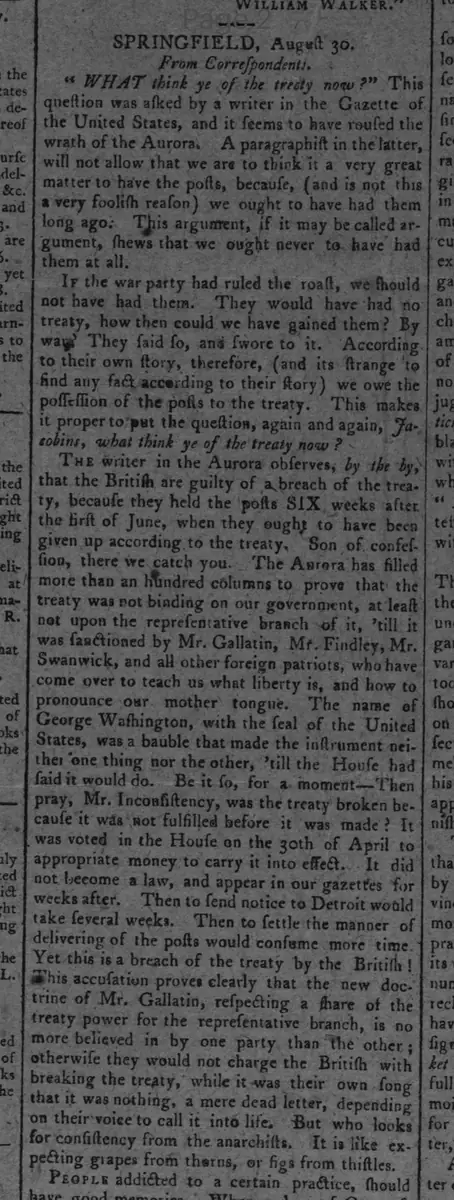
SPRINGFIELD, August 30.
From Correspondents.
"WHAT think ye of the treaty now?" This
question was asked by a writer in the Gazette of
the United States, and it seems to have roused the
wrath of the Aurora. A paragraphist in the latter,
will not allow that we are to think it a very great
matter to have the posts, because, (and is not this
a very foolish reason) we ought to have had them
long ago: This argument, if it may be called ar-
gument, shews that we ought never to have had
them at all.
If the war party had ruled the roast, we should
not have had them. They would have had no
treaty, how then could we have gained them? By
war! They said so, and swore to it. According
to their own story, therefore, (and its strange to
find any fact according to their story) we owe the
possession of the posts to the treaty. This makes
it proper to put the question, again and again, Fa-
colins, what think ye of the treaty now?
The writer in the Aurora observes, by the by,
that the British are guilty of a breach of the trea-
ty, because they held the posts SIX weeks after
the first of June, when they ought to have been
given up according to the treaty. So of confe-
ion, there we catch you. The Aurora has filled
more than an hundred columns to prove that the
treaty was not binding on our government, at least
not upon the representative branch of it, 'till it
was sanctioned by Mr. Gallatin, Mr. Findley, Mr.
Swanwick, and all other foreign patriots, who have
come over to teach us what liberty is, and how to
pronounce our mother tongue. The name of
George Washington, with the seal of the United
States, was a bauble that made the instrument nei-
ther one thing nor the other, 'till the House had
said it would do. Be it so, for a moment—Then
pray, Mr. Inconsistency, was the treaty broken be-
cause it was not fulfilled before it was made? It
was voted in the House on the 30th of April to
appropriate money to carry it into effect. It did
not become a law, and appear in our gazettes for
weeks after. Then to send notice to Detroit would
take several weeks. Then to settle the manner of
delivering of the posts would consume more time.
Yet this is a breach of the treaty by the British!
This accusation proves clearly that the new doc-
trine of Mr. Gallatin, respecting a share of the
treaty power for the representative branch, is no
more believed in by one party than the other;
otherwise they would not charge the British with
breaking the treaty, while it was their own song
that it was nothing, a mere dead letter, depending
on their voice to call it into life. But who looks
for consistency from the anarchists. It is like ex-
pecting grapes from thorns, or figs from thistles.
From Correspondents.
"WHAT think ye of the treaty now?" This
question was asked by a writer in the Gazette of
the United States, and it seems to have roused the
wrath of the Aurora. A paragraphist in the latter,
will not allow that we are to think it a very great
matter to have the posts, because, (and is not this
a very foolish reason) we ought to have had them
long ago: This argument, if it may be called ar-
gument, shews that we ought never to have had
them at all.
If the war party had ruled the roast, we should
not have had them. They would have had no
treaty, how then could we have gained them? By
war! They said so, and swore to it. According
to their own story, therefore, (and its strange to
find any fact according to their story) we owe the
possession of the posts to the treaty. This makes
it proper to put the question, again and again, Fa-
colins, what think ye of the treaty now?
The writer in the Aurora observes, by the by,
that the British are guilty of a breach of the trea-
ty, because they held the posts SIX weeks after
the first of June, when they ought to have been
given up according to the treaty. So of confe-
ion, there we catch you. The Aurora has filled
more than an hundred columns to prove that the
treaty was not binding on our government, at least
not upon the representative branch of it, 'till it
was sanctioned by Mr. Gallatin, Mr. Findley, Mr.
Swanwick, and all other foreign patriots, who have
come over to teach us what liberty is, and how to
pronounce our mother tongue. The name of
George Washington, with the seal of the United
States, was a bauble that made the instrument nei-
ther one thing nor the other, 'till the House had
said it would do. Be it so, for a moment—Then
pray, Mr. Inconsistency, was the treaty broken be-
cause it was not fulfilled before it was made? It
was voted in the House on the 30th of April to
appropriate money to carry it into effect. It did
not become a law, and appear in our gazettes for
weeks after. Then to send notice to Detroit would
take several weeks. Then to settle the manner of
delivering of the posts would consume more time.
Yet this is a breach of the treaty by the British!
This accusation proves clearly that the new doc-
trine of Mr. Gallatin, respecting a share of the
treaty power for the representative branch, is no
more believed in by one party than the other;
otherwise they would not charge the British with
breaking the treaty, while it was their own song
that it was nothing, a mere dead letter, depending
on their voice to call it into life. But who looks
for consistency from the anarchists. It is like ex-
pecting grapes from thorns, or figs from thistles.
What sub-type of article is it?
Foreign Affairs
Partisan Politics
Constitutional
What keywords are associated?
Jay Treaty
British Posts
Aurora Criticism
Gallatin Doctrine
Treaty Ratification
Partisan Inconsistency
War Party
What entities or persons were involved?
Aurora
Gazette Of The United States
British
War Party
Mr. Gallatin
Mr. Findley
Mr. Swanwick
George Washington
Editorial Details
Primary Topic
Defense Of The Jay Treaty Against Aurora Critics
Stance / Tone
Pro Treaty, Mocking Opponents' Inconsistencies
Key Figures
Aurora
Gazette Of The United States
British
War Party
Mr. Gallatin
Mr. Findley
Mr. Swanwick
George Washington
Key Arguments
Critics Undervalue Gaining The Posts Via Treaty, Implying They Shouldn't Have Them At All.
Without The Treaty, War Party Would Not Have Secured The Posts.
Aurora's Claim Of British Breach Ignores Their Own Argument That Treaty Wasn't Binding Until House Approval.
Delays In Us Ratification And Communication Justify British Delay.
Opponents' Doctrine On Treaty Power Is Inconsistent And Unbelievable Even To Themselves.