Thank you for visiting SNEWPapers!
Sign up free
North American
Swanton, Franklin County, Vermont
What is this article about?
In a March 11 parliamentary speech, Mr. Ward quotes a Preston letter detailing the intolerable poverty and starvation among weavers due to low wages and economic reductions, criticizing English aristocracy's support for corn taxes akin to pre-revolutionary French nobility.
Clipping
OCR Quality
Full Text
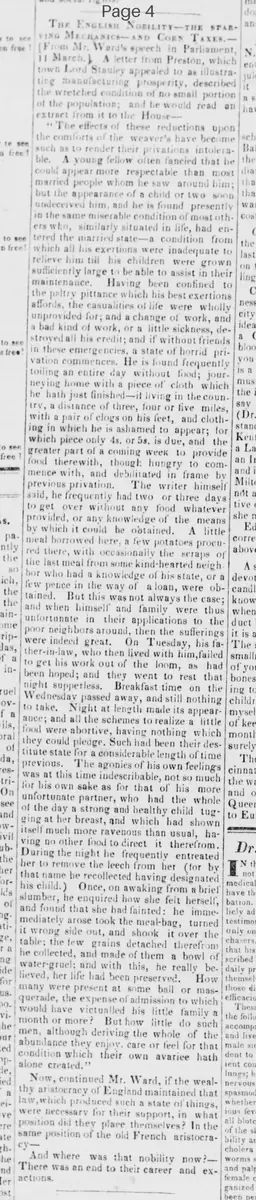
(From Mr. Ward's speech in Parliament, 11 March. A letter from Preston, which town Lord Stanley appealed to as illustrating manufacturing prosperity, described the wretched condition of no small portion of the population; and he would read an extract from it to the House—
"The effects of these reductions upon the comforts of the weavers have become such as to render their privations intolerable. A young fellow often fancied that he could appear more respectable than most married people whom he saw around him but the appearance of a child or two soon undeceived him, and he is found presently in the same miserable condition of most others who, similarly situated in life, had entered the married state—a condition from which all his exertions were inadequate to relieve him till his children were grown sufficiently large to be able to assist in their maintenance.
Having been confined to the paltry pittance which his best exertions afford, the casualties of life were wholly unprovided for; and a change of work, and a bad kind of work, or a little sickness, destroyed all his credit; and if without friends in these emergencies, a state of horrid privation commences. He is found frequently toiling an entire day without food; journeying home with a piece of cloth which he hath just finished—if living in the country, a distance of three, four or five miles, with a pair of clogs on his feet, and clothing in which he is ashamed to appear; for which piece only 4s. or 5s. is due, and the greater part of a coming week to provide food therewith, though hungry to commence with. and debilitated in frame by previous privation. The writer himself said, he frequently had two or three days to get over without any food whatever provided, or any knowledge of the means by which it could be obtained. A little meal borrowed here. a few potatoes procured there, with occasionally the scraps of the last meal from some kind-hearted neighbor who had a knowledge of his state, or a few pence in the way of a loan, were obtained. But this was not always the case; and when himself and family were thus unfortunate in their applications to the poor neighbors around, then the sufferings were indeed great. On Tuesday. his father-in-law, who then lived with him, failed to get his work out of the loom, as had been hoped; and they went to rest that night supperless. Breakfast time on the Wednesday passed away, and still nothing to take. Night at length made its appearance; and all the schemes to realize a little food were abortive, having nothing which they could pledge. Such had been their destitute state for a considerable length of time previous. The agonies of his own feelings was at this time indescribable, not so much for his own sake as for that of his more unfortunate partner, who had the whole of the day a strong and healthy child tugging at her breast, and which had shown itself much more ravenous than usual, having no other food to divert it therefrom. During the night he frequently entreated her to remove the leech from her (for by that name he recollected having designated his child.) Once, on awaking from a brief slumber. he enquired how she felt herself, and found that she had fainted: he immediately arose took the meal-bag, turned it wrong side out, and shook it over the table: the few grains detached therefrom he collected, and made of them a bowl of water-gruel: and with this, he really believed, her life had been preserved. How many were present at some ball or masquerade, the expense of admission to which would have victualled his little family a month or more? But how little do such men, although deriving the whole of the abundance they enjoy. care or feel for that condition which their own avarice hath alone created."
Now, continued Mr. Ward, if the wealthy aristocracy of England maintained that law, which produced such a state of things, were necessary for their support, in what position did they place themselves? In the same position of the old French aristocracy
And where was that nobility now?-
There was an end to their career and exactions.
What sub-type of article is it?
What keywords are associated?
What entities or persons were involved?
Where did it happen?
Foreign News Details
Primary Location
Preston
Event Date
11 March
Key Persons
Outcome
dire privations and starvation among weavers, critiqued as leading to aristocratic downfall similar to pre-revolutionary france.
Event Details
Mr. Ward's parliamentary speech quotes a Preston letter describing weavers' intolerable poverty from wage reductions, including days without food, family suffering, and reliance on meager aid, contrasting with claims of prosperity and blaming aristocratic policies like corn taxes.