Thank you for visiting SNEWPapers!
Sign up free
Story
September 12, 1945
Midland Cooperator
Minneapolis, Hennepin County, Minnesota
What is this article about?
Practical guide to conserving soap in clothes washing amid shortage: optimal water temps, softeners, short soaking, measured soap for suds, thorough rinsing. Notes British monthly ration of 1/2 lb. flakes + 1 bar; ersatz soap causes skin diseases in Europe.
Clipping
OCR Quality
98%
Excellent
Full Text
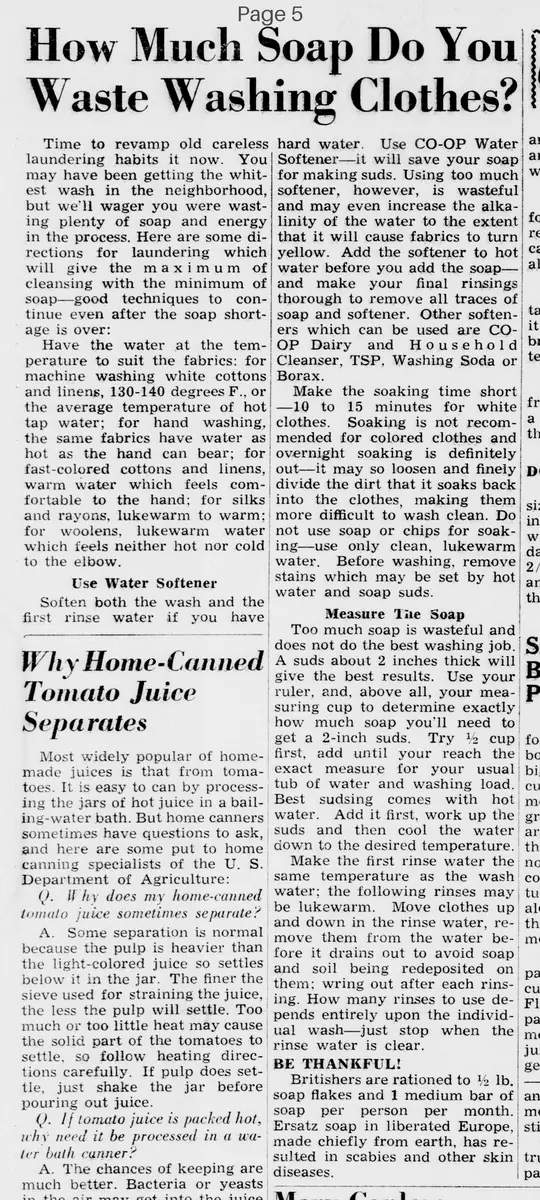
How Much Soap Do You Waste Washing Clothes?
Time to revamp old careless laundering habits. It's now. You may have been getting the whitest wash in the neighborhood, but we'll wager you were wasting plenty of soap and energy in the process. Here are some directions for laundering which will give the maximum of cleansing with the minimum of soap—good techniques to continue even after the soap shortage is over:
Have the water at the temperature to suit the fabrics: for machine washing white cottons and linens, 130-140 degrees F., or the average temperature of hot tap water; for hand washing, the same fabrics have water as hot as the hand can bear; for fast-colored cottons and linens, warm water which feels comfortable to the hand; for silks and rayons, lukewarm to warm; for woolens, lukewarm water which feels neither hot nor cold to the elbow.
Use Water Softener
Soften both the wash and the first rinse water if you have hard water. Use CO-OP Water Softener—it will save your soap for making suds. Using too much softener, however, is wasteful and may even increase the alkalinity of the water to the extent that it will cause fabrics to turn yellow. Add the softener to hot water before you add the soap—and make your final rinsings thorough to remove all traces of soap and softener. Other softeners which can be used are CO-OP Dairy and Household Cleanser, TSP, Washing Soda or Borax.
Make the soaking time short—10 to 15 minutes for white clothes. Soaking is not recommended for colored clothes and overnight soaking is definitely out—it may so loosen and finely divide the dirt that it soaks back into the clothes, making them more difficult to wash clean. Do not use soap or chips for soaking—use only clean, lukewarm water.
Before washing, remove stains which may be set by hot water and soap suds.
Measure The Soap
Too much soap is wasteful and does not do the best washing job. A suds about 2 inches thick will give the best results. Use your ruler, and, above all, your measuring cup to determine exactly how much soap you'll need to get a 2-inch suds. Try 1/2 cup first, add until you reach the exact measure for your usual tub of water and washing load.
Best sudsing comes with hot water. Add it first, work up the suds and then cool the water down to the desired temperature.
Make the first rinse water the same temperature as the wash water; the following rinses may be lukewarm. Move clothes up and down in the rinse water, remove them from the water before it drains out to avoid soap and soil being redeposited on them; wring out after each rinsing. How many rinses to use depends entirely upon the individual wash—just stop when the rinse water is clear.
BE THANKFUL!
Britishers are rationed to 1/2 lb. soap flakes and 1 medium bar of soap per person per month. Ersatz soap in liberated Europe, made chiefly from earth, has resulted in scabies and other skin diseases.
Time to revamp old careless laundering habits. It's now. You may have been getting the whitest wash in the neighborhood, but we'll wager you were wasting plenty of soap and energy in the process. Here are some directions for laundering which will give the maximum of cleansing with the minimum of soap—good techniques to continue even after the soap shortage is over:
Have the water at the temperature to suit the fabrics: for machine washing white cottons and linens, 130-140 degrees F., or the average temperature of hot tap water; for hand washing, the same fabrics have water as hot as the hand can bear; for fast-colored cottons and linens, warm water which feels comfortable to the hand; for silks and rayons, lukewarm to warm; for woolens, lukewarm water which feels neither hot nor cold to the elbow.
Use Water Softener
Soften both the wash and the first rinse water if you have hard water. Use CO-OP Water Softener—it will save your soap for making suds. Using too much softener, however, is wasteful and may even increase the alkalinity of the water to the extent that it will cause fabrics to turn yellow. Add the softener to hot water before you add the soap—and make your final rinsings thorough to remove all traces of soap and softener. Other softeners which can be used are CO-OP Dairy and Household Cleanser, TSP, Washing Soda or Borax.
Make the soaking time short—10 to 15 minutes for white clothes. Soaking is not recommended for colored clothes and overnight soaking is definitely out—it may so loosen and finely divide the dirt that it soaks back into the clothes, making them more difficult to wash clean. Do not use soap or chips for soaking—use only clean, lukewarm water.
Before washing, remove stains which may be set by hot water and soap suds.
Measure The Soap
Too much soap is wasteful and does not do the best washing job. A suds about 2 inches thick will give the best results. Use your ruler, and, above all, your measuring cup to determine exactly how much soap you'll need to get a 2-inch suds. Try 1/2 cup first, add until you reach the exact measure for your usual tub of water and washing load.
Best sudsing comes with hot water. Add it first, work up the suds and then cool the water down to the desired temperature.
Make the first rinse water the same temperature as the wash water; the following rinses may be lukewarm. Move clothes up and down in the rinse water, remove them from the water before it drains out to avoid soap and soil being redeposited on them; wring out after each rinsing. How many rinses to use depends entirely upon the individual wash—just stop when the rinse water is clear.
BE THANKFUL!
Britishers are rationed to 1/2 lb. soap flakes and 1 medium bar of soap per person per month. Ersatz soap in liberated Europe, made chiefly from earth, has resulted in scabies and other skin diseases.
What sub-type of article is it?
Household Advice
Wartime Conservation
What themes does it cover?
Misfortune
Survival
What keywords are associated?
Soap Saving
Laundry Tips
Water Softener
Soap Rationing
Wartime Washing
Story Details
Story Details
Article offers practical tips for efficient clothes washing to minimize soap waste during a shortage, including water temperature guidelines, use of softeners, short soaking, stain removal, precise soap measurement for 2-inch suds, and proper rinsing techniques. Contrasts with British rationing of 1/2 lb. soap flakes and 1 bar per person monthly, and ersatz soap issues in Europe.