Thank you for visiting SNEWPapers!
Sign up free
National Gazette
Philadelphia, Philadelphia County, Pennsylvania
What is this article about?
Citizen 'TAPHNA' opines on the US's delicate position fulfilling its French treaty amid war with Britain, critiques the ambiguity in President Washington's neutrality proclamation but affirms his pacific intentions and right to declare neutrality. Addresses and rebukes critics 'Friend to Peace' and 'Pacificus' for defending it blindly.
Clipping
OCR Quality
Full Text
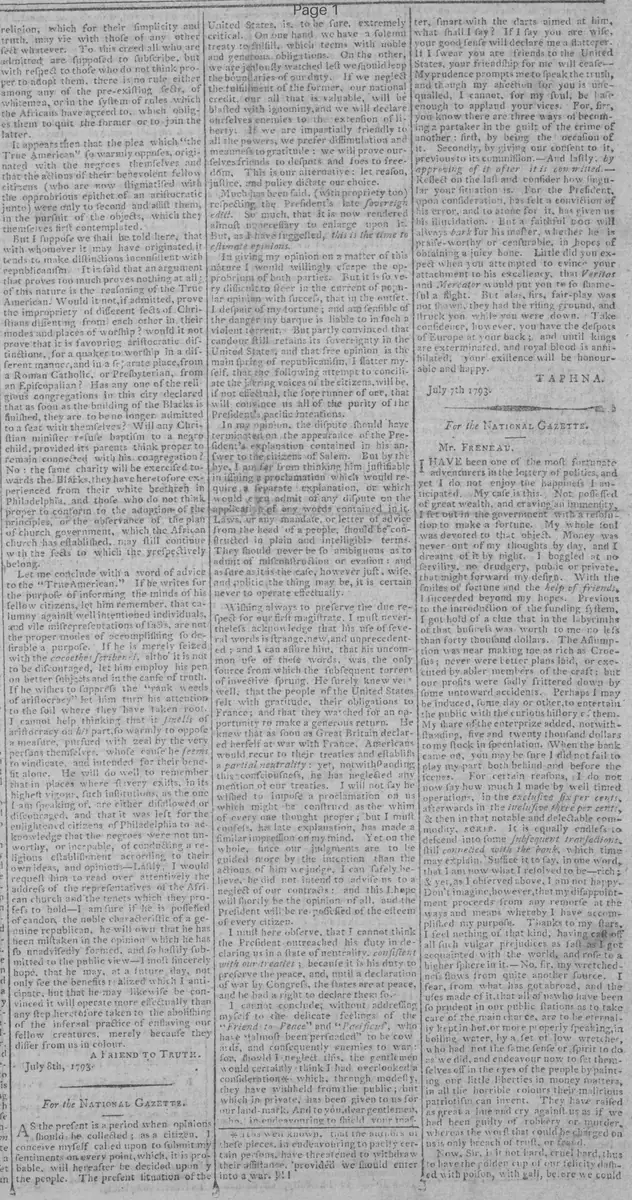
AS the present is a period when opinions should be collected; as a citizen, I conceive myself called upon to submit my sentiments on every point, which, it is probable, will hereafter be decided upon by the people. The present situation of the United States is to be sure, extremely critical. On one hand we have a solemn treaty to fulfill, which teems with noble and generous obligations. On the other, we are jealously watched lest we should leap the boundaries of our duty. If we neglect the fulfillment of the former, our national credit, or all that is valuable will be blasted with ignominy, and we will declare ourselves enemies to the extension of liberty. If we are impartially friendly to all the powers, we prefer dissimulation and meanness to gratitude: we will prove ourselves friends to depots and foes to freedom. This is our alternative: let reason, justice, and policy dictate our choice.
Much has been said, (with propriety too) respecting the President's late sovereign edict. So much that it is now rendered almost unnecessary to enlarge upon it. But, as I have suggested, this is the time to estimate opinions.
In giving my opinion on a matter of this nature I would willingly escape the opprobrium of both parties. But it is very difficult to steer in the current of popular opinion with success, that in the outset I despair of my fortune; and am sensible of the danger my barge is liable to in such a violent torrent. But partly convinced that candour still retains its sovereignty in the United States, and that free opinion is the main spring of republicanism, I flatter myself that the following attempt to conciliate the jarring voices of the citizens, will be, if not effectual, the forerunner of more, that will convince us all of the purity of the President's pacific intentions.
In my opinion the dispute should have terminated on the appearance of the President's explanation contained in his answer to the citizens of Salem. But by the bye, I am far from thinking him justifiable in issuing a proclamation which would require a separate explanation, or which would even admit of any dispute on the application of any words contained in it.
Laws, or any mandate, or letter of advice from the head of a people should be constructed in plain and intelligible terms. They should never be so ambiguous as to admit of misconstruction or evasion: and as far as it is the case, however just, wise, and politic the thing may be, it is certain never to operate effectually.
Wishing always to preserve the due respect for our first magistrate, I must nevertheless acknowledge that his use of several words is strange, new, and unprecedented; and I can assure him that his uncommon use of these words, was the only source from which the subsequent torrent of invective sprung. He surely knew very well that the people of the United States felt with gratitude, their obligations to France; and that they watched for an opportunity to make a general return. He knew that as soon as Great Britain declared herself at war with France, Americans would recur to their treaties and establish a partial neutrality: yet, notwithstanding this consciousness, he has neglected any mention of our treaties. I will not say he wished to impose a proclamation on us which might be construed as the whim of every one thought proper; but I must confess, his late explanation, has made a similar impression on my mind. Yet on the whole, since our judgments are to be guided more by the intention than the actions of him we judge, I can safely believe he did not intend to advise us to a neglect of our contracts: and this I hope will shortly be the opinion of all, and the President will be repossessed of the esteem of every citizen.
I must here observe that I cannot think the President overreached his duty in declaring us in a state of neutrality consistent with our treaties; because it is his duty to preserve the peace, and, until a declaration of war by Congress, the states are at peace, and he had a right to declare them so.
I cannot conclude without addressing myself to the delicate feelings of the "Friend to Peace" and "Pacificus," who have "almost been persuaded" to be cowards, and consequently enemies to war: for, should I neglect this, the gentlemen would certainly think I had overlooked a consideration which, through modesty, they have withheld from the public; but which in private, has been given to us for our land-mark. And to you, dear gentlemen, I have, in endeavouring to shield your master inart with the darts aimed at him, what shall I say? If I say you are wise, your good sense will declare me a flatterer. If I swear you are friends to the United States, your friendship for me will cease-- My prudence prompts me to speak the truth, and though my affection for you is unequalled, I cannot, or my soul, be base enough to applaud your vices. For, sirs, you know there are three ways of becoming a partaker in the guilt of the crime of another: first, by being the occasion of it. Secondly, by giving our consent to it previous to its commission. And lastly, by approving of it after it is committed. Reflect on the last and consider how singular your situation is. For the President, upon consideration, has felt a conviction of his error, and to atone for it, has given us his elucidation. But a faithful dog will always bark for his master, whether he is praise-worthy or censurable, in hopes of obtaining a juicy bone. Little did you expect when you attempted to evince your attachment to his excellency, that Veritas and Mercator would put you to so shameful a flight. But alas, sirs, fair-play was not shown, they had the rising ground, and struck you while you were down. Take confidence, however, you have the despots of Europe at your back; and until kings are exterminated, and royal blood is annihilated, your existence will be honourable and happy.
TAPHNA.
July 7th 1793.
What sub-type of article is it?
What themes does it cover?
What keywords are associated?
What entities or persons were involved?
Letter to Editor Details
Author
Taphna
Recipient
National Gazette
Main Argument
the president's neutrality proclamation was ambiguously worded, leading to unnecessary dispute, but his intentions were pacific and consistent with treaties; the us must fulfill its obligations to france while maintaining peace, and critics like 'friend to peace' and 'pacificus' blindly defend him.
Notable Details