Thank you for visiting SNEWPapers!
Sign up free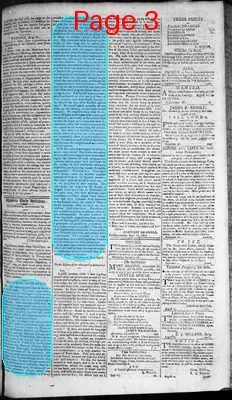
Editorial
September 28, 1805
Alexandria Daily Advertiser
Alexandria, Virginia
What is this article about?
The editorial denounces Spanish Minister Marquis d'Yrujo for secretly obtaining unfavorable legal opinions from American lawyers in 1802 to undermine US ratification of the convention with Spain, criticizing this diplomatic intrigue as disgraceful and potentially harmful to American merchants and peace.
Clipping
OCR Quality
75%
Good
Full Text
RELATIONS WITH SPAIN.
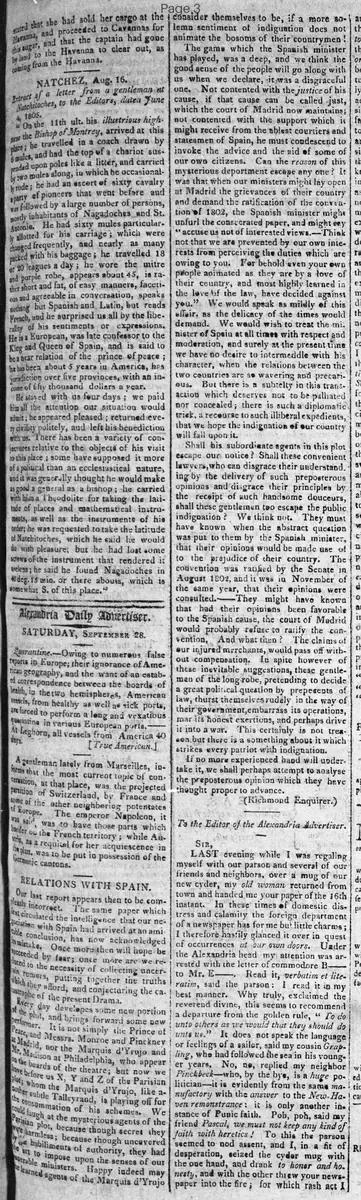
Our last report appears then to be completely incorrect. The same paper which had circulated the intelligence that our negotiation with Spain had arrived at an amicable conclusion, has now acknowledged its mistake. Once more then will hope be succeeded by fear; once more are we reduced to the necessity of collecting uncertain rumors putting together the truths which every day affords the development of the present drama, conjecturing some new portion of the catastrophe of the performer, plot and brings forward some new Peace. Mr. Madison and Messrs. at Philadelphia not Monroe Marquis and d who Yrujo Pinckney appear and have before us the theatre and of but the now Parisian plot we plot. The other consommation whom subtle the Talleyrand Marquis of his schemes. is d playing Yrujo o like for a- parents of the Parisian plot, because though secret they are harmless because though the habiliments of authority, they had art to impose upon the senses of our venerable ministers. Happy indeed may the learned agents of the Marquis d'Yrujo consider themselves to be, if a more solemn sentiment of indignation does not animate the bosoms of their countrymen! The games which the Spanish minister has played, was a deep, and we think the good sense of the people will go along with us when we declare, it was a disgraceful one. Not contented with the justice of his cause, if that cause can be called just, which the court of Madrid now maintains; not contented with the support which it might receive from the ablest courtiers and statesmen of Spain, he must condescend to invoke the advice and the aid of some of our own citizens. Can the reason of this mysterious deportment escape any one? It was that when our ministers might lay open at Madrid the grievances of their country and demand the ratification of the convention of 1802, the Spanish minister might unfurl the consecrated paper, and might say 'accuse us not of interested views.--Think not that we are prevented by our own interests from perceiving the duties which are owing to you. For behold even your own people animated as they are by a love of their country, and most highly learned in the love of the law, have decided against you.'. We would speak as mildly of this affair. as the delicacy of the times would demand. We would wish to treat the minister of Spain at all times with respect and moderation, and surely at the present time we have no desire to intermeddle with his character, when the relations between the two countries are so wavering and precarious. But there is a subtlety in this transaction which deserves not to be palliated nor concealed; there is such a diplomatic trick, a recourse to such illiberal expedients, that we hope the indignation of our country will fall upon it. Shall his subordinate agents in this plot escape our notice? Shall these convenient lawyers, who can disgrace their understanding by the delivery of such preposterous opinions and disgrace their principles by the receipt of such handsome douceurs, shall these gentlemen too escape the public indignation? We think not. They must have known when the abstract question was put to them by the Spanish minister. that their opinions would be made use of to the prejudice of their country. The convention was ratified by the Senate in August 1802, and it was in November of the same year, that their opinions were consulted.---They might have known that had their opinions been favorable to the Spanish cause, the court of Madrid would probably refuse to ratify the convention. And what then? The claims of our injured merchants, would pass off without compensation. In spite however of these inevitable suggestions, these gentlemen of the long robe, pretending to decide a great political question by precedents of law, thrust themselves rudely in the way of their government, embarrass its operations, mar its honest exertions, and perhaps drive it into a war. This certainly is not treason but there is a something about it which strikes every patriot with indignation.
If no more experienced hand will undertake it, we shall perhaps attempt to analyse the preposterous opinion which they have thought proper to advance.
(Richmond Enquirer.)
Our last report appears then to be completely incorrect. The same paper which had circulated the intelligence that our negotiation with Spain had arrived at an amicable conclusion, has now acknowledged its mistake. Once more then will hope be succeeded by fear; once more are we reduced to the necessity of collecting uncertain rumors putting together the truths which every day affords the development of the present drama, conjecturing some new portion of the catastrophe of the performer, plot and brings forward some new Peace. Mr. Madison and Messrs. at Philadelphia not Monroe Marquis and d who Yrujo Pinckney appear and have before us the theatre and of but the now Parisian plot we plot. The other consommation whom subtle the Talleyrand Marquis of his schemes. is d playing Yrujo o like for a- parents of the Parisian plot, because though secret they are harmless because though the habiliments of authority, they had art to impose upon the senses of our venerable ministers. Happy indeed may the learned agents of the Marquis d'Yrujo consider themselves to be, if a more solemn sentiment of indignation does not animate the bosoms of their countrymen! The games which the Spanish minister has played, was a deep, and we think the good sense of the people will go along with us when we declare, it was a disgraceful one. Not contented with the justice of his cause, if that cause can be called just, which the court of Madrid now maintains; not contented with the support which it might receive from the ablest courtiers and statesmen of Spain, he must condescend to invoke the advice and the aid of some of our own citizens. Can the reason of this mysterious deportment escape any one? It was that when our ministers might lay open at Madrid the grievances of their country and demand the ratification of the convention of 1802, the Spanish minister might unfurl the consecrated paper, and might say 'accuse us not of interested views.--Think not that we are prevented by our own interests from perceiving the duties which are owing to you. For behold even your own people animated as they are by a love of their country, and most highly learned in the love of the law, have decided against you.'. We would speak as mildly of this affair. as the delicacy of the times would demand. We would wish to treat the minister of Spain at all times with respect and moderation, and surely at the present time we have no desire to intermeddle with his character, when the relations between the two countries are so wavering and precarious. But there is a subtlety in this transaction which deserves not to be palliated nor concealed; there is such a diplomatic trick, a recourse to such illiberal expedients, that we hope the indignation of our country will fall upon it. Shall his subordinate agents in this plot escape our notice? Shall these convenient lawyers, who can disgrace their understanding by the delivery of such preposterous opinions and disgrace their principles by the receipt of such handsome douceurs, shall these gentlemen too escape the public indignation? We think not. They must have known when the abstract question was put to them by the Spanish minister. that their opinions would be made use of to the prejudice of their country. The convention was ratified by the Senate in August 1802, and it was in November of the same year, that their opinions were consulted.---They might have known that had their opinions been favorable to the Spanish cause, the court of Madrid would probably refuse to ratify the convention. And what then? The claims of our injured merchants, would pass off without compensation. In spite however of these inevitable suggestions, these gentlemen of the long robe, pretending to decide a great political question by precedents of law, thrust themselves rudely in the way of their government, embarrass its operations, mar its honest exertions, and perhaps drive it into a war. This certainly is not treason but there is a something about it which strikes every patriot with indignation.
If no more experienced hand will undertake it, we shall perhaps attempt to analyse the preposterous opinion which they have thought proper to advance.
(Richmond Enquirer.)
What sub-type of article is it?
Foreign Affairs
What keywords are associated?
Spain Relations
Yrujo Intrigue
Convention 1802
Diplomatic Tricks
American Lawyers
Merchant Claims
What entities or persons were involved?
Marquis D'yrujo
Mr. Madison
Monroe
Pinckney
Talleyrand
Court Of Madrid
American Lawyers
Editorial Details
Primary Topic
Criticism Of Marquis D'yrujo's Intrigue Against 1802 Convention
Stance / Tone
Strongly Indignant And Critical Of Spanish Diplomatic Tactics
Key Figures
Marquis D'yrujo
Mr. Madison
Monroe
Pinckney
Talleyrand
Court Of Madrid
American Lawyers
Key Arguments
Spanish Minister Sought Secret Opinions From American Citizens To Undermine Us Negotiations
This Tactic Is Disgraceful And Relies On Illiberal Expedients
Lawyers Knew Their Opinions Could Prejudice Their Country And Harm Merchants' Claims
Such Actions Embarrass Government And Risk War
Public Indignation Should Target Both Minister And Complicit Lawyers