Thank you for visiting SNEWPapers!
Sign up free
Gazette Of The United States
New York, New York County, New York
What is this article about?
On April 23, 1792, in Philadelphia's House of Representatives, Mr. Page renewed a motion to recommit a bill for raising frontier protection funds, advocating alternatives to the Secretary of the Treasury's third plan, including bank stock sale or tonnage duties. The motion failed. Mr. Williamson successfully amended to remove duty exemption for books imported to colleges.
Clipping
OCR Quality
Full Text
PHILADELPHIA.
HOUSE OF REPRESENTATIVES,
FRIDAY, April 23, 1792.
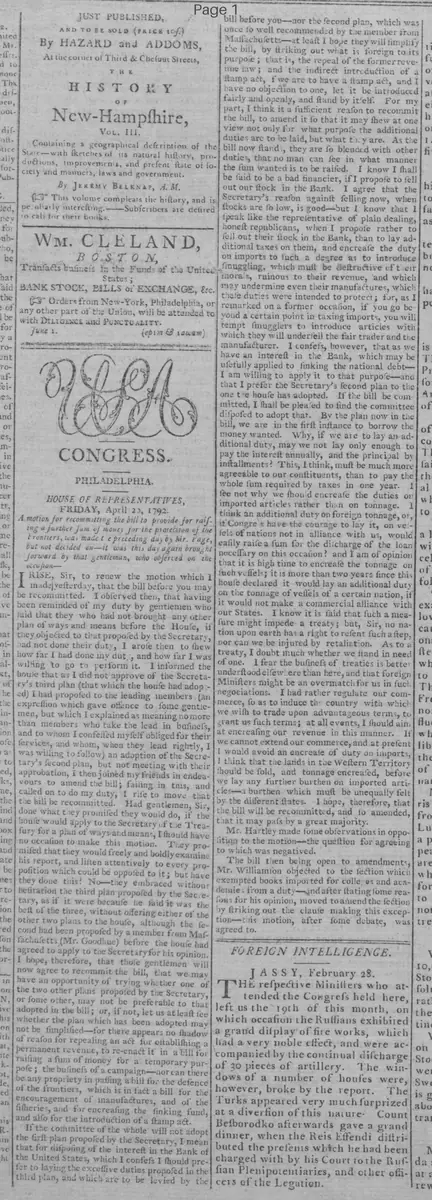
A motion for recommitting the bill to provide for raising a further sum of money for the protection of the frontiers, was made the preceding day by Mr. Page, but not decided on--it was this day again brought forward by that gentleman, who observed on the occasion
"RISE, Sir, to renew the motion which I made yesterday, that the bill before you may be recommitted. I observed then, that having been reminded of my duty by gentlemen who said that they who had not brought any other plan of ways and means before the House, if they objected to that proposed by the Secretary, had not done their duty, I arose then to shew how far I had done my duty, and how far I was willing to go to perform it. I informed the house that as I did not approve of the Secretary's third plan (that which the house had adopted) I had proposed to the leading members (an expression which gave offence to some gentlemen, but which I explained as meaning no more than members who take the lead in business, and to whom I confessed myself obliged for their services, and whom, when they lead rightly, I was willing to follow) an adoption of the Secretary's second plan, but not meeting with their approbation, I then joined my friends in endeavours to amend the bill; failing in this, and called on to do my duty, I rise to move that the bill be recommitted. Had gentlemen, Sir, done what they promised they would do, if the house would apply to the Secretary of the Treasury for a plan of ways and means, I should have no occasion to make this motion. They promised that they would freely and boldly examine his report, and listen attentively to every proposition which could be opposed to it; but have they done this? No--they embraced without hesitation the third plan proposed by the Secretary, as if it were because he said it was the best of the three, without offering either of the other two plans to the house, although the second had been proposed by a member from Massachusetts (Mr. Goodhue) before the house had agreed to apply to the Secretary for his opinion. I hope, therefore, that those gentlemen will now agree to recommit the bill, that we may have an opportunity of trying whether one of the two other plans proposed by the Secretary, or some other, may not be preferable to that adopted in the bill; or, if not, let us at least see whether the plan which has been adopted may not be simplified--for there appears no shadow of reason for repealing an act for establishing a permanent revenue, to re-enact it in a bill for raising a sum of money for a temporary purpose; the business of a campaign--nor can there be any propriety in passing a bill for the defence of the frontiers, which is in fact a bill for the encouragement of manufactures, and of the fisheries, and for increasing the sinking fund, and also for the introduction of a stamp act. If the committee of the whole will not adopt the first plan proposed by the Secretary, I mean that for disposing of the interest in the Bank of the United States, which I confess I should prefer to laying the excise duties proposed in the third plan, and which are to be levied by the bill before you--nor the second plan, which was once so well recommended by the member from Massachusetts--at least I hope they will simplify the bill, by striking out what is foreign to its purpose; that is, the repeal of the former revenue law; and the indirect introduction of a stamp act. If we are to have a stamp act, and I have no objection to one, let it be introduced fairly and openly, and stand by itself. For my part, I think it a sufficient reason to recommit the bill, to amend it so that it may shew at one view not only for what purpose the additional duties are to be laid, but what they are. As the bill now stands, they are so blended with other duties, that no man can see in what manner the sum wanted is to be raised. I know I shall be said to be a bad financier, if I propose to sell out our stock in the Bank. I agree that the Secretary's reason against selling now, when stocks are so low, is good--but I know that I speak like the representative of plain dealing; honest republicans, when I propose rather to sell out their stock in the Bank, than to lay additional taxes on them, and encrease the duty on imports to such a degree as to introduce smuggling, which must be destructive of their morals, ruinous to their revenue, and which may undermine even their manufactures, which these duties were intended to protect; for, as I remarked on a former occasion, if you go beyond a certain point in taxing imports, you will tempt smugglers to introduce articles with which they will undersell the fair trader and the manufacturer. I confess, however, that as we have an interest in the Bank, which may be usefully applied to sinking the national debt I am willing to apply it to that purpose--and that I prefer the Secretary's second plan to the one the house has adopted. If the bill be committed, I shall be pleased to find the committee disposed to adopt that. By the plan now in the bill, we are in the first instance to borrow the money wanted. Why, if we are to lay an additional duty, may we not lay only enough to pay the interest annually, and the principal by installments? This, I think, must be much more agreeable to our constituents, than to pay the whole sum required by taxes in one year. I see not why we should encrease the duties on imported articles rather than on tonnage. I think an additional duty on foreign tonnage, or, if Congress have the courage to lay it, on vessels of nations not in alliance with us, would easily raise a sum for the discharge of the loan necessary on this occasion? and I am of opinion that it is high time to encrease the tonnage on such vessels; it is more than two years since this house declared it would lay an additional duty on the tonnage of vessels of a certain nation, if it would not make a commercial alliance with our States. I know it is said that such a measure might impede a treaty; but, Sir, no nation upon earth has a right to resent such a step, nor can we be injured by retaliation. As to a treaty, I doubt much whether we stand in need of one. I fear the business of treaties is better understood elsewhere than here, and that foreign Ministers might be an overmatch for us in such negociations. I had rather regulate our commerce, so as to induce the country with which we wish to trade upon advantageous terms, to grant us such terms; at all events, I should aim at encreasing our revenue in this manner. If we cannot extend our commerce, and at present I would avoid an encrease of duty on imports, I think that the lands in the Western Territory should be sold, and tonnage encreased, before we lay any further burthen on imported articles--a burthen which must be unequally felt by the different states. I hope, therefore, that the bill will be recommitted, and so amended, that it may pass by a great majority."
Mr. Hartley made some observations in opposition to the motion--the question for agreeing to which was negatived.
The bill then being open to amendments, Mr. Williamson objected to the section which exempted books imported for colleges and academies from a duty--and after stating some reasons for his opinion, moved to amend the section by striking out the clause making this exception--this motion, after some debate, was agreed to.
What sub-type of article is it?
What keywords are associated?
What entities or persons were involved?
Where did it happen?
Domestic News Details
Primary Location
Philadelphia
Event Date
April 23, 1792
Key Persons
Outcome
motion to recommit the bill negatived. amendment to strike out exemption for books imported for colleges and academies from duty agreed to.
Event Details
Mr. Page renewed motion to recommit bill for raising money for frontier protection, criticizing adoption of Secretary of the Treasury's third plan without considering alternatives like selling Bank stock or increasing tonnage duties. He suggested simplifying the bill and avoiding blended duties. Mr. Hartley opposed. After motion failed, Mr. Williamson moved to remove duty exemption for imported books to educational institutions, which passed after debate.