Thank you for visiting SNEWPapers!
Sign up free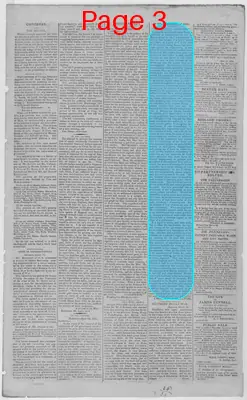
Letter to Editor
April 12, 1814
Daily National Intelligencer
Washington, District Of Columbia
What is this article about?
A letter to the National Intelligencer argues against prohibiting the exportation of raw wool in the US, warning it would harm agriculture and land cultivation in a sparsely populated nation, unlike in Europe. It contrasts with English policy and notes benefits of exporting Merino wool for cheaper imports post-war.
Clipping

OCR Quality
95%
Excellent
Full Text
ON THE CULTIVATION OF WOOL
FOR THE NATIONAL INTELLIGENCER
A writer in the United States Gazette published at Philadelphia, of the 7th March, seems to shew considerable alarm at the danger, if a peace should take place, of a great part of the wool in the country being bought up by foreign agents for exportation, at such prices as will prevent the woollen manufacturers of this country from procuring supplies of that article in such quantities and on such terms as will enable them to carry on their business to the extent and with the profits they have contemplated. He endeavors to create an impression (more indeed by general assertions than by argument) that it would be for the interest of the landed part of the community totally to prohibit the exportation of the raw article, or at least for several years, in order to enable the manufacturers here to buy it of the farmers at their own prices ; and has adduced the example of England in prohibiting the exportation of wool as a sufficient reason for a similar measure here, without even considering whether the causes which induced the adoption of the English policy in this respect have any existence in the United States. I humbly conceive they have not, In England and other thickly settled countries of Europe (as Silesia, Lusatia, Westphalia, &c.) where there is a far greater population than is necessary for the cultivation of the land and the other usual avocations of a nation, it is certainly a wise policy to encourage the manufacture of raw commodities, by prohibiting their exportation until brought into a fabricated state, and with the increase of their value, the price of labor, giving bread and comforts to whatever portion of the population may remain after the cultivation of the lands and other necessary objects are provided for, Indeed, in such places, manufactures must spring up, if there be within the reach of this wretched redundance of population any raw materials to work upon; otherwise they must starve for want of employment, or perhaps seek an asylum in the armies of their prince, who by the misery of his subjects is thus enabled to carry on his schemes of conquest and ambition. In the U. States, with our comparatively sparse population, the very reverse is the case. The raw material whose value we should be most anxious to increase, is our uncultivated lands. They should be converted into grain fields and pasture grounds for cattle. Can it be pretended that a prohibition of the exportation of wool would produce this effect ? Would the diminution in price which must necessarily ensue, be an inducement to extend the culture of that most useful of animals, the sheep ? Certainly not. For the support of 5 or 6 sheep an acre of land is necessary. What amazing benefits to the landed interest would the general cultivation of this animal produce, by clearing millions of acres which have hitherto lain dormant capital in the shape of a wilderness !
: It is urged by many, and with truth, that in times like the present, the vigor and energy of the government should not be impaired by a dependance on foreign countries, and especially upon our enemies, for a sufficient supply of woollen clothing for the land and naval forces employed in carrying on the war. The freedom of exportation of wool would not diminish the resources of the government in this respect. The inferior qualities, which are the kinds used in the manufacture of cloths, &c. suitable for army clothing, are in no danger of being exported. They can be procured in England and in Germany, and Poland. at half or two-thirds the prices they were sold at in this country before the rise occasioned by the restriction on the importation of British woollens. It is the full and cross-blooded Merino wool which is already begun to be bought. and, if peace should be restored, will be exported to the English market and returned to us in the cloth (after paying a freight to our merchant 'ships and a handsome duty for the support of government) cheaper than our manufacturers would sell us the same quality if the exportation of wool were prohibited.
A FRIEND TO AGRICULTURE.
FOR THE NATIONAL INTELLIGENCER
A writer in the United States Gazette published at Philadelphia, of the 7th March, seems to shew considerable alarm at the danger, if a peace should take place, of a great part of the wool in the country being bought up by foreign agents for exportation, at such prices as will prevent the woollen manufacturers of this country from procuring supplies of that article in such quantities and on such terms as will enable them to carry on their business to the extent and with the profits they have contemplated. He endeavors to create an impression (more indeed by general assertions than by argument) that it would be for the interest of the landed part of the community totally to prohibit the exportation of the raw article, or at least for several years, in order to enable the manufacturers here to buy it of the farmers at their own prices ; and has adduced the example of England in prohibiting the exportation of wool as a sufficient reason for a similar measure here, without even considering whether the causes which induced the adoption of the English policy in this respect have any existence in the United States. I humbly conceive they have not, In England and other thickly settled countries of Europe (as Silesia, Lusatia, Westphalia, &c.) where there is a far greater population than is necessary for the cultivation of the land and the other usual avocations of a nation, it is certainly a wise policy to encourage the manufacture of raw commodities, by prohibiting their exportation until brought into a fabricated state, and with the increase of their value, the price of labor, giving bread and comforts to whatever portion of the population may remain after the cultivation of the lands and other necessary objects are provided for, Indeed, in such places, manufactures must spring up, if there be within the reach of this wretched redundance of population any raw materials to work upon; otherwise they must starve for want of employment, or perhaps seek an asylum in the armies of their prince, who by the misery of his subjects is thus enabled to carry on his schemes of conquest and ambition. In the U. States, with our comparatively sparse population, the very reverse is the case. The raw material whose value we should be most anxious to increase, is our uncultivated lands. They should be converted into grain fields and pasture grounds for cattle. Can it be pretended that a prohibition of the exportation of wool would produce this effect ? Would the diminution in price which must necessarily ensue, be an inducement to extend the culture of that most useful of animals, the sheep ? Certainly not. For the support of 5 or 6 sheep an acre of land is necessary. What amazing benefits to the landed interest would the general cultivation of this animal produce, by clearing millions of acres which have hitherto lain dormant capital in the shape of a wilderness !
: It is urged by many, and with truth, that in times like the present, the vigor and energy of the government should not be impaired by a dependance on foreign countries, and especially upon our enemies, for a sufficient supply of woollen clothing for the land and naval forces employed in carrying on the war. The freedom of exportation of wool would not diminish the resources of the government in this respect. The inferior qualities, which are the kinds used in the manufacture of cloths, &c. suitable for army clothing, are in no danger of being exported. They can be procured in England and in Germany, and Poland. at half or two-thirds the prices they were sold at in this country before the rise occasioned by the restriction on the importation of British woollens. It is the full and cross-blooded Merino wool which is already begun to be bought. and, if peace should be restored, will be exported to the English market and returned to us in the cloth (after paying a freight to our merchant 'ships and a handsome duty for the support of government) cheaper than our manufacturers would sell us the same quality if the exportation of wool were prohibited.
A FRIEND TO AGRICULTURE.
What sub-type of article is it?
Persuasive
Informative
Political
What themes does it cover?
Economic Policy
Agriculture
Commerce Trade
What keywords are associated?
Wool Exportation
Merino Sheep
Agriculture Policy
Manufacturing
War Supplies
Land Cultivation
What entities or persons were involved?
A Friend To Agriculture
National Intelligencer
Letter to Editor Details
Author
A Friend To Agriculture
Recipient
National Intelligencer
Main Argument
the us should not prohibit wool exportation like england, as it would harm agricultural expansion in a sparsely populated country; instead, exporting merino wool would benefit farmers and allow cheaper imports of finished cloth.
Notable Details
Contrasts Us Sparse Population With Europe's Dense Population
References English Wool Export Prohibition
Mentions Merino Wool Export To England
Discusses War Time Clothing Supplies