Thank you for visiting SNEWPapers!
Sign up free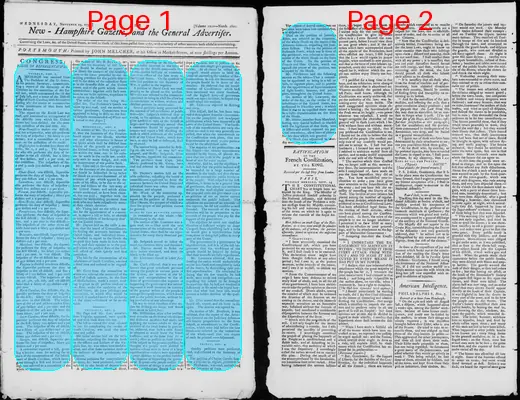
The New Hampshire Gazette And General Advertiser
Portsmouth, Rockingham County, New Hampshire
What is this article about?
Proceedings of the U.S. House of Representatives from November 1-4, including a Treasury report on excise law districts and salaries, delays in South Carolina census, motions on public debt subscriptions, alterations to excise law, war department balances, bankruptcy system, and debate on representation ratio.
Merged-components note: This is a continuation of the detailed narrative report on House of Representatives proceedings from November 1 to 4, originally labeled as domestic_news on page 2 but fitting as a single story.
Clippings
1 of 2
OCR Quality
Full Text
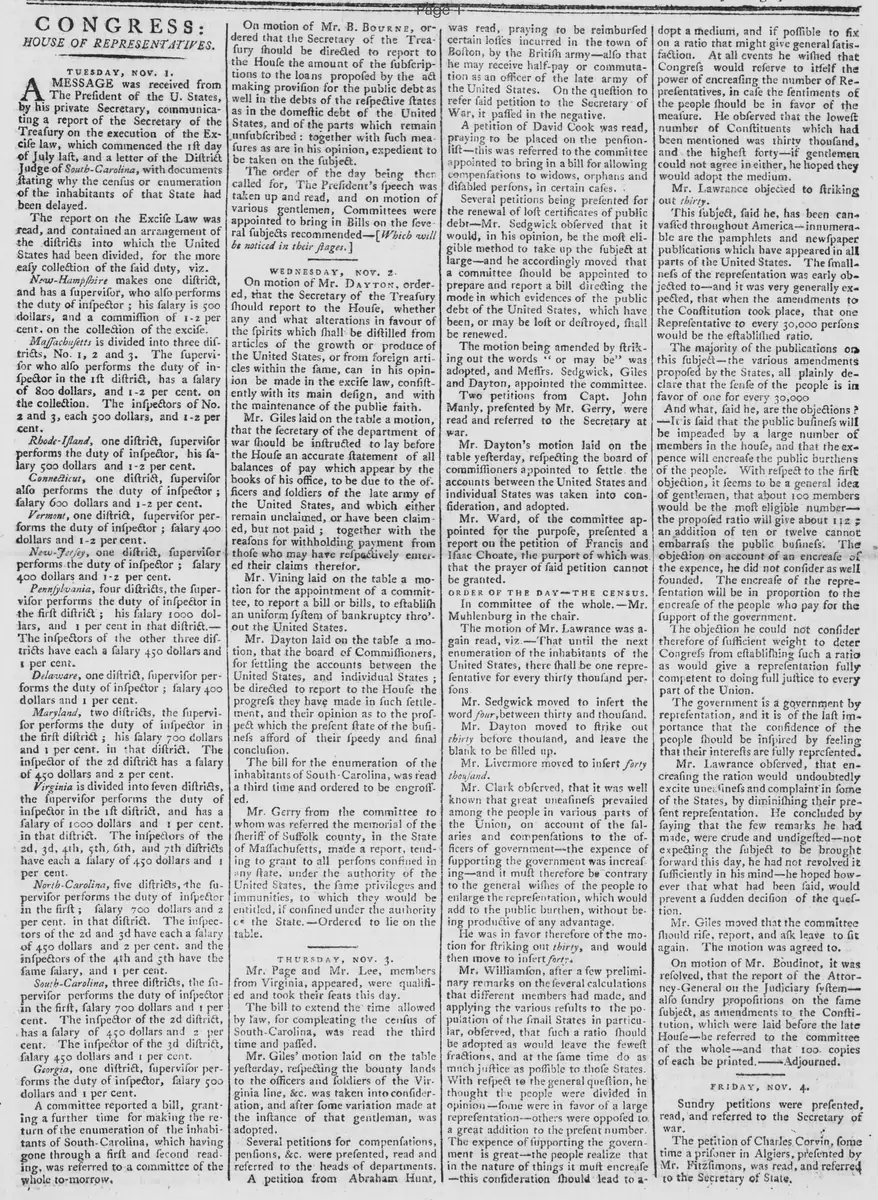
HOUSE OF REPRESENTATIVES.
TUESDAY, NOV. 1.
A MESSAGE was received from the President of the United States, by his private Secretary, communicating a report of the Secretary of the Treasury on the execution of the Excise law, which commenced the 1st day of July last, and a letter of the District Judge of South-Carolina, with documents stating why the census or enumeration of the inhabitants of that State had been delayed.
The report on the Excise Law was read, and contained an arrangement of the districts into which the United States had been divided, for the more easy collection of the said duty, viz. New-Hampshire makes one district, and has a supervisor, who also performs the duty of inspector: his salary is 200 dollars, and a commission of 1/2 per cent, on the collection of the excise. Massachusetts is divided into three districts, No. 1, 2 and 3. The supervisor who also performs the duty of inspector in the 1st district, has a salary of 800 dollars, and 1/2 per cent. on the collection. The inspectors of No. 2 and 3, each 500 dollars, and 1/2 per cent. Rhode-Island, one district, supervisor performs the duty of inspector, his salary 500 dollars and 1/2 per cent. Connecticut, one district, supervisor also performs the duty of inspector; salary 600 dollars and 1/2 per cent. Vermont, one district, supervisor performs the duty of inspector; salary 400 dollars and 1/2 per cent. New-Jersey, one district, supervisor performs the duty of inspector; salary 400 dollars and 1/2 per cent. Pennsylvania, four districts, the supervisor performs the duty of inspector in the first district; his salary 1000 dollars, and 1 per cent in that district. The inspectors of the other three districts have each a salary 450 dollars and 1 per cent. Delaware, one district, supervisor performs the duty of inspector; salary 400 dollars and 1 per cent. Maryland, two districts, the supervisor performs the duty of inspector in the first district; his salary 700 dollars and 1 per cent. in that district. The inspector of the 2nd district has a salary of 450 dollars and 1 per cent. Virginia is divided into seven districts, the supervisor performs the duty of inspector in the 1st district, and has a salary of 1000 dollars and 1 per cent. in that district. The inspectors of the 2nd, 3rd, 4th, 5th, 6th, and 7th districts have each a salary of 450 dollars and 1 per cent. North-Carolina, five districts, the supervisor performs the duty of inspector in the first; salary 700 dollars and 1 per cent. in that district. The inspectors of the 2nd and 3rd have each a salary of 450 dollars and 1 per cent. and the inspectors of the 4th and 5th have the same salary, and 1 per cent. South-Carolina, three districts, the supervisor performs the duty of inspector in the first, salary 700 dollars and 1 per cent. The inspector of the 2nd district, has a salary of 450 dollars and 2 per cent. The inspector of the 3rd district, salary 450 dollars and 1 per cent. Georgia, one district, supervisor performs the duty of inspector, salary 500 dollars and 1 per cent.
A committee reported a bill, granting a further time for making the return of the enumeration of the inhabitants of South-Carolina, which having gone through a first and second reading, was referred to a committee of the whole to-morrow.
On motion of Mr. B. Bourne, ordered that the Secretary of the Treasury should be directed to report to the House the amount of the subscriptions to the loans proposed by the act making provision for the public debt as well in the debts of the respective states as in the domestic debt of the United States, and of the parts which remain unsubscribed: together with such measures as are in his opinion, expedient to be taken on the subject.
The order of the day being then called for. The President's speech was taken up and read, and on motion of various gentlemen, Committees were appointed to bring in Bills on the several subjects recommended--[Which will be noticed in their stages.]
WEDNESDAY, NOV. 2.
On motion of Mr. Dayton, ordered, that the Secretary of the Treasury should report to the House, whether any and what alterations in favour of the spirits which shall be distilled from articles of the growth or produce of the United States, or from foreign articles within the same, can in his opinion be made in the excise law, consistently with its main design, and with the maintenance of the public faith.
Mr. Giles laid on the table a motion, that the Secretary of the department of war should be instructed to lay before the House an accurate statement of all balances of pay which appear by the books of his office, to be due to the officers and soldiers of the late army of the United States, and which either remain unclaimed, or have been claimed, but not paid; together with the reasons for withholding payment from those who may have respectively entered their claims therefor.
Mr. Vining laid on the table a motion for the appointment of a committee, to report a bill or bills, to establish an uniform system of bankruptcy thro' out the United States.
Mr. Dayton laid on the table a motion, that the board of Commissioners, for settling the accounts between the United States, and individual States; be directed to report to the House the progress they have made in such settlement, and their opinion as to the prospect which the present state of the business afford of their speedy and final conclusion.
The bill for the enumeration of the inhabitants of South-Carolina, was read a third time and ordered to be engrossed.
Mr. Gerry from the committee to whom was referred the memorial of the sheriff of Suffolk county, in the State of Massachusetts, made a report, tending to grant to all persons confined in any state, under the authority of the United States, the same privileges and immunities, to which they would be entitled, if confined under the authority of the State. Ordered to lie on the table.
THURSDAY, NOV. 3.
Mr. Page and Mr. Lee, members from Virginia, appeared, were qualified and took their seats this day.
The bill to extend the time allowed by law, for completing the census of South-Carolina, was read the third time and passed.
Mr. Giles' motion laid on the table yesterday, respecting the bounty lands to the officers and soldiers of the Virginia line, &c. was taken into consideration, and after some variation made at the instance of that gentleman, was adopted.
Several petitions for compensations, pensions, &c. were presented, read and referred to the heads of departments.
A petition from Abraham Hunt, was read, praying to be reimbursed certain losses incurred in the town of Boston, by the British army--also that he may receive half-pay or commutation as an officer of the late army of the United States. On the question to refer said petition to the Secretary of War, it passed in the negative.
A petition of David Cook was read, praying to be placed on the pension-list--this was referred to the committee appointed to bring in a bill for allowing compensations to widows, orphans and disabled persons, in certain cases.
Several petitions being presented for the renewal of lost certificates of public debt--Mr. Sedgwick observed that it would, in his opinion, be the most eligible method to take up the subject at large--and he accordingly moved that a committee should be appointed to prepare and report a bill directing the mode in which evidences of the public debt of the United States, which have been, or may be lost or destroyed, shall be renewed.
The motion being amended by striking out the words "or may be" was adopted, and Messrs. Sedgwick, Giles and Dayton, appointed the committee.
Two petitions from Capt. John Manly, presented by Mr. Gerry, were read and referred to the Secretary at war.
Mr. Dayton's motion laid on the table yesterday, respecting the board of commissioners appointed to settle the accounts between the United States and individual States was taken into consideration, and adopted.
Mr. Ward, of the committee appointed for the purpose, presented a report on the petition of Francis and Isaac Choate, the purport of which was that the prayer of said petition cannot be granted.
ORDER OF THE DAY--THE CENSUS.
In committee of the whole.--Mr. Muhlenburg in the chair.
The motion of Mr. Lawrence was again read, viz.--That until the next enumeration of the inhabitants of the United States, there shall be one representative for every thirty thousand persons.
Mr. Sedgwick moved to insert the word four, between thirty and thousand.
Mr. Dayton moved to strike out thirty before thousand, and leave the blank to be filled up.
Mr. Livermore moved to insert forty thousand.
Mr. Clarke observed, that it was well known that great uneasiness prevailed among the people in various parts of the Union, on account of the salaries and compensations to the officers of government--the expense of supporting the government was increasing--and it must therefore be contrary to the general wishes of the people to enlarge the representation, which would add to the public burthen, without being productive of any advantage. He was in favor therefore of the motion for striking out thirty, and would then move to insert forty.
Mr. Williamson, after a few preliminary remarks on the several calculations that different members had made, and applying the various results to the population of the small States in particular, observed, that such a ratio should be adopted as would leave the fewest fractions, and at the same time do as much justice as possible to those States. With respect to the general question, he thought the people were divided in opinion--some were in favor of a large representation--others were opposed to a great addition to the present number. The expense of supporting the government is great--the people realize that in the nature of things it must increase--this consideration should lead to adopt a medium, and if possible to fix on a ratio that might give general satisfaction. At all events he wished that Congress would reserve to itself the power of increasing the number of Representatives, in case the sentiments of the people should be in favor of the measure. He observed that the lowest number of Constituents which had been mentioned was thirty thousand, and the highest forty--if gentlemen could not agree in either, he hoped they would adopt the medium.
Mr. Lawrence objected to striking out thirty.
This subject, said he, has been canvassed throughout America--innumerable are the pamphlets and newspaper publications which have appeared in all parts of the United States. The smallness of the representation was early objected to--and it was very generally expected, that when the amendments to the Constitution took place, that one Representative to every 30,000 persons would be the established ratio. The majority of the publications on this subject--the various amendments proposed by the States, all plainly declare that the sense of the people is in favor of one for every 30,000. And what, said he, are the objections? --It is said that the public business will be impeded by a large number of members in the house, and that the expense will increase the public burthens of the people. With respect to the first objection, it seems to be a general idea of gentlemen, that about 100 members would be the most eligible number-- the proposed ratio will give about 112; an addition of ten or twelve cannot embarrass the public business. The objection on account of an increase of the expense, he did not consider as well founded. The increase of the representation will be in proportion to the increase of the people who pay for the support of the government. The objection he could not consider therefore of sufficient weight to deter Congress from establishing such a ratio as would give a representation fully competent to doing full justice to every part of the Union. The government is a government by representation, and it is of the last importance that the confidence of the people should be inspired by feeling that their interests are fully represented.
Mr. Lawrence observed, that increasing the ratio would undoubtedly excite uneasiness and complaint in some of the States, by diminishing their present representation. He concluded by saying that the few remarks he had made, were crude and undigested--not expecting the subject to be brought forward this day, he had not revolved it sufficiently in his mind--he hoped however that what had been said, would prevent a sudden decision of the question.
Mr. Giles moved that the committee should rise, report, and ask leave to sit again. The motion was agreed to.
On motion of Mr. Boudinot, it was resolved, that the report of the Attorney-General on the Judiciary system-- also sundry propositions on the same subject, as amendments to the Constitution, which were laid before the late House--be referred to the committee of the whole--and that 100 copies of each be printed.--Adjourned.
FRIDAY, NOV. 4.
Sundry petitions were presented, read, and referred to the Secretary of war.
The petition of Charles Corvin, some time a prisoner in Algiers, presented by Mr. Fitzsimons, was read, and referred to the Secretary of State.
The reports of several committees on
petitions were taken into consideration.
and disposed of.
That on the petition of Jeremiah
Allen, was referred to the committee
of the whole House on the report of the
Attorney-General, respecting the Judi-
ciary System. That on the petition of
Susannah Fowle, which was in favor of
the petitioner, was referred to the com-
mittee of the whole House on the State
of the Union. On the petition of
Francis and Isaac Choate, which was
against the prayer of the petition, was
accepted by the House.
Mr. Fitzsimons laid the following
motion on the table--That a commit-
tee be appointed to bring in a bill or
bills, to regulate pilots, and to provide
for the appointment of superintendents
of light-houses, beacons, and public
piers, throughout the United States.
On motion of Mr. Lawrence, the
order of the day, on the census of the
inhabitants of the United States, was
postponed to Thursday next ; at which
time it was to be expected there would
be a fuller representation on the floor
of the House.
Mr. Sterret, member from Maryland,
having very special business to transact
with the legislature of that State, now
in session and which required his per-
sonal attendance, asked leave of absence
for ten days which was granted.
The House then adjourned to Mon-
day morning, 11 o'clock.
What sub-type of article is it?
What keywords are associated?
What entities or persons were involved?
Where did it happen?
Story Details
Key Persons
Location
House Of Representatives
Event Date
Tuesday, Nov. 1 To Friday, Nov. 4
Story Details
The House received a Treasury report detailing excise law districts, supervisors, and salaries across states; addressed delays in South Carolina census with a bill extension; considered motions on public debt subscriptions, excise alterations, war pay balances, bankruptcy system, and state accounts; debated representation ratio from 30,000 to 40,000 persons; handled various petitions for pensions, compensations, and lost debt certificates; postponed census discussion.