Thank you for visiting SNEWPapers!
Sign up free
Story
March 3, 1884
The Rock Island Argus
Rock Island, Rock Island County County, Illinois
What is this article about?
Article discusses Watterson's proposed news copyright bill in Congress, opposed by country editors who wield unexpected power, defeating the measure intended to limit rural newspapers' access to news from big city papers like The Sun.
Clipping
OCR Quality
95%
Excellent
Full Text
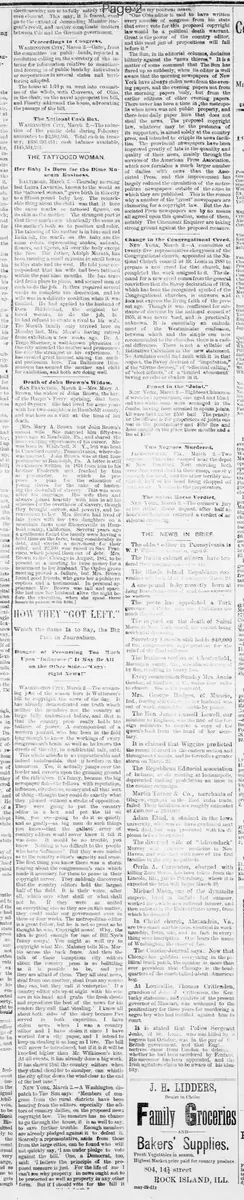
HOW THEY "GOT LEFT."
Which the Same Is to Say, the Big Fish in Journalism.
Danger of Presuming Too Much Upon "Influence:" It May Be All on the Other Side—"Copyright News!"
WASHINGTON CITY, March 2.—The screaming joke of the season here is Watterson's bill to copyright the news of the day. It has already demonstrated one truth which neither the members nor the country at large fully understood before, and that is that the country press really holds the balance of power. A correspondent of a western journal, who has been in the field long enough to know the workings of every congressman's brain as well as he knows the streets of the city, in confidential talk, said:
This whole scheme is so impracticable and indeed indefensible, that it borders on the humorous. Yes, it actually jumps over the border and cavorts upon the grinning ground of the ridiculous. It's funny, because the big newspaper fish—the fellows with reputation, influence, circulation, money and all that sort of thing—thought they could do exactly what they pleased without a stroke of opposition. They were going to put the country editor in a box and put the lid on him, you see—going to do it so quietly and so gently—as big men do such things you know—that the gallant army of country editors would never know it till it was done. It would be no trouble, you know. Nothing is too difficult to the people who have 'influence.' But they were misled as to the country editor's sagacity and sense. The first thing you know there was a storm roaring about the congressmen's ears which made it necessary for them to pause in their copyright career. They suddenly discovered that the country editors held the largest half of the field. It is their voice, after all, which says what shall or what shall not be. If they were as united on everything else as they are on this matter, they could make our government over in three or four weeks. The metropolitan editor is a great fellow, but he is not so great as he thought he was. Copyright news! Why, the idea is good enough for one of Bill Nye's funny essays! You might as well try to copyright what Mrs. Maloney tells Mrs. Martin across the back fence. And then the talk of these bumptious city editors about the country press is as belittling as it is possible to be, and yet they are afraid of them. They all steal news, steal from one another, steal from any source they can, but they call it 'enterprise.' If a country editor sits up at night with his scissors in his hand and grabs the fresh sheet, and reproduces the best of the news for his readers they call that 'stealing.' I know all about both sides of the story because I've served in both capacities. I have stolen news when I was a country editor and I have stolen it since I have worked for a city paper, and I intend to keep on stealing it as long as I live. The bill will never be introduced, but if it is it will be knocked higher than Mr. Wilkinson's kite. At all events, it has already done a big work. It has shown that the country editors when they stand shoulder to shoulder, can whistle the city editor down the wind clear to the end of the last lane.
New York, March 2.—A Washington dispatch to The Sun says: "Members of congress from the rural districts have been hearing from the editors, especially the editors of country dailies, on the proposed news copyright law. The measure has no chance to go through the house, it is as well to say, to save further trouble. Enough members are already pledged against it to defeat it. Scarcely a representative, aside from those from the large cities, can be found who will not quickly say, 'I am under pledge to vote against the bill.' One, a Democrat, too, said: 'I believe the principle of the proposed measure is just. For the life of me I can't see why property in news ought not to be protected as well as property in any other form.
"One Ohio editor is said to have written every member of congress from his state that every vote for this proposed copyright law would be a political death warrant. Great is the power of the country editor, and this most just of propositions will fall before it."
The Sun, in its editorial columns, declaims bitterly against the "news thieves." It is a matter of some comment that The Sun has flared up so suddenly, when its editor is well aware that the morning newspapers of New York have always stolen news from the evening papers, and the evening papers not from the morning papers only, but from the earlier editions of other evening papers. There never has been a time in the metropolis when news was not public property, and there is no daily paper here that does not steal the news.
The proposed copyright law, whatever may be the pretenses of its supporters, is aimed solely at the country press, and intended to cripple its news facilities. The provincial newspapers have been improved greatly of late in the quantity and quality of their news, mainly through the services of the American Press Association, which now furnishes a much larger number of dailies with news than the Associated Press, and this improvement has largely reduced the circulation of the metropolitan newspapers outside of the cities in which they are published. This is the reason why a number of the "great" newspapers are clamoring for a copyright law. But the Associated Press newspapers are by no means all agreed upon this question, some of them, notably The Cincinnati Enquirer are taking strong ground against the proposed measure.
Which the Same Is to Say, the Big Fish in Journalism.
Danger of Presuming Too Much Upon "Influence:" It May Be All on the Other Side—"Copyright News!"
WASHINGTON CITY, March 2.—The screaming joke of the season here is Watterson's bill to copyright the news of the day. It has already demonstrated one truth which neither the members nor the country at large fully understood before, and that is that the country press really holds the balance of power. A correspondent of a western journal, who has been in the field long enough to know the workings of every congressman's brain as well as he knows the streets of the city, in confidential talk, said:
This whole scheme is so impracticable and indeed indefensible, that it borders on the humorous. Yes, it actually jumps over the border and cavorts upon the grinning ground of the ridiculous. It's funny, because the big newspaper fish—the fellows with reputation, influence, circulation, money and all that sort of thing—thought they could do exactly what they pleased without a stroke of opposition. They were going to put the country editor in a box and put the lid on him, you see—going to do it so quietly and so gently—as big men do such things you know—that the gallant army of country editors would never know it till it was done. It would be no trouble, you know. Nothing is too difficult to the people who have 'influence.' But they were misled as to the country editor's sagacity and sense. The first thing you know there was a storm roaring about the congressmen's ears which made it necessary for them to pause in their copyright career. They suddenly discovered that the country editors held the largest half of the field. It is their voice, after all, which says what shall or what shall not be. If they were as united on everything else as they are on this matter, they could make our government over in three or four weeks. The metropolitan editor is a great fellow, but he is not so great as he thought he was. Copyright news! Why, the idea is good enough for one of Bill Nye's funny essays! You might as well try to copyright what Mrs. Maloney tells Mrs. Martin across the back fence. And then the talk of these bumptious city editors about the country press is as belittling as it is possible to be, and yet they are afraid of them. They all steal news, steal from one another, steal from any source they can, but they call it 'enterprise.' If a country editor sits up at night with his scissors in his hand and grabs the fresh sheet, and reproduces the best of the news for his readers they call that 'stealing.' I know all about both sides of the story because I've served in both capacities. I have stolen news when I was a country editor and I have stolen it since I have worked for a city paper, and I intend to keep on stealing it as long as I live. The bill will never be introduced, but if it is it will be knocked higher than Mr. Wilkinson's kite. At all events, it has already done a big work. It has shown that the country editors when they stand shoulder to shoulder, can whistle the city editor down the wind clear to the end of the last lane.
New York, March 2.—A Washington dispatch to The Sun says: "Members of congress from the rural districts have been hearing from the editors, especially the editors of country dailies, on the proposed news copyright law. The measure has no chance to go through the house, it is as well to say, to save further trouble. Enough members are already pledged against it to defeat it. Scarcely a representative, aside from those from the large cities, can be found who will not quickly say, 'I am under pledge to vote against the bill.' One, a Democrat, too, said: 'I believe the principle of the proposed measure is just. For the life of me I can't see why property in news ought not to be protected as well as property in any other form.
"One Ohio editor is said to have written every member of congress from his state that every vote for this proposed copyright law would be a political death warrant. Great is the power of the country editor, and this most just of propositions will fall before it."
The Sun, in its editorial columns, declaims bitterly against the "news thieves." It is a matter of some comment that The Sun has flared up so suddenly, when its editor is well aware that the morning newspapers of New York have always stolen news from the evening papers, and the evening papers not from the morning papers only, but from the earlier editions of other evening papers. There never has been a time in the metropolis when news was not public property, and there is no daily paper here that does not steal the news.
The proposed copyright law, whatever may be the pretenses of its supporters, is aimed solely at the country press, and intended to cripple its news facilities. The provincial newspapers have been improved greatly of late in the quantity and quality of their news, mainly through the services of the American Press Association, which now furnishes a much larger number of dailies with news than the Associated Press, and this improvement has largely reduced the circulation of the metropolitan newspapers outside of the cities in which they are published. This is the reason why a number of the "great" newspapers are clamoring for a copyright law. But the Associated Press newspapers are by no means all agreed upon this question, some of them, notably The Cincinnati Enquirer are taking strong ground against the proposed measure.
What sub-type of article is it?
Historical Event
Curiosity
What themes does it cover?
Triumph
Social Manners
Justice
What keywords are associated?
News Copyright
Country Editors
Press Power
Journalism Controversy
Congress Bill
Associated Press
What entities or persons were involved?
Watterson
Bill Nye
Mr. Wilkinson
Where did it happen?
Washington City, New York
Story Details
Key Persons
Watterson
Bill Nye
Mr. Wilkinson
Location
Washington City, New York
Event Date
March 2
Story Details
Proposed bill by Watterson to copyright daily news faces strong opposition from country editors, revealing their significant influence over Congress and defeating the measure aimed at crippling rural press by big city newspapers.