Thank you for visiting SNEWPapers!
Sign up free
Letter to Editor
September 27, 1839
The Liberator
Boston, Suffolk County, Massachusetts
What is this article about?
Detailed account of a divisive quarterly meeting of the Norfolk County Anti-Slavery Society in Wrentham, highlighting disputes over women's voting rights, biased chairmanship, and resulting split where the majority formed a new society to escape oppression from the old organization's minority.
Clipping
OCR Quality
98%
Excellent
Full Text
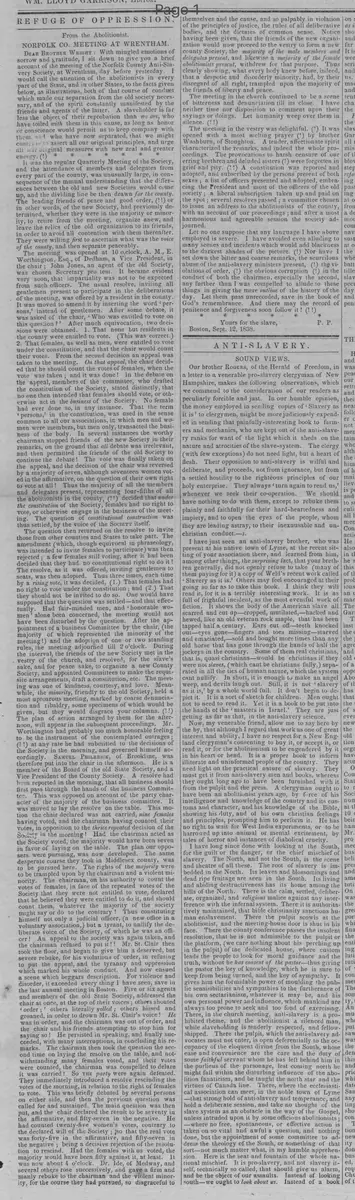
REFUGE OF OPPRESSION.
From the Abolitionist.
NORFOLK CO. MEETING AT WRENTHAM.
Dear Brother Wright: With mingled emotions of sorrow and gratitude, I sit down to give you a brief account of the meeting of the Norfolk County Anti-Slavery Society, at Wrentham, day before yesterday. I would call the attention of the abolitionists in every part of the State, and in other States, to the facts given below, as illustrations, both of that course of conduct which made our separation from the old society necessary, and of the spirit constantly manifested by the friends and agents of the latter. A slaveholder is far less the object of their reprobation than we are, who have toiled with them in this cause, as long as honor or conscience would permit us to keep company with them, and who have now separated, that we might continue to assert all our original principles, and urge all original measures with new zeal and greater energy. (!)
It was the regular Quarterly Meeting of the Society, and the attendance of members and delegates from every part of the county, was unusually large, in consequence of the mutual understanding that the differences between the old and new Societies would come up, and the dividing line be then drawn for the county. The leading friends of peace and good order, (!!) or in other words, of the new Society, had previously determined, whether they were in the majority or minority, to retire from the meeting, organize anew, and leave the relics of the old organization to its friends, in order to avoid all contention with them thereafter. They were willing first to ascertain what was the voice of the county, and then separate peaceably.
The meeting was opened at 10 o'clock, A. M., E. Worthington, Esq., of Dedham, a Vice President, in the chair; John Jones, an agent of the old Society, was chosen Secretary pro tem. It became evident very soon, that impartiality was not to be expected from such officers. The usual resolve, inviting all gentlemen present to participate in the deliberations of the meeting, was offered by a resident in the county. It was moved to amend it by inserting the word 'persons,' instead of gentlemen. After some debate, it was asked of the chair, 'Who was entitled to vote on this question?' After much equivocation, two decisions were obtained. 1. That none but residents in the county were entitled to vote. (This was correct.) 2. That females, as well as men, were entitled to vote under the constitution, and that the chair would count their votes. From the second decision an appeal was taken to the meeting. On that appeal, the chair decided that he should count the votes of females, when the vote was taken; and it was done! In the debate on the appeal, members of the committee, who drafted the constitution of the Society, stated distinctly, that no one then intended that females should vote, or otherwise act in the business of the Society. No female had ever done so, in any instance. That the term 'persons,' in the constitution, was used in the sense common to all our associations, in which men and women were members, but men only, transacted the business of the body. In several instances the worthy chairman stopped friends of the new Society in their remarks, on the ground that all debate was irrelevant, and then permitted the friends of the old Society to continue the debate! The vote was finally taken on the appeal, and the decision of the chair was reversed by a majority of seven, although seventeen women voted in the affirmative, on the question of their own right to vote at all! Thus the majority of all the members and delegates present, representing four-fifths of all the abolitionists in the county. (!!) decided that under the constitution of the Society, females had no right to vote, or otherwise engage in the business of the meeting. The question of constitutional construction was thus settled, by the voice of the Society itself.
The question then returned on the resolve to invite those from other counties and States to take part. The amendment (which, though equivocal in phraseology, was intended to invite females to participate) was then rejected; a few females still voting, after it had been decided that they had no constitutional right to do it! The resolve, as it was offered, inviting gentlemen to seats, was then adopted. Thus three times, each time by a rising vote, it was decided, (1.) That females had no right to vote under the constitution; and (2.) That they should not be invited to do so. One would have supposed that the question was settled—and that effectually. Had fair-minded men, and 'honorable women' alone been concerned, the meeting would not have been disturbed by the question. After the appointment of a business Committee by the chair, (the majority of which represented the minority of the meeting!) and the adoption of one or two standing rules, the meeting adjourned till 2 o'clock. During the interval, the friends of the new Society met in the vestry of the church, and resolved, for the slave's sake, and for peace sake, to organize a new County Society, and appointed Committees to make the requisite arrangements, draft a constitution, etc. The meeting was one of kindness, courtesy, and love. Meanwhile, the minority, friendly to the old Society, held a most uproarious meeting, marked by coarse denunciation and ribaldry, some specimens of which would be given, but they would disgrace your columns. (!!) The plan of action arranged by them for the afternoon, will appear in the subsequent proceedings. Mr. Worthington had probably too much honorable feeling to be the instrument of the contemplated outrages; (!!) at any rate he had submitted to the decisions of the Society in the morning, and governed himself accordingly. Samuel Philbrick, of Brookline, was therefore put into the chair in the afternoon. He is a member of the Board of the old State Society, and a Vice President of the County Society. A resolve had been reported in the morning, that all business should first pass through the hands of the business Committee. This was opposed on account of the party character of the majority of the business committee. It was moved to lay the resolve on the table. This motion the chair declared was not carried, nine females having voted, and the chairman having counted their votes, in opposition to the thrice repeated decision of the Society in the morning! Had the chairman acted as the Society voted, the majority would have been seven in favor of laying on the table. The plan our opposers were pursuing, was now developed. The same desperate course they took in Middlesex county, was to be pursued here. The rights of the majority were to be trampled upon by the chairman and a violent minority. The chairman, on his authority to count the votes of females, in face of the repeated votes of the Society that they were not entitled to vote, declared that he believed they were entitled to do it, and should count them, whatever the majority of the society might say or do to the contrary! Thus constituting himself not only a judicial officer, (a new office in a voluntary association,) but a tyrant, to nullify the deliberate voice of the Society, of which he was an officer! An appeal to the society was again taken, and the chairman refused to put it!! Mr. St. Clair then took the floor, and began to give him a deserved, but severe rebuke, for his violations of order, in refusing to put the appeal, and the tyranny and oppression which marked his whole conduct. And now ensued a scene which beggars description. For violence and disorder, it exceeded every thing I have seen, save in the last annual meeting in Boston. Five or six agents and members of the old State Society, addressed the chair at once, at the top of their voices; others shouted 'order;' others literally yelled; others hissed and groaned, in order to drown Mr. St. Clair's voice! He was in order, and the chairman was out of order, and the chair and his friends attempting to stop him for saying so! He persisted in speaking, and finally succeeded, with many interruptions, in concluding his remarks. The chairman then took the question the second time on laying the resolve on the table, and notwithstanding many females voted, and their votes were counted, the chairman was compelled to declare it was carried! So the party were again defeated. They immediately introduced a resolve rescinding the votes of the morning, in relation to the right of females to vote. This was briefly debated by several persons on either side, and then the previous question was called for and sustained. The main question was then put, and the chair declared the result to be seventy in the affirmative, and fifty-seven in the negative. He had counted twenty-five women's votes, contrary to the declared will of the Society; so that the real vote was forty-five in the affirmative, and fifty-seven in the negative; being a decisive rejection of the resolution to rescind. Had the females with us voted, the majority would have been fifty against it, at least. It was now about 4 o'clock. Dr. Ide, of Medway, and several others rose successively, and gave a firm and manly rebuke to the chairman and the violent minority, for the course they had pursued, so disgraceful to themselves and the cause, and so palpably in violation of the principles of justice, the rules of all deliberative bodies, and the dictates of common sense. Notice having been given, that the friends of the new organization would now proceed to the vestry to form a new county Society, the majority of the male members and delegates present, and likewise a majority of the female abolitionists present, withdrew for that purpose. Thus clearly showing, what every body knew before, indeed, that a despotic and disorderly minority, had, by their disregard of all right, trampled upon the majority of the friends of liberty and peace.
The meeting in the church continued to be a scene of bitterness and denunciation till its close. I have neither time nor disposition to comment upon their sayings or doings. Let humanity weep over them in silence. (!!)
From the Abolitionist.
NORFOLK CO. MEETING AT WRENTHAM.
Dear Brother Wright: With mingled emotions of sorrow and gratitude, I sit down to give you a brief account of the meeting of the Norfolk County Anti-Slavery Society, at Wrentham, day before yesterday. I would call the attention of the abolitionists in every part of the State, and in other States, to the facts given below, as illustrations, both of that course of conduct which made our separation from the old society necessary, and of the spirit constantly manifested by the friends and agents of the latter. A slaveholder is far less the object of their reprobation than we are, who have toiled with them in this cause, as long as honor or conscience would permit us to keep company with them, and who have now separated, that we might continue to assert all our original principles, and urge all original measures with new zeal and greater energy. (!)
It was the regular Quarterly Meeting of the Society, and the attendance of members and delegates from every part of the county, was unusually large, in consequence of the mutual understanding that the differences between the old and new Societies would come up, and the dividing line be then drawn for the county. The leading friends of peace and good order, (!!) or in other words, of the new Society, had previously determined, whether they were in the majority or minority, to retire from the meeting, organize anew, and leave the relics of the old organization to its friends, in order to avoid all contention with them thereafter. They were willing first to ascertain what was the voice of the county, and then separate peaceably.
The meeting was opened at 10 o'clock, A. M., E. Worthington, Esq., of Dedham, a Vice President, in the chair; John Jones, an agent of the old Society, was chosen Secretary pro tem. It became evident very soon, that impartiality was not to be expected from such officers. The usual resolve, inviting all gentlemen present to participate in the deliberations of the meeting, was offered by a resident in the county. It was moved to amend it by inserting the word 'persons,' instead of gentlemen. After some debate, it was asked of the chair, 'Who was entitled to vote on this question?' After much equivocation, two decisions were obtained. 1. That none but residents in the county were entitled to vote. (This was correct.) 2. That females, as well as men, were entitled to vote under the constitution, and that the chair would count their votes. From the second decision an appeal was taken to the meeting. On that appeal, the chair decided that he should count the votes of females, when the vote was taken; and it was done! In the debate on the appeal, members of the committee, who drafted the constitution of the Society, stated distinctly, that no one then intended that females should vote, or otherwise act in the business of the Society. No female had ever done so, in any instance. That the term 'persons,' in the constitution, was used in the sense common to all our associations, in which men and women were members, but men only, transacted the business of the body. In several instances the worthy chairman stopped friends of the new Society in their remarks, on the ground that all debate was irrelevant, and then permitted the friends of the old Society to continue the debate! The vote was finally taken on the appeal, and the decision of the chair was reversed by a majority of seven, although seventeen women voted in the affirmative, on the question of their own right to vote at all! Thus the majority of all the members and delegates present, representing four-fifths of all the abolitionists in the county. (!!) decided that under the constitution of the Society, females had no right to vote, or otherwise engage in the business of the meeting. The question of constitutional construction was thus settled, by the voice of the Society itself.
The question then returned on the resolve to invite those from other counties and States to take part. The amendment (which, though equivocal in phraseology, was intended to invite females to participate) was then rejected; a few females still voting, after it had been decided that they had no constitutional right to do it! The resolve, as it was offered, inviting gentlemen to seats, was then adopted. Thus three times, each time by a rising vote, it was decided, (1.) That females had no right to vote under the constitution; and (2.) That they should not be invited to do so. One would have supposed that the question was settled—and that effectually. Had fair-minded men, and 'honorable women' alone been concerned, the meeting would not have been disturbed by the question. After the appointment of a business Committee by the chair, (the majority of which represented the minority of the meeting!) and the adoption of one or two standing rules, the meeting adjourned till 2 o'clock. During the interval, the friends of the new Society met in the vestry of the church, and resolved, for the slave's sake, and for peace sake, to organize a new County Society, and appointed Committees to make the requisite arrangements, draft a constitution, etc. The meeting was one of kindness, courtesy, and love. Meanwhile, the minority, friendly to the old Society, held a most uproarious meeting, marked by coarse denunciation and ribaldry, some specimens of which would be given, but they would disgrace your columns. (!!) The plan of action arranged by them for the afternoon, will appear in the subsequent proceedings. Mr. Worthington had probably too much honorable feeling to be the instrument of the contemplated outrages; (!!) at any rate he had submitted to the decisions of the Society in the morning, and governed himself accordingly. Samuel Philbrick, of Brookline, was therefore put into the chair in the afternoon. He is a member of the Board of the old State Society, and a Vice President of the County Society. A resolve had been reported in the morning, that all business should first pass through the hands of the business Committee. This was opposed on account of the party character of the majority of the business committee. It was moved to lay the resolve on the table. This motion the chair declared was not carried, nine females having voted, and the chairman having counted their votes, in opposition to the thrice repeated decision of the Society in the morning! Had the chairman acted as the Society voted, the majority would have been seven in favor of laying on the table. The plan our opposers were pursuing, was now developed. The same desperate course they took in Middlesex county, was to be pursued here. The rights of the majority were to be trampled upon by the chairman and a violent minority. The chairman, on his authority to count the votes of females, in face of the repeated votes of the Society that they were not entitled to vote, declared that he believed they were entitled to do it, and should count them, whatever the majority of the society might say or do to the contrary! Thus constituting himself not only a judicial officer, (a new office in a voluntary association,) but a tyrant, to nullify the deliberate voice of the Society, of which he was an officer! An appeal to the society was again taken, and the chairman refused to put it!! Mr. St. Clair then took the floor, and began to give him a deserved, but severe rebuke, for his violations of order, in refusing to put the appeal, and the tyranny and oppression which marked his whole conduct. And now ensued a scene which beggars description. For violence and disorder, it exceeded every thing I have seen, save in the last annual meeting in Boston. Five or six agents and members of the old State Society, addressed the chair at once, at the top of their voices; others shouted 'order;' others literally yelled; others hissed and groaned, in order to drown Mr. St. Clair's voice! He was in order, and the chairman was out of order, and the chair and his friends attempting to stop him for saying so! He persisted in speaking, and finally succeeded, with many interruptions, in concluding his remarks. The chairman then took the question the second time on laying the resolve on the table, and notwithstanding many females voted, and their votes were counted, the chairman was compelled to declare it was carried! So the party were again defeated. They immediately introduced a resolve rescinding the votes of the morning, in relation to the right of females to vote. This was briefly debated by several persons on either side, and then the previous question was called for and sustained. The main question was then put, and the chair declared the result to be seventy in the affirmative, and fifty-seven in the negative. He had counted twenty-five women's votes, contrary to the declared will of the Society; so that the real vote was forty-five in the affirmative, and fifty-seven in the negative; being a decisive rejection of the resolution to rescind. Had the females with us voted, the majority would have been fifty against it, at least. It was now about 4 o'clock. Dr. Ide, of Medway, and several others rose successively, and gave a firm and manly rebuke to the chairman and the violent minority, for the course they had pursued, so disgraceful to themselves and the cause, and so palpably in violation of the principles of justice, the rules of all deliberative bodies, and the dictates of common sense. Notice having been given, that the friends of the new organization would now proceed to the vestry to form a new county Society, the majority of the male members and delegates present, and likewise a majority of the female abolitionists present, withdrew for that purpose. Thus clearly showing, what every body knew before, indeed, that a despotic and disorderly minority, had, by their disregard of all right, trampled upon the majority of the friends of liberty and peace.
The meeting in the church continued to be a scene of bitterness and denunciation till its close. I have neither time nor disposition to comment upon their sayings or doings. Let humanity weep over them in silence. (!!)
What sub-type of article is it?
Persuasive
Emotional
Investigative
What themes does it cover?
Slavery Abolition
Feminism
Politics
What keywords are associated?
Norfolk County
Anti Slavery Society
Wrentham Meeting
Women Voting Rights
Society Split
Abolitionist Separation
Procedural Tyranny
What entities or persons were involved?
Brother Wright
Letter to Editor Details
Recipient
Brother Wright
Main Argument
the old anti-slavery society's leadership and minority exhibited tyrannical behavior by ignoring majority votes on women's rights and procedural fairness, justifying the separation and formation of a new society to uphold original principles without contention.
Notable Details
Debate On Women's Voting Rights Under Constitution
Chairman Counted Female Votes Despite Reversals
Formation Of New Norfolk County Anti Slavery Society
Chaotic Scene With Shouting And Disorder
References To Similar Events In Middlesex County And Boston