Thank you for visiting SNEWPapers!
Sign up free
Americus Times Recorder
Americus, Sumter County, Georgia
What is this article about?
In Paris on May 12, women have taken over 32% of men's jobs in street sweeping, subways, elevators, trolleys, and telegraphs due to war mobilization. Servants face high unemployment, while demand for low-skill office roles outstrips supply, boosting wages; skilled workers struggle amid retrenchment.
Clipping
OCR Quality
Full Text
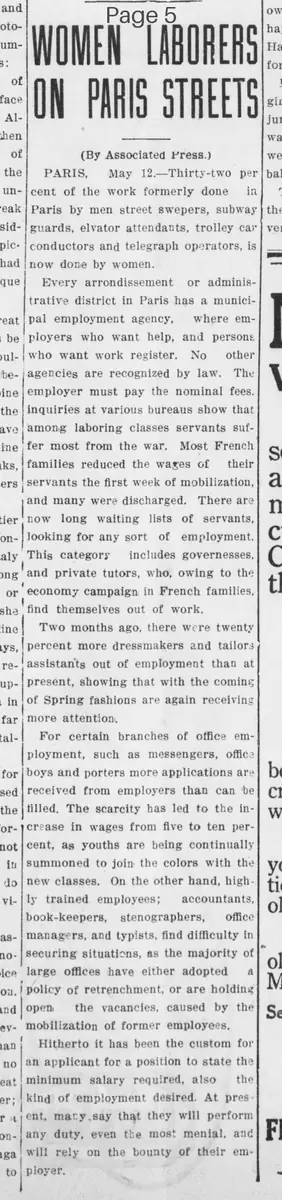
(By Associated Press.)
PARIS, May 12.-Thirty-two per cent of the work formerly done in Paris by men street sweepers, subway guards, elevator attendants, trolley car conductors and telegraph operators, is now done by women.
Every arrondissement or administrative district in Paris has a municipal employment agency, where employers who want help, and persons who want work register. No other agencies are recognized by law. The employer must pay the nominal fees. Inquiries at various bureaus show that among laboring classes servants suffer most from the war. Most French families reduced the wages of their servants the first week of mobilization, and many were discharged. There are now long waiting lists of servants looking for any sort of employment. This category includes governesses, and private tutors, who, owing to the economy campaign in French families find themselves out of work. Two months ago, there were twenty percent more dressmakers and tailors assistants out of employment than at present, showing that with the coming of Spring fashions are again receiving more attention.
For certain branches of office employment, such as messengers, office boys and porters more applications are received from employers than can be filled. The scarcity has led to the increase in wages from five to ten per cent, as youths are being continually summoned to join the colors with the new classes. On the other hand, highly trained employees; accountants, book-keepers, stenographers, office managers, and typists, find difficulty in securing situations, as the majority of large offices have either adopted a policy of retrenchment, or are holding open the vacancies, caused by the mobilization of former employees.
Hitherto it has been the custom for an applicant for a position to state the minimum salary required, also the kind of employment desired. At present, many say that they will perform any duty, even the most menial, and will rely on the bounty of their employer.
What sub-type of article is it?
What keywords are associated?
Where did it happen?
Foreign News Details
Primary Location
Paris
Event Date
May 12
Outcome
women now perform 32% of work previously done by men in roles like street sweepers, subway guards, elevator attendants, trolley car conductors, and telegraph operators. servants face high unemployment; dressmakers and tailors assistants have seen reduced unemployment with spring fashions. demand exceeds supply for messengers, office boys, and porters, leading to 5-10% wage increases. highly trained office employees struggle to find positions due to retrenchment and held vacancies.
Event Details
In Paris, municipal employment agencies handle job registrations for employers and workers. Among laboring classes, servants, including governesses and tutors, suffer most from the war, with many discharged and long waiting lists for any employment. Two months ago, 20% more dressmakers and tailors assistants were unemployed, but numbers have decreased. For certain office roles like messengers and porters, more employer applications than available workers, causing wage hikes as youths are mobilized. Highly trained employees like accountants and stenographers face difficulties due to office retrenchment or held vacancies. Applicants now accept any menial duties, relying on employer bounty.