Thank you for visiting SNEWPapers!
Sign up free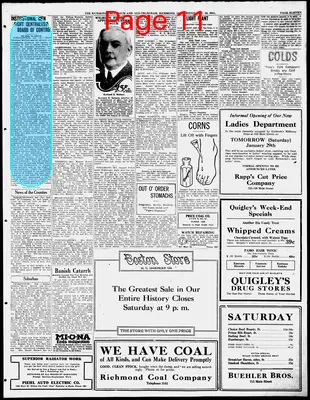
Story
January 28, 1921
The Richmond Palladium And Sun Telegram
Richmond, Wayne County, Indiana
What is this article about?
In Indiana, institutional leaders oppose a proposed central board of control for state benevolent, correctional, and penal institutions, arguing it would politicize management and undermine the current non-partisan, humanitarian local boards, as Governor McCray remains open-minded.
Clipping
OCR Quality
98%
Excellent
Full Text
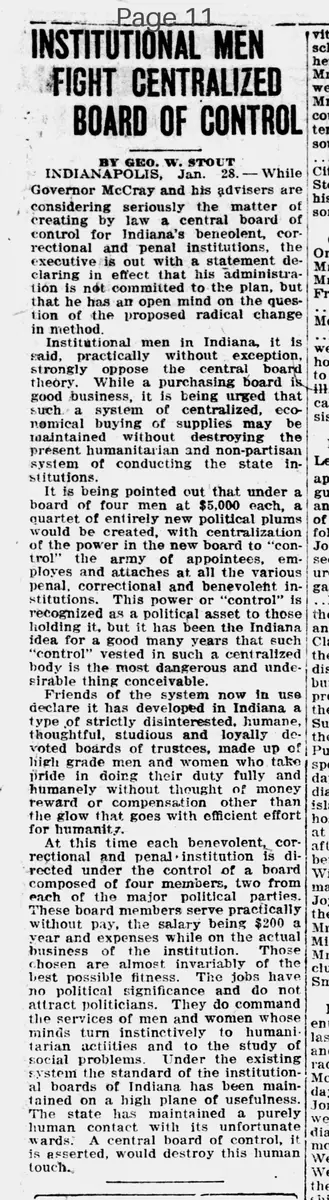
INSTITUTIONAL MEN
FIGHT CENTRALIZED
BOARD OF CONTROL
BY GEO. W. STOUT
INDIANAPOLIS, Jan. 28. -- While Governor McCray and his advisers are considering seriously the matter of creating by law a central board of control for Indiana's benevolent, correctional and penal institutions, the executive is out with a statement declaring in effect that his administration is not committed to the plan, but that he has an open mind on the question of the proposed radical change in method.
Institutional men in Indiana, it is said, practically without exception strongly oppose the central board theory. While a purchasing board is good business, it is being urged that such a system of centralized, economical buying of supplies may be maintained without destroying the present humanitarian and non-partisan system of conducting the state institutions.
It is being pointed out that under a board of four men at $5,000 each, a quartet of entirely new political plums would be created, with centralization of the power in the new board to "control" the army of appointees, employees and attaches at all the various penal, correctional and benevolent institutions. This power or "control" is recognized as a political asset to those holding it, but it has been the Indiana idea for a good many years that such "control" vested in such a centralized body is the most dangerous and undesirable thing conceivable.
Friends of the system now in use declare it has developed in Indiana a type of strictly disinterested, humane, thoughtful, studious and loyally devoted boards of trustees, made up of high grade men and women who take pride in doing their duty fully and humanely without thought of money reward or compensation other than the glow that goes with efficient effort for humanity.
At this time each benevolent, correctional and penal institution is directed under the control of a board composed of four members, two from each of the major political parties. These board members serve practically without pay, the salary being $200 a year and expenses while on the actual business of the institution. Those chosen are almost invariably of the best possible fitness. The jobs have no political significance and do not attract politicians. They do command the services of men and women whose minds turn instinctively to humanitarian activities and to the study of social problems. Under the existing system the standard of the institutional boards of Indiana has been maintained on a high plane of usefulness. The state has maintained a purely human contact with its unfortunate wards. A central board of control, it is asserted, would destroy this human touch.
FIGHT CENTRALIZED
BOARD OF CONTROL
BY GEO. W. STOUT
INDIANAPOLIS, Jan. 28. -- While Governor McCray and his advisers are considering seriously the matter of creating by law a central board of control for Indiana's benevolent, correctional and penal institutions, the executive is out with a statement declaring in effect that his administration is not committed to the plan, but that he has an open mind on the question of the proposed radical change in method.
Institutional men in Indiana, it is said, practically without exception strongly oppose the central board theory. While a purchasing board is good business, it is being urged that such a system of centralized, economical buying of supplies may be maintained without destroying the present humanitarian and non-partisan system of conducting the state institutions.
It is being pointed out that under a board of four men at $5,000 each, a quartet of entirely new political plums would be created, with centralization of the power in the new board to "control" the army of appointees, employees and attaches at all the various penal, correctional and benevolent institutions. This power or "control" is recognized as a political asset to those holding it, but it has been the Indiana idea for a good many years that such "control" vested in such a centralized body is the most dangerous and undesirable thing conceivable.
Friends of the system now in use declare it has developed in Indiana a type of strictly disinterested, humane, thoughtful, studious and loyally devoted boards of trustees, made up of high grade men and women who take pride in doing their duty fully and humanely without thought of money reward or compensation other than the glow that goes with efficient effort for humanity.
At this time each benevolent, correctional and penal institution is directed under the control of a board composed of four members, two from each of the major political parties. These board members serve practically without pay, the salary being $200 a year and expenses while on the actual business of the institution. Those chosen are almost invariably of the best possible fitness. The jobs have no political significance and do not attract politicians. They do command the services of men and women whose minds turn instinctively to humanitarian activities and to the study of social problems. Under the existing system the standard of the institutional boards of Indiana has been maintained on a high plane of usefulness. The state has maintained a purely human contact with its unfortunate wards. A central board of control, it is asserted, would destroy this human touch.
What sub-type of article is it?
Historical Event
What themes does it cover?
Justice
Moral Virtue
What keywords are associated?
Central Board
Institutional Control
Indiana Governance
Political Opposition
Humanitarian System
What entities or persons were involved?
Governor Mccray
Geo. W. Stout
Where did it happen?
Indiana, Indianapolis
Story Details
Key Persons
Governor Mccray
Geo. W. Stout
Location
Indiana, Indianapolis
Event Date
Jan. 28
Story Details
Institutional leaders in Indiana oppose Governor McCray's consideration of a central board of control for state institutions, arguing it would create political plums and destroy the current non-partisan, humanitarian system of local boards.