Thank you for visiting SNEWPapers!
Sign up free
Editorial
June 3, 1848
Wisconsin Herald
Lancaster, Grant County, Wisconsin
What is this article about?
Endorsement of Philadelphia North American's remarks supporting federal internal improvements for the West, criticizing Southern Locofocoism, President Polk, and Mr. Calhoun's opposition as unconstitutional dogma, amid Senate debate on Mr. Douglas's Illinois railroad land grant bill.
Clipping
OCR Quality
98%
Excellent
Full Text
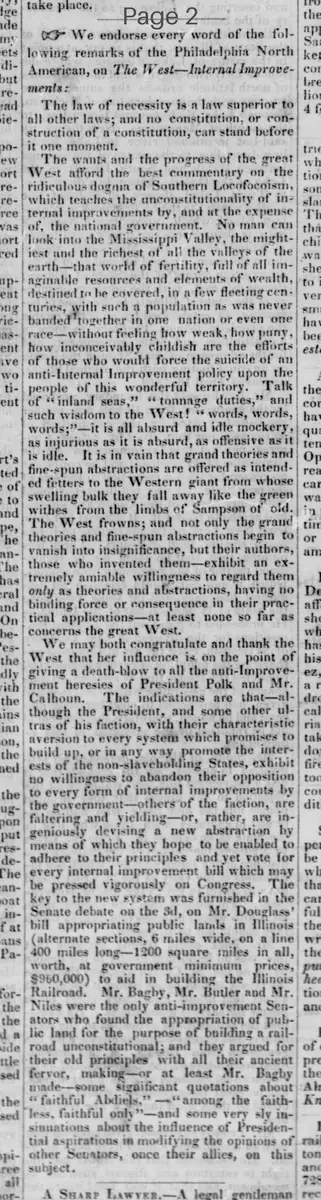
We endorse every word of the following remarks of the Philadelphia North American, on The West-Internal Improvements:
The law of necessity is a law superior to all other laws: and no constitution, or construction of a constitution, can stand before it one moment.
The wants and the progress of the great West afford the best commentary on the ridiculous dogma of Southern Locofocoism, which teaches the unconstitutionality of internal improvements by, and at the expense of. the national government. No man can look into the Mississippi Valley, the mightiest and the richest of all the valleys of the earth-that world of fertility, full of all imaginable resources and elements of wealth. destined to be covered, in a few fleeting centuries. with such a population as was never banded together in one nation or even one race—without feeling how weak, how puny. how inconceivably childish are the efforts of those who would force the suicide of an anti-Internal Improvement policy upon the people of this wonderful territory. Talk of "inland seas." "tonnage duties," and such wisdom to the West! "words. words. words;"—it is all absurd and idle mockery, as injurious as it is absurd, as offensive as it is idle. It is in vain that grand theories and fine-spun abstractions are offered as intended fetters to the Western giant from whose swelling bulk they fall away like the green withes from the limbs of Sampson of old.
The West frowns: and not only the grand theories and fine-spun abstractions begin to vanish into insignificance, but their authors. those who invented them--exhibit an extremely amiable willingness to regard them only as theories and abstractions, having no binding force or consequence in their practical applications-at least none so far as concerns the great West.
We may both congratulate and thank the West that her influence is on the point of giving a death-blow to all the anti-Improvement heresies of President Polk and Mr. Calhoun. The indications are that—although the President, and some other ultras of his faction, with their characteristic aversion to every system which promises to build up, or in any way promote the interests of the non-slaveholding States, exhibit no willingness to abandon their opposition to every form of internal improvements by the government--others of the faction, are faltering and yielding-or, rather, are ingeniously devising a new abstraction by means of which they hope to be enabled to adhere to their principles and yet vote for every internal improvement bill which may be pressed vigorously on Congress. The key to the new system was furnished in the Senate debate on the 3d, on Mr. Douglas bill appropriating public lands in Illinois (alternate sections, 6 miles wide, on a line 400 miles long-1200 square miles in all, worth, at government minimum prices, $960,000) to aid in building the Illinois Railroad. Mr. Bagby, Mr. Butler and Mr Niles were the only anti-improvement Senators who found the appropriation of public land for the purpose of building a railroad unconstitutional; and they argued for their old principles with all their ancient fervor, making—or at least Mr. Bagby made--some significant quotations about "faithful Abdiels," -"among the faithless, faithful only"—and some very sly insinuations about the influence of Presidential aspirations in modifying the opinions of other Senators, once their allies, on this subject.
The law of necessity is a law superior to all other laws: and no constitution, or construction of a constitution, can stand before it one moment.
The wants and the progress of the great West afford the best commentary on the ridiculous dogma of Southern Locofocoism, which teaches the unconstitutionality of internal improvements by, and at the expense of. the national government. No man can look into the Mississippi Valley, the mightiest and the richest of all the valleys of the earth-that world of fertility, full of all imaginable resources and elements of wealth. destined to be covered, in a few fleeting centuries. with such a population as was never banded together in one nation or even one race—without feeling how weak, how puny. how inconceivably childish are the efforts of those who would force the suicide of an anti-Internal Improvement policy upon the people of this wonderful territory. Talk of "inland seas." "tonnage duties," and such wisdom to the West! "words. words. words;"—it is all absurd and idle mockery, as injurious as it is absurd, as offensive as it is idle. It is in vain that grand theories and fine-spun abstractions are offered as intended fetters to the Western giant from whose swelling bulk they fall away like the green withes from the limbs of Sampson of old.
The West frowns: and not only the grand theories and fine-spun abstractions begin to vanish into insignificance, but their authors. those who invented them--exhibit an extremely amiable willingness to regard them only as theories and abstractions, having no binding force or consequence in their practical applications-at least none so far as concerns the great West.
We may both congratulate and thank the West that her influence is on the point of giving a death-blow to all the anti-Improvement heresies of President Polk and Mr. Calhoun. The indications are that—although the President, and some other ultras of his faction, with their characteristic aversion to every system which promises to build up, or in any way promote the interests of the non-slaveholding States, exhibit no willingness to abandon their opposition to every form of internal improvements by the government--others of the faction, are faltering and yielding-or, rather, are ingeniously devising a new abstraction by means of which they hope to be enabled to adhere to their principles and yet vote for every internal improvement bill which may be pressed vigorously on Congress. The key to the new system was furnished in the Senate debate on the 3d, on Mr. Douglas bill appropriating public lands in Illinois (alternate sections, 6 miles wide, on a line 400 miles long-1200 square miles in all, worth, at government minimum prices, $960,000) to aid in building the Illinois Railroad. Mr. Bagby, Mr. Butler and Mr Niles were the only anti-improvement Senators who found the appropriation of public land for the purpose of building a railroad unconstitutional; and they argued for their old principles with all their ancient fervor, making—or at least Mr. Bagby made--some significant quotations about "faithful Abdiels," -"among the faithless, faithful only"—and some very sly insinuations about the influence of Presidential aspirations in modifying the opinions of other Senators, once their allies, on this subject.
What sub-type of article is it?
Infrastructure
Partisan Politics
What keywords are associated?
Internal Improvements
West
Locofocoism
Constitutionality
Polk
Calhoun
Douglas Bill
Illinois Railroad
Senate Debate
What entities or persons were involved?
Philadelphia North American
Southern Locofocoism
President Polk
Mr. Calhoun
Mr. Douglas
Mr. Bagby
Mr. Butler
Mr. Niles
Editorial Details
Primary Topic
Support For Federal Internal Improvements In The West
Stance / Tone
Strongly Pro Internal Improvements, Critical Of Anti Improvement Faction
Key Figures
Philadelphia North American
Southern Locofocoism
President Polk
Mr. Calhoun
Mr. Douglas
Mr. Bagby
Mr. Butler
Mr. Niles
Key Arguments
Law Of Necessity Supersedes Constitutional Restrictions On Internal Improvements
West's Progress Exposes Unconstitutionality Dogma As Ridiculous
Opposition To Improvements Is Childish And Suicidal For The Fertile Mississippi Valley
Theories Like Inland Seas And Tonnage Duties Are Absurd Mockery To The West
Western Influence Will Defeat Anti Improvement Heresies Of Polk And Calhoun
Polk's Faction Opposes Improvements Benefiting Non Slaveholding States
Some Faction Members Falter And Devise New Abstractions To Support Bills
Senate Debate On Douglas's Illinois Railroad Land Grant Bill Highlights Shifting Positions
Only Bagby, Butler, And Niles Firmly Oppose The Land Appropriation As Unconstitutional