Thank you for visiting SNEWPapers!
Sign up free
Martinsburg Gazette And Public Advertiser
Martinsburg, Berkeley County, West Virginia
What is this article about?
Article details political violence and intimidation in U.S. Congress during Andrew Jackson's presidency, including assassination attempts by Jackson supporters like Houston and Heard on members such as Stanbery and Arnold, amid debates on House privileges and Jackson's alleged encouragement of such acts.
Clipping
OCR Quality
Full Text
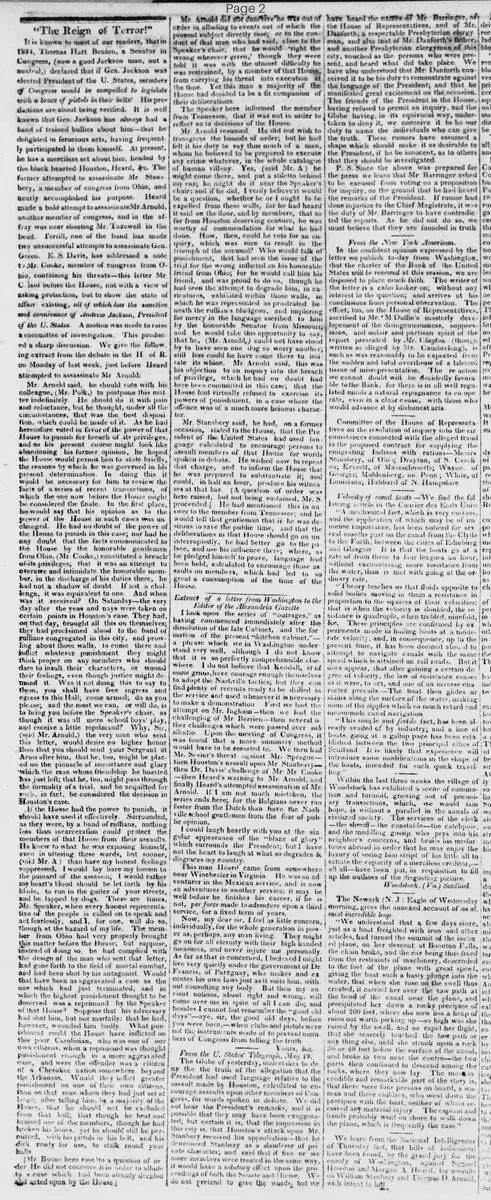
It is known to most of our readers, that in 1824, Thomas Hart Benton, a Senator in Congress, (now a good Jackson man, not a neutral,) declared that if Gen. Jackson was elected President of the U. States, members of Congress would be compelled to legislate with a brace of pistols in their belts! His predictions are about being verified. It is well known that Gen. Jackson has always had a band of trained bullies about him—that he delighted in ferocious acts, having frequently participated in them himself. At present, he has a merciless set about him, headed by the black-hearted Houston, Heard, &c. The former attempted to assassinate Mr. Stanbery, a member of Congress from Ohio, and nearly accomplished his purpose. Heard made a bold attempt to assassinate Mr. Arnold, another member of Congress, and in the affray was near shooting Mr. Tazewell in the head. Terrill, one of the band, has made two unsuccessful attempts to assassinate Gen. Green. E. S. Davis, has addressed a note to Mr. Cooke, member of Congress from Ohio, containing his threats—this letter Mr. C. laid before the House, not with a view of asking protection, but to show the state of affairs existing, all of which has the sanction and connivance of Andrew Jackson, President of the U. States. A motion was made to raise a committee of investigation. This produced a sharp discussion. We give the following extract from the debate in the H. of R. on Monday of last week, just before Heard attempted to assassinate Mr. Arnold:
Mr. Arnold said, he should vote with his colleague, (Mr. Polk,) to postpone this matter indefinitely. He should do it with pain and reluctance, but he thought, under all the circumstances, that was the best disposition which could be made of it. As he had heretofore voted in favor of the power of that House to punish for breach of its privileges, and as his present course might look like abandoning his former opinion, he hoped the House would permit him to state briefly, the reasons by which he was governed in his present determination. In doing this it would be necessary for him to review the facts of a series of recent transactions, of which the one now before the House might be considered the finale. In the first place, he would say that his opinion as to the power of the House in such cases was unchanged. He had no doubt of the power of the House to punish in this case; nor had he any doubt that the facts communicated to the House by the honorable gentleman from Ohio, (Mr. Cooke,) constituted a breach of its privileges; that it was an attempt to overawe and intimidate the honorable member, in the discharge of his duties there. He had not a shadow of doubt. If not a challenge, it was equivalent to one. And when was it received? On Saturday—the very day after the yeas and nays were taken on certain points in Houston's case. They had, on that day, brought all this on themselves; they had proclaimed aloud to the band of ruffians congregated in this city, and prowling about those walls, to come there and inflict whatever punishment they might think proper on any members who should dare to insult their characters, or wound their feelings, even though justice might demand it. Was it not doing this to say to them, you shall have free ingress and egress to this Hall; come armed; do as you please; and the most we can, or will do, is to bring you before the Speaker's chair, as though it was all mere school boys' play, and receive a little reprimand? Why, Sir, (said Mr. Arnold,) the very man who sent this letter, would desire no higher honor than that you should send your Sergeant-at-Arms after him, that he, too, might be placed on the pinnacle of importance and glory which the man whose friendship he boasted has just left; that he, too, might pass through the formality of a trial, and be acquitted for such, in fact, be considered the decision in Houston's case.
If the House had the power to punish, it should have used it effectively. Surrounded, as they were, by a band of ruffians, nothing less than incarceration could protect the members of that House from their assaults. He knew to what he was exposing himself, even in uttering these words, but sooner, (said Mr. A.) than have my honest feelings suppressed, I would lay bare my bosom to the poinard of the assassin; I would rather my heart's blood should be let forth by his blade, to run in the gutter of your streets, and be lapped by dogs. These are times, Mr. Speaker, when every honest representative of the people is called on to speak and act fearlessly, and, for one, will do so, though at the hazard of my life. The member from Ohio had very properly brought this matter before the House; but suppose, instead of doing so, he had complied with the design of the man who sent that letter, had gone forth to the field of mortal-combat, and had been shot by his antagonist? Would that have been as aggravated a case as the one which had just terminated, and in which the highest punishment thought to be deserved was a reprimand by the Speaker of that House? Suppose that his adversary had shot him, but not mortally: that he had, however, wounded him badly. What punishment could the House have inflicted on this poor Carolinian, who was one of our own citizens, when a reprimand was thought punishment enough in a more aggravated case, and were the offender was a citizen of a Cherokee nation somewhere beyond the Arkansas. Would they inflict greater punishment on one of their own citizens, than on that man whom they had just set at large; after telling him, by a majority of the House, that he should not be excluded from that hall; that though he beat and bruised one of the members, though he had broken his bones, yet he should still be permitted, with his pistols in his belt, and his dirk ready for use, to stalk round your halls?
[Mr. Boone here rose to a question of order. He did not conceive it in order to allude to a case which had been already decided and acted upon by the House.]
Mr. Arnold did not conceive he was out of order in alluding to events out of which the present subject directly rose; or to the conduct of that man who had said, close to the Speaker's chair, that he would right the wrong wherever given, though they were told it was with the utmost difficulty he was restrained, by a member of that House, from carrying his threat into execution at the time. Yet this man a majority of the House had decided to be a fit companion of their deliberations.
The Speaker here informed the member from Tennessee, that it was not in order to reflect on the decisions of the House.
Mr. Arnold resumed. He did not wish to transgress the bounds of order; but he had felt it his duty to say thus much of a man, whom he believed to be prepared to execute any crime whatever, in the whole catalogue of human villany. Yes, (said Mr. A.) he might come there, and put a stiletto behind my ear; he might do it near the Speaker's chair; and if he did, I verily believe it would be a question, whether he or I ought to be expelled from these walls, for he had heard it said on the floor, and by members, that so far from Houston deserving censure, he was worthy of commendation for what he had done. "How, then, could he vote for an inquiry, which was sure to result in the triumph of the accused? Who would talk of punishment, that had seen the issue of the trial for the wrong inflicted on his honorable friend from Ohio; for he would call him his friend, and was proud to do so, though he had seen the attempt to degrade him, in caricatures, exhibited within those walls, in which he was represented as prostrated beneath the ruffian's bludgeon, and imploring for mercy in the language ascribed to him by the honorable Senator from Missouri; and he would take this opportunity to say, that he, (Mr. Arnold,) could not have stood by to have seen one dog so worry another; still less could he have come there to imitate its whine. Mr. Arnold said, this was his objection to an inquiry into the breach of privilege, which he had no doubt had here been committed in this case; that the House had virtually refused to exercise its powers of punishment, in a case where the offence was of a much more heinous character.
Mr. Stanbery said, he had, on a former occasion, stated to the House, that the President of the United States had used language calculated to encourage persons to assault members of that House for words spoken in debate. He wished now to repeat that charge, and to inform the House that he was prepared to substantiate it; and could, in half an hour, produce his witnesses at that bar. [A question of order was here raised, but not being sustained, Mr. S. proceeded.] He had mentioned this in an answer to the member from Tennessee; and he would tell that gentleman that if he was desirous to save the public time, and that the deliberations in that House should go on uninterruptedly, he had better go to the palace, and use his influence there; where, as he pledged himself to prove, language had been held, calculated to encourage those assaults on members, which had led to so great a consumption of the time of the House.
Extract of a letter from Washington to the Editor of the Alexandria Gazette.
I look upon the series of "outrages," as having commenced immediately after the dissolution of the late Cabinet, and the formation of the present "kitchen cabinet,"—a phrase which we in Washington understand very well, although I do not know that it is so perfectly comprehensible elsewhere. I do not believe that Kendall, et id omne genus, have courage enough themselves to adopt the Nashville tactics; but they can find plenty of recruits ready to be drilled in the service and used whenever it is necessary to make a demonstration. First we had the attempt on Mr. Ingham—then we had the challenging of Mr. Berrien—then several other challenges which were passed over sub silentio. Upon the meeting of Congress, it was found that a more summary method would have to be resorted to. We then had Mr. Sevier's threat against Mr. Sprague—then Houston's assault upon Mr. Stanbery—then Dr. Davis' challenge of Mr. Cooke—then Heard's warning to Mr. Arnold, and finally Heard's attempted assassination of Mr. Arnold. If I am not much mistaken, the series ends here; for the Belgians never ran faster from the Dutch than have the Nashville school gentlemen from the fear of public opinion.
I could laugh heartily with you at the singular appearance of the "blaze of glory" which surrounds the President; but I have not the heart to laugh at what so degrades & disgraces my country.
This man Heard came from somewhere near Winchester in Virginia. He was an adventurer in the Mexican service, and is now an adventurer in another service: it may be well before he finishes his career, if he is not, per force, made to adventure upon a third service, for a fixed term of years.
Now, my dear sir, I feel as little concern, individually, for the whole generation in power as, perhaps, any man living. They might go on for all eternity with their high handed measures, and never injure me personally. As far as that is concerned, I believe I might live very quietly under the government of Dr. Francia, of Paraguay, who makes and executes his own laws just as it suits him, without consulting anybody. But then my ancient notions, about right and wrong, will come over me in spite of all I can do; and besides I cannot but remember the "good old days"—aye, sir, the good old days, before you were born,—when clubs and pistols were not the instruments made use of to prevent members of Congress from telling the truth.
Yours, &c.
From the U. States' Telegraph, May 19.
The Globe of yesterday, undertakes to deny the truth of the allegation that the President had used language relative to the assault made by Houston, calculated to encourage assaults upon other members of Congress, for words spoken in debate. We did not hear the President's remarks, and it is possible that they may have been exaggerated; but certain it is, that the impression in this city is, that Houston's attack upon Mr. Stanbery received his approbation—that he denounced Stanbery as a slanderer of private character; and said that if five or six more members were treated in the same way, it would have a salutary effect upon the proceedings of both the Senate and House. We do not pretend to give the words; but we have heard the names of Mr. Barringer, of the House of Representatives, and of Mr. Danforth, a respectable Presbyterian clergyman, and also that of Mr. Danforth's father, and another Presbyterian clergyman of this city, vouched as the persons who were present, and heard what did take place. We have also understood that Mr. Danforth conceived it to be his duty to remonstrate against the language of the President; and that he manifested great excitement on the occasion. The friends of the President in the House, having refused to permit an inquiry, and the Globe having, in its equivocal way, undertaken to deny it, we conceive it to be our duty to name the individuals who can give the truth. These rumors have assumed a shape which should make it as desirable to the President, if he be innocent, as to others that they should be investigated.
P. S. Since the above was prepared for the press we learn that Mr. Barringer asked to be excused from voting on a proposition for inquiry, on the ground that he had heard the remarks of the President. If rumor had done injustice to the Chief Magistrate, it was the duty of Mr. Barringer to have contradicted the reports. As he did not do so, we must believe that they are founded in truth.
What sub-type of article is it?
What themes does it cover?
What keywords are associated?
What entities or persons were involved?
Where did it happen?
Story Details
Key Persons
Location
Washington, U. S. Congress
Event Date
1824 And May 1832
Story Details
Criticism of Andrew Jackson's administration for fostering violence in Congress through supporters like Houston and Heard, who assaulted members Stanbery and Arnold; includes debate excerpts where Arnold and Stanbery decry the lack of punishment and allege Jackson's encouragement of such acts.