Thank you for visiting SNEWPapers!
Sign up free
Independent Journal, Or, The General Advertiser
New York, New York County, New York
What is this article about?
In the House of Commons on May 10, Mr. Courtenay delivers a speech criticizing defenses of Warren Hastings during his impeachment, using irony and historical analogies to highlight alleged corruption, oppression in India, including the Begums affair, Mahratta campaigns, and comparisons to figures like Cortez.
Merged-components note: Continuation of the House of Commons debate on Mr. Hastings across pages.
Clippings
1 of 2
OCR Quality
Full Text
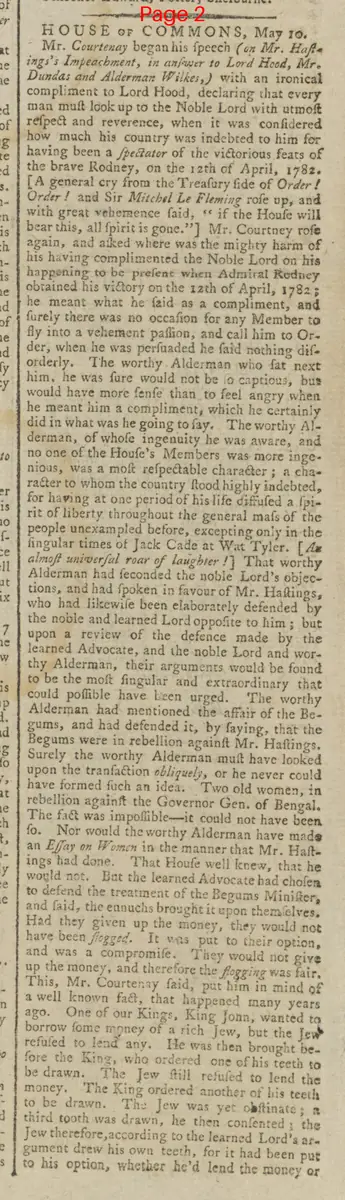
Mr. Courtenay began his speech (on Mr. Hastings's Impeachment, in answer to Lord Hood, Mr. Dundas and Alderman Wilkes,) with an ironical compliment to Lord Hood, declaring that every man must look up to the Noble Lord with utmost respect and reverence, when it was considered how much his country was indebted to him for having been a spectator of the victorious feats of the brave Rodney, on the 12th of April, 1782.
[A general cry from the Treasury side of Order! Order! and Sir Mitchell Le Fleming rose up, and with great vehemence said. "if the House will bear this, all spirit is gone."] Mr. Courtenay rose again, and asked where was the mighty harm of his having complimented the Noble Lord on his happening to be present when Admiral Rodney obtained his victory on the 12th of April, 1782; he meant what he said as a compliment, and surely there was no occasion for any Member to fly into a vehement passion, and call him to Order, when he was persuaded he said nothing disorderly. The worthy Alderman who sat next him, he was sure would not be so captious, but would have more sense than to feel angry when he meant him a compliment, which he certainly did in what he was going to say. The worthy Alderman, of whose ingenuity he was aware, and no one of the House's Members was more ingenious, was a most respectable character; a character to whom the country stood highly indebted, for having at one period of his life diffused a spirit of liberty throughout the general mass of the people unexampled before, excepting only in the singular times of Jack Cade at Wat Tyler. [A almost universal roar of laughter!] That worthy Alderman had seconded the noble Lord's objections, and had spoken in favour of Mr. Hastings, who had likewise been elaborately defended by the noble and learned Lord opposite to him; but upon a review of the defence made by the learned Advocate, and the noble Lord and worthy Alderman, their arguments would be found to be the most singular and extraordinary that could possible have been urged. The worthy Alderman had mentioned the affair of the Begums, and had defended it, by saying, that the Begums were in rebellion against Mr. Hastings. Surely the worthy Alderman must have looked upon the transaction obliquely, or he never could have formed such an idea. Two old women, in rebellion against the Governor Gen. of Bengal. The fact was impossible—it could not have been so. Nor would the worthy Alderman have made an Essay on Women in the manner that Mr. Hastings had done. That House well knew, that he would not. But the learned Advocate had chosen to defend the treatment of the Begums Minister, and said, the eunuchs brought it upon themselves. Had they given up the money, they would not have been flogged. It was put to their option, and was a compromise. They would not give up the money, and therefore the flogging was fair. This, Mr. Courtenay said, put him in mind of a well known fact, that happened many years ago. One of our Kings, King John, wanted to borrow some money of a rich Jew, but the Jew refused to lend any. He was then brought before the King, who ordered one of his teeth to be drawn. The Jew still refused to lend the money. The King ordered another of his teeth to be drawn. The Jew was yet obstinate; a third tooth was drawn, he then consented; the Jew therefore, according to the learned Lord's argument drew his own teeth, for it had been put to his option, whether he'd lend the money or
have his teeth drawn, and he chose the latter.
Another extraordinary argument made use of by the learned Lord, was his contending, that although Mr. Hastings took the present of the Nabob Vizier, he nevertheless rigorously exacted the immediate payment of the Nabob's debt to the Company, and consequently proved that the present had not produced a corrupt effect. This reminded him of a case in point, which happened in James the Second's time, in 1686, when there being some insurrections in the West, Gen. Kirk was sent to quell the disturbances, an office which he executed with great rigour and severity. It happened that a young man was taken up as one of the delinquents, who was just going to be married to a young woman, and between them a mutual and an ardent passion united. The young woman went to the General's tent, and implored mercy for her lover. The Gen. told her, if she would suffer him to enjoy her, her lover should be saved. The young woman consented, and the next thing that Kirk did in the morning, was to lead the young woman out of his tent, and shew her the body of her lover hanging on a tree. In this instance, according to the learned Lord's argument, Gen. Kirk acted with strict justice, and in a laudable manner, for though he enjoyed the woman, he did his duty, and hung her lover. The learned Lord, Mr. Courtenay observed, had laid great stress upon the motive and the intention, declaring that without proving that the House as accusers had no right to ascribe guilt. This was new to him. He had hitherto always thought, that if the criminal fact was proved, the criminal intention was presumed.
But according to the learned Lord's doctrine, if a man were to murder another, and not to rob him, he would be guilty of no crime, because he only murdered his object, and who could impute a criminal intention, since it was evident he had not robbed him, although he might, if he chose to have done so? With arguments absurd and ridiculous, upon the face of them, as those he had answered, had Mr. Hastings been defended; what he had said therefore was a sufficient answer to all of them: no real argument, solid, substantial, and rational, had been brought to prove that Mr. Hastings had not acted uniformly upon a system of treachery, breach of faith, corruption, oppression, and injustice; without regard to his engagements to his duty, to his station and character.
As an instance that he had not done his best to promote the interest of his employers, Mr. Courtenay said, he would state an authentic anecdote, of which, if necessary, he could give indubitable proof. Gen. Camac was about to embark for Europe, when intelligence reached Calcutta, that the Mahrattas threatened the invasion of Bengal. Mr. Hastings sent to desire the General to take the command of the troops, and march to the defence of the frontier of Bengal. The General consented, and by his uncommon vigilance and exertions, brought Madagee Scindia to an engagement, in which he completely routed him, and destroyed a great number of his troops. Madagee sent to the Gen. an offer of terms of peace, highly beneficial to the Company's interests. Mr. Hastings, instead of meeting the proposal, conveyed to him by General Camac, sends General Muir, a man debilitated by indisposition, and a martyr to the gout, to take command of the troops, in the place of General Camac, and three years afterwards, after the expenditure of millions, a dishonourable and disadvantageous peace was concluded with the Mahrattas.
Mr. Courtenay expatiated on this anecdote, and took notice that Mr. Hastings had in the course of the preceding debates been compared to Verres, to Alexander, to Scipio, and to Epaminondas. He said, he thought the first the comparison most in point; but he would not refer to the Romans and Grecians for a comparison. It was so long since he read books relative to them, that he had almost forgotten their contents. He would look to more Modern history for a comparison, and he recollected an apt and a close one. It was Ferdinand Cortez, to whom he alluded. Ferdinand Cortez had been sent out by Charles the Fifth, to make discoveries in South America, to instruct, to murder, and to baptize the uninformed Indians. He pursued his object, and his footsteps were marked with blood and cruelty; insomuch that the news of his brutality reached Madrid, and was thought so much a national disgrace, that an enquiry into his conduct was deemed due to the national character. The Bishops and Archbishops, who united in their own persons the characters of Prelates and Chief-Justices, were ordered to conduct the enquiry. Cortez was accompanied by one of these Chief-Justices, the Archbishop of Toledo, whose object it was to go about and collect affidavits. In order to clear themselves from the charge, they contrived to get several affidavits sworn, that the deponents heard a chorus of Angels singing in the Mexican language, Gloria in Excelsis, and the blessings of Heaven upon the head of Ferdinand Cortez, for his humanity and benevolence to the Mexicans and Peruvians. The Archbishop of Toledo, transmitted these to the bench of his revered brother Chief Justices; they persuaded the people to believe the facts deposed, a general credulity prevailed, and at the same time Cortez sent Charles the Fifth some jewels, not a Bull, he believed, for that was an Oriental word, not then known in Europe, but which had an equal effect upon the Spanish Monarch's mind, Spain rang with the praises of Ferdinand Cortez. Extravagant and ludicrous as this story might appear, Mr. Courtenay said, it was an undoubted fact, stated as such in the Letters of Cortez to Charles the Fifth. Mr. Courtenay dwelt for some time on the analogy between the conduct of Cortez, and the conduct of Mr. Hastings, and at length concluded a very long speech, with declaring, that he should vote for the second reading of the Report.
What sub-type of article is it?
What keywords are associated?
What entities or persons were involved?
Where did it happen?
Foreign News Details
Primary Location
Bengal
Event Date
May 10
Key Persons
Outcome
mr. courtenay votes for the second reading of the report on mr. hastings's impeachment; historical anecdotes highlight alleged corruption and poor decisions leading to dishonourable peace with mahrattas after expenditure of millions.
Event Details
Mr. Courtenay's speech in House of Commons criticizes defenses of Warren Hastings's actions as Governor-General of Bengal, using irony against Lord Hood and Alderman Wilkes, analogies to King John, Gen. Kirk, and Ferdinand Cortez to argue against corruption in Begums affair, eunuch treatment, Nabob Vizier present, and mishandling of Mahratta threat by replacing Gen. Camac with General Muir, resulting in disadvantageous peace.