Thank you for visiting SNEWPapers!
Sign up free
Editorial
February 8, 1923
The Alaska Daily Empire
Juneau, Alaska
What is this article about?
Editorial from Ketchikan Chronicle urges support for Delegate Dan Sutherland's amendment to the federal highway bill, estimating millions for Alaska road construction to aid territorial development, stimulate mining and agriculture, and protect Southeastern Alaska's forest funds from diversion.
Clipping
OCR Quality
98%
Excellent
Full Text
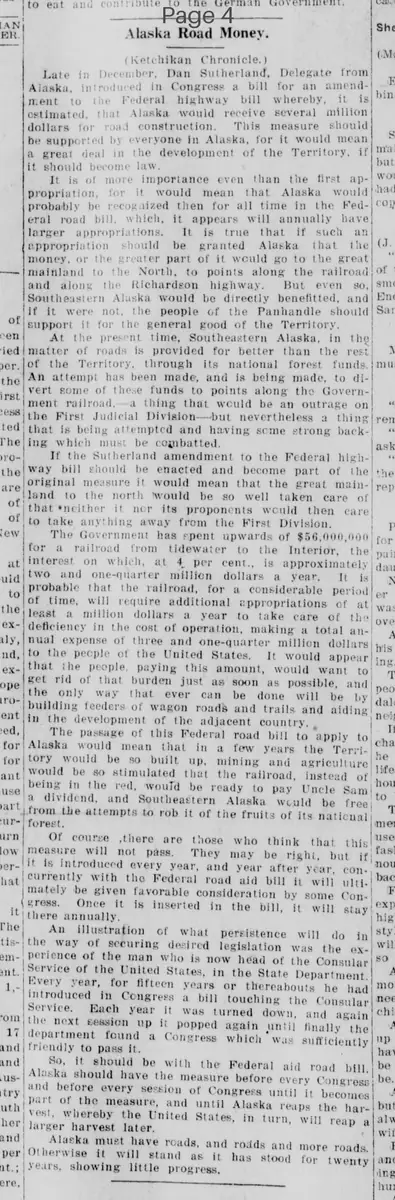
Alaska Road Money.
(Ketchikan Chronicle)
Late in December, Dan Sutherland, Delegate from Alaska, introduced in Congress a bill for an amendment to the Federal highway bill whereby, it is estimated, that Alaska would receive several million dollars for road construction. This measure should be supported by everyone in Alaska, for it would mean a great deal in the development of the Territory, if it should become law.
It is of more importance even than the first appropriation, for it would mean that Alaska would probably be recognized then for all time in the Federal road bill, which, it appears will annually have larger appropriations. It is true that if such an appropriation should be granted Alaska that the money, or the greater part of it would go to the great mainland to the North, to points along the railroad and along the Richardson highway. But even so, Southeastern Alaska would be directly benefitted, and if it were not, the people of the Panhandle should support it for the general good of the Territory.
At the present time, Southeastern Alaska, in the matter of roads is provided for better than the rest of the Territory, through its national forest funds. An attempt has been made, and is being made, to divert some of these funds to points along the Government railroad, a thing that would be an outrage on the First Judicial Division—but nevertheless a thing that is being attempted and having some strong backing which must be combatted.
If the Sutherland amendment to the Federal highway bill should be enacted and become part of the original measure it would mean that the great mainland to the north would be so well taken care of that neither it nor its proponents would then care to take anything away from the First Division.
The Government has spent upwards of $56,000,000 for a railroad from tidewater to the Interior, the interest on which, at 4 per cent., is approximately two and one-quarter million dollars a year. It is probable that the railroad, for a considerable period of time, will require additional appropriations of at least a million dollars a year to take care of the deficiency in the cost of operation, making a total annual expense of three and one-quarter million dollars to the people of the United States. It would appear that the people, paying this amount, would want to get rid of that burden just as soon as possible, and the only way that ever can be done will be by building feeders of wagon roads and trails and aiding in the development of the adjacent country.
The passage of this Federal road bill to apply to Alaska would mean that in a few years the Territory would be so built up, mining and agriculture would be so stimulated that the railroad, instead of being in the red, would be ready to pay Uncle Sam a dividend, and Southeastern Alaska would be free from the attempts to rob it of the fruits of its national forest.
Of course, there are those who think that this measure will not pass. They may be right, but if it is introduced every year, and year after year, concurrently with the Federal road aid bill it will ultimately be given favorable consideration by some Congress. Once it is inserted in the bill, it will stay there annually.
An illustration of what persistence will do in the way of securing desired legislation was the experience of the man who is now head of the Consular Service of the United States, in the State Department. Every year, for fifteen years or thereabouts he had introduced in Congress a bill touching the Consular Service. Each year it was turned down, and again the next session up it popped again until finally the department found a Congress which was sufficiently friendly to pass it.
So, it should be with the Federal aid road bill. Alaska should have the measure before every Congress and before every session of Congress until it becomes part of the measure, and until Alaska reaps the harvest, whereby the United States, in turn, will reap a larger harvest later.
Alaska must have roads, and roads and more roads. Otherwise it will stand as it has stood for twenty years, showing little progress.
(Ketchikan Chronicle)
Late in December, Dan Sutherland, Delegate from Alaska, introduced in Congress a bill for an amendment to the Federal highway bill whereby, it is estimated, that Alaska would receive several million dollars for road construction. This measure should be supported by everyone in Alaska, for it would mean a great deal in the development of the Territory, if it should become law.
It is of more importance even than the first appropriation, for it would mean that Alaska would probably be recognized then for all time in the Federal road bill, which, it appears will annually have larger appropriations. It is true that if such an appropriation should be granted Alaska that the money, or the greater part of it would go to the great mainland to the North, to points along the railroad and along the Richardson highway. But even so, Southeastern Alaska would be directly benefitted, and if it were not, the people of the Panhandle should support it for the general good of the Territory.
At the present time, Southeastern Alaska, in the matter of roads is provided for better than the rest of the Territory, through its national forest funds. An attempt has been made, and is being made, to divert some of these funds to points along the Government railroad, a thing that would be an outrage on the First Judicial Division—but nevertheless a thing that is being attempted and having some strong backing which must be combatted.
If the Sutherland amendment to the Federal highway bill should be enacted and become part of the original measure it would mean that the great mainland to the north would be so well taken care of that neither it nor its proponents would then care to take anything away from the First Division.
The Government has spent upwards of $56,000,000 for a railroad from tidewater to the Interior, the interest on which, at 4 per cent., is approximately two and one-quarter million dollars a year. It is probable that the railroad, for a considerable period of time, will require additional appropriations of at least a million dollars a year to take care of the deficiency in the cost of operation, making a total annual expense of three and one-quarter million dollars to the people of the United States. It would appear that the people, paying this amount, would want to get rid of that burden just as soon as possible, and the only way that ever can be done will be by building feeders of wagon roads and trails and aiding in the development of the adjacent country.
The passage of this Federal road bill to apply to Alaska would mean that in a few years the Territory would be so built up, mining and agriculture would be so stimulated that the railroad, instead of being in the red, would be ready to pay Uncle Sam a dividend, and Southeastern Alaska would be free from the attempts to rob it of the fruits of its national forest.
Of course, there are those who think that this measure will not pass. They may be right, but if it is introduced every year, and year after year, concurrently with the Federal road aid bill it will ultimately be given favorable consideration by some Congress. Once it is inserted in the bill, it will stay there annually.
An illustration of what persistence will do in the way of securing desired legislation was the experience of the man who is now head of the Consular Service of the United States, in the State Department. Every year, for fifteen years or thereabouts he had introduced in Congress a bill touching the Consular Service. Each year it was turned down, and again the next session up it popped again until finally the department found a Congress which was sufficiently friendly to pass it.
So, it should be with the Federal aid road bill. Alaska should have the measure before every Congress and before every session of Congress until it becomes part of the measure, and until Alaska reaps the harvest, whereby the United States, in turn, will reap a larger harvest later.
Alaska must have roads, and roads and more roads. Otherwise it will stand as it has stood for twenty years, showing little progress.
What sub-type of article is it?
Infrastructure
Economic Policy
What keywords are associated?
Alaska Roads
Federal Highway Bill
Sutherland Amendment
Territorial Development
National Forest Funds
Government Railroad
Mining Agriculture Stimulation
What entities or persons were involved?
Dan Sutherland
Congress
Alaska
Southeastern Alaska
First Judicial Division
Panhandle
Government Railroad
Richardson Highway
Editorial Details
Primary Topic
Support For Sutherland Amendment To Federal Highway Bill For Alaska Roads
Stance / Tone
Strongly Supportive Of Amendment For Development And Protection Of Regional Funds
Key Figures
Dan Sutherland
Congress
Alaska
Southeastern Alaska
First Judicial Division
Panhandle
Government Railroad
Richardson Highway
Key Arguments
Amendment Would Provide Millions For Road Construction Benefiting Territorial Development
Ensures Ongoing Federal Recognition And Larger Annual Appropriations For Alaska Roads
Protects Southeastern Alaska's National Forest Funds From Diversion To Northern Areas
Reduces Federal Burden On Alaska Railroad By Stimulating Mining And Agriculture
Persistence In Introducing Bill Annually Will Lead To Eventual Passage
Roads Essential For Progress; Without Them, Alaska Stagnates