Thank you for visiting SNEWPapers!
Sign up free
Pittsburg Dispatch
Pittsburgh, Allegheny County, Pennsylvania
What is this article about?
The pawnbroker's three golden balls symbol traces back to the 12th-century Medici family in Florence, whose coat of arms featured six red pills. Lombard merchants adopted three golden ones and brought pawnbroking to 16th-century London, influencing the sign and the word 'lumber'.
Clipping
OCR Quality
Full Text
NOW A SIGN OF THE PAWNBROKER.
Significance Given Three Pellets by the Lombard Merchants.
A NEW WORD ADDED TO THE ENGLISH
[WRITTEN FOR THE DISPATCH.]
The familiar three golden balls which dangle over the portals of the pawnbroker have a history bound up with that of the most famous parvenu family the world ever saw.
Somewhere about the beginning of the twelfth century there dwelt in Florence a quack doctor, who by his skill in cures acquired a great reputation and a considerable fortune. He bequeathed his business to his children, who practiced medicine with much success. They were surnamed "Dei Medici" from their profession. In 1268 the head of the family Giovanni dei Medici was a Florentine citizen of such prominence, that he was raised from the bourgeois class, made a gentleman, and granted a coat of arms.
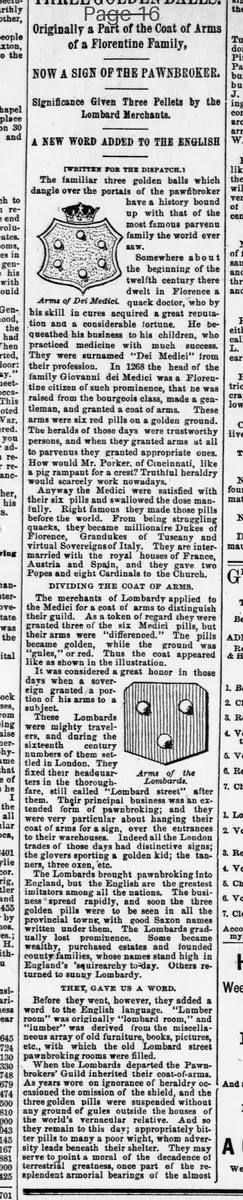
These arms were six red pills on a golden ground. The heralds of those days were trustworthy persons, and when they granted arms at all to parvenus they granted appropriate ones. How would Mr. Packer, of Cincinnati, like a pig rampant for a crest? Truthful heraldry would scarcely work nowadays.
Anyway the Medici were satisfied with their six pills and swallowed the dose manfully. Right famous they made those pills before the world. From being struggling quacks, they became millionaire Dukes of Florence, Grand Dukes of Tuscany and virtual Sovereigns of Italy. They are intermarried with the royal houses of France, Austria and Spain, and they gave two Popes and eight Cardinals to the Church.
DIVIDING THE COAT OF ARMS.
The merchants of Lombardy applied to the Medici for a coat of arms to distinguish their guild. As a token of regard they were granted three of the six Medici pills, but their arms were "differenced." The pills became golden, while the ground was "gules," or red. Thus the coat appeared like as shown in the illustration.
It was considered a great honor in those days when a sovereign granted a portion of his arms to a subject.
These Lombards were mighty travelers, and during the sixteenth century numbers of them settled in London. They fixed their headquarters in the thoroughfare, still called "Lombard street" after them. Their principal business was an extended form of pawnbroking; and they were very particular about hanging their coat of arms for a sign, over the entrances to their warehouses. Indeed all the London trades of those days had distinctive signs; the glovers sporting a golden kid; the tanners, three oxen, etc.
The Lombards brought pawnbroking into England, but the English are the greatest imitators among all the nations. The business spread rapidly, and soon the three golden pills were to be seen in all the provincial towns, with good Saxon names written under them. The Lombards gradually lost prominence. Some became wealthy, purchased estates and founded county families, whose names stand high in England's 'squirearchy to-day. Others returned to sunny Lombardy.
THEY GAVE US A WORD.
Before they went, however, they added a word to the English language. "Lumber room" was originally "lombard room," and "lumber" was derived from the miscellaneous array of old furniture, books, pictures, etc., with which the old Lombard street pawnbroking rooms were filled.
When the Lombards departed the Pawnbrokers' Guild inherited their coat-of-arms. As years wore on ignorance of heraldry occasioned the omission of the shield, and the three golden pills were suspended without any ground of gules outside the houses of the world's vernacular relative. And so they remain to this day; appropriately bitter pills to many a poor wight, whom adversity leads beneath their shelter. They may serve to point a moral of the decadence of terrestrial greatness, once part of the resplendent armorial bearings of the almost
What sub-type of article is it?
What themes does it cover?
What keywords are associated?
What entities or persons were involved?
Where did it happen?
Story Details
Key Persons
Location
Florence, Lombardy, London
Event Date
12th Century To 16th Century
Story Details
The three golden balls sign of pawnbrokers originated from the Medici family's coat of arms with six red pills granted in 1268. Lombard merchants received three golden pills on a red ground and introduced pawnbroking to England in the 16th century via Lombard Street, eventually leading to the modern sign and the word 'lumber' from 'lombard room'.