Thank you for visiting SNEWPapers!
Sign up free
The Rhode Island Republican
Newport, Newport County, Rhode Island
What is this article about?
In 1754 Alexandria, Colonel Washington is felled in an election brawl by William Payne. His devoted regiment arms for vengeance, but Washington revives, disarms their fury, and nobly apologizes to Payne, forging a lasting friendship and exemplifying heroic restraint. (214 characters)
Merged-components note: Continuation of the 'Anecdote of Washington' story across pages; relabeled from 'editorial' to 'story' as it is narrative with moral conclusion
Clippings
1 of 2
OCR Quality
Full Text
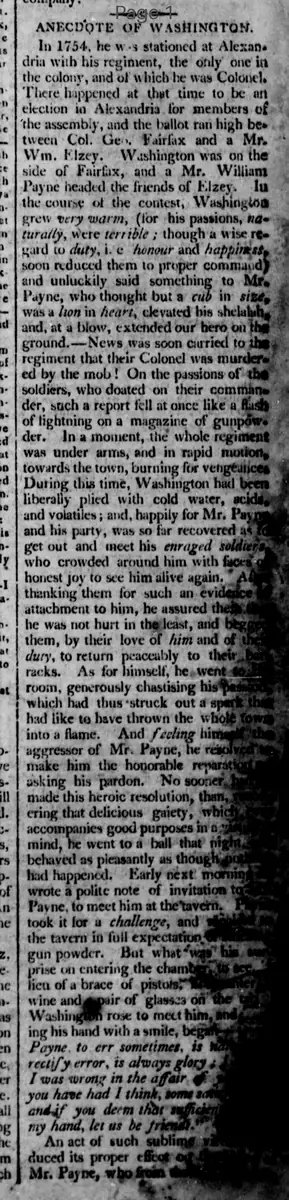
In 1754, he was stationed at Alexandria with his regiment, the only one in the colony, and of which he was Colonel. There happened at that time to be an election in Alexandria for members of the assembly, and the ballot ran high between Col. Geo. Fairfax and a Mr. Wm. Elzey. Washington was on the side of Fairfax, and a Mr. William Payne headed the friends of Elzey. In the course of the contest, Washington grew very warm, (for his passions, naturally, were terrible; though a wise regard to duty, i. e. honour and happiness soon reduced them to proper command) and unluckily said something to Mr. Payne, who thought but a cub in size was a lion in heart, elevated his shillalah and, at a blow, extended our hero on the ground.--News was soon carried to the regiment that their Colonel was murdered by the mob! On the passions of the soldiers, who doated on their commander, such a report fell at once like a flash of lightning on a magazine of gunpowder. In a moment, the whole regiment was under arms, and in rapid motion towards the town, burning for vengeance. During this time, Washington had been liberally plied with cold water, acids and volatiles; and, happily for Mr. Payne and his party, was so far recovered as to get out and meet his enraged soldiers who crowded around him with faces of honest joy to see him alive again. After thanking them for such an evidence of attachment to him, he assured them he was not hurt in the least, and begged them, by their love of him and of duty, to return peaceably to their barracks. As for himself, he went up to his room, generously chastising his passion which had thus "struck out a spark" that had like to have thrown the whole town into a flame. And feeling himself the aggressor of Mr. Payne, he resolved to make him the honorable reparation of asking his pardon. No sooner had he made this heroic resolution, than, entering that delicious gaiety, which accompanies good purposes in a good mind, he went to a ball that night and behaved as pleasantly as though nothing had happened. Early next morning he wrote a polite note of invitation to Payne, to meet him at the tavern. He took it for a challenge, and hastened to the tavern in full expectation of gun powder. But what a surprise on entering the chamber, in lieu of a brace of pistols, to see wine and a pair of glasses on the table. Washington rose to meet him, and taking his hand with a smile, began--"To err sometimes, Mr. Payne, is natural; to rectify error, is always glory: I was wrong in the affair yesterday, and you have had, I think, some satisfaction; and if you deem that sufficient, give me your hand, let us be friends."
An act of such sublimity produced its proper effect on Mr. Payne, who from that hour became one of the most attached friends Washington ever had.
came the most enthusiastic admirer and friend of Washington; and, for his sake, ready at any time to charge up to a battery of two and forty pounders.
Would our Youth but be persuaded to act in style so correct and so heroical, our papers would no longer shock us with accounts of elegant young men murdering each other, on false principles of honor; and, by one desperate deed, amerced themselves of all present pleasure, and of all future hope. Would they but exert the courage, the only true courage, to stamp into immediate silence the clamours of brutish passion, and to leap at the sacred call of duty, they might long live as good children, to equal the hopes of their fond parents—as good citizens, with their virtues to enrich their country—as good husbands, to bless the sex they were born to love and to protect—and at length like Washington attain to good old age "crown'd with riches and with honours."
A life how glorious! to his country dear,
Her first in council, and her first in war.
May his example, all our sons inspire!
And from their father's history, catch his fire.
What sub-type of article is it?
What themes does it cover?
What keywords are associated?
What entities or persons were involved?
Where did it happen?
Story Details
Key Persons
Location
Alexandria
Event Date
1754
Story Details
During an 1754 election in Alexandria, Colonel Washington, supporting Col. Geo. Fairfax, argues heatedly with Mr. William Payne, supporter of Mr. Wm. Elzey, and is knocked down by Payne. The regiment mobilizes for revenge, but Washington recovers, calms them, and reconciles with Payne by apologizing, making him a lifelong friend. The anecdote teaches heroic self-control and forgiveness over passion.