Thank you for visiting SNEWPapers!
Sign up free
Editorial
October 16, 1811
Norfolk Gazette And Publick Ledger
Norfolk, Virginia
What is this article about?
A 'Native American' critiques E.C. Genet's letters on US maritime jurisdiction, refuting claims of 20-league territorial seas under the British treaty. Cites law of nations authors, Russian declarations, and US actions in 1793-94 cases like the Fanny and Grange, affirming one marine league limit.
Clipping
OCR Quality
75%
Good
Full Text
FROM THE ALBANY GAZETTE.
REFLECTIONS OF A NATIVE AMERICAN
ON THE LATE PUBLICATIONS OF E. C.
GENET.
(Continued.)
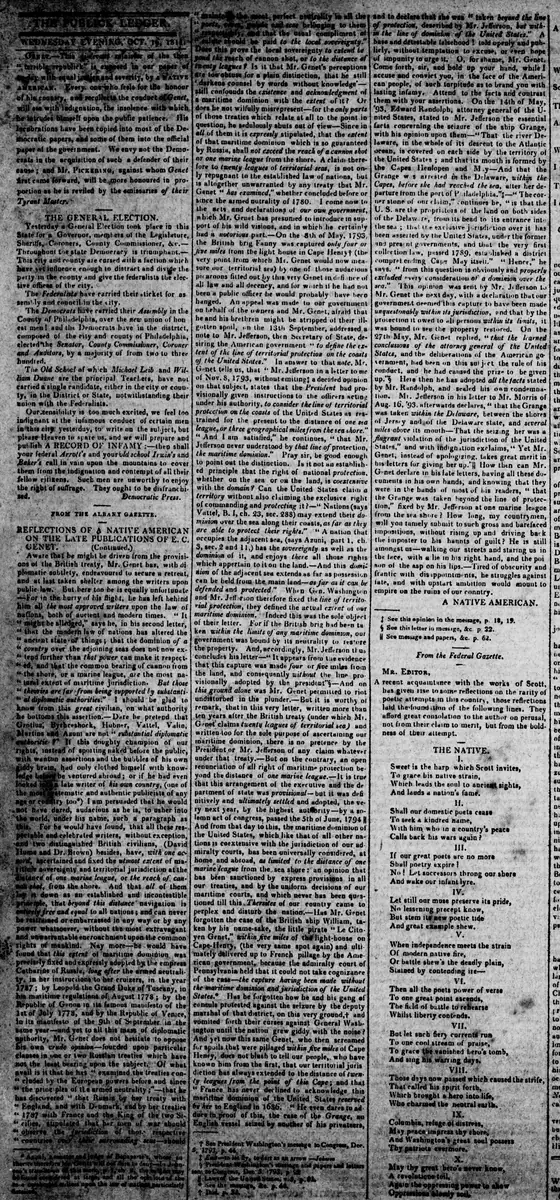
Aware that he might be driven from the provisions of the British treaty, Mr. Genet has, with diplomatic subtlety, endeavoured to secure a retreat, and at last taken shelter among the writers upon public law. But here too he is equally unfortunate For in the hurry of his flight, he has let behind him all the most approved writers upon the law of nations both of ancient and modern times. "It might be alleged." says he, in his second letter. that the modern law of nations has altered the "ancient state of things; that the dominion of a "country over the adjoining seas does not now ex- "tend further than that power can make it respect- "ed and that the common bearing of cannon from "the shore, or a marine league, are the most na- "tural extent of maritime jurisdiction. But those "theories are far from being supported by substanti- "al diplomatic authorities!" I should be glad to know from this great civilian, on what authority he bottoms this assertion.--Does he pretend that Grotius, Bynkershoek, Hubner, Vattel, Valin, Martini and Azuni are not "substantial diplomatic "authorities If this doughty champion of our "rights, instead of sporting naked before the public "with wanton assertions and the bubbles of his own " giddy brain had only clothed himself with know- "ledge before he ventured abroad; or if he had even "consulted any late writer. of his own country, (one of "the most systematic and authentic publicists of any "or every country too') I am persuaded that he would "not have dared, audacious as he is, to usher into "the world under his name, such a paragraph as "this For he would have found, that all these res- "pectable and celebrated writers, without exception, "and two distinguished British civilians, (David "Hume and Dr Brown) besides, have, with one ac- "cord ascertained and fixed the utmost extent of ma- "ritime sovereignty and territorial jurisdiction at the "distance of one marine league, or the reach of can- "non shot from the shore. And that all of them "lay down as an established and incontestible "fact, that beyond this distance navigation is "free and equal to all nations; and can never "be restrained or embarrassed in any way or by any "power whatsoever, without the most extravagant "and unwarrantable encroachment upon the common "rights of mankind? Nay more -he would have "found that this extent of maritime dominion was "precisely fixed and expressly adopted by the emppress "Catherine of Russia long after the armed neutrality. "in her instructions to her cruisers, in the year "1787; by Leopold the Grand Duke of Tuscany, in "his maritime regulations of August 1778; by the "Republic of Genoa in its famous manifesto of the "1st of July 1778, and by the Republic of Venice, "in its manifesto of the 9th of September in the "same year and yet to all this mass of diplomatic "authority, Mr. Genet does not hesitate to oppose "his own crude opinion founded upon particular "clauses in one or two Russian treaties which have "not the least bearing upon the subject Of what "avail is it that he has "examined the treaties con- "cluded by the European powers before and since "the principles of the armed neutrality ;" that he "has discovered "that Russia by her treaty with "England, and with Denmark and by her treaties "1787 with France and, the King of the two Si- "cilies, stipulated that her men of war should "observe.-they "dictions.of those respective
whal, "
t0
Goagarte's, : whose: 1u
hortv therefore Mr: Genet will not dare to deny- John-
zwa himo
rehAytiowMda w
Mll Ghe odkniow uf thr
"t
LurMityaoilrthe
s4
JorttAt
reae-belonging to-them
titbd-usearccomplimentso
salute should: be paid to the local sovereignty.
Does this prove the local sovereignty to extend to
beyond the reach of cannon shot or to the distance of
twenty leagues/ Is it that Mr. Genet's perceptions
are too obtuse for a plain distinction, that he still
"darkens counsel by words without knowledge"-
still confounds the existence and acknowledgment of
a maritime dominion with the extent of it? Or
does he not wilfully misrepresent--for the only parts
of those treaties which relate at all to the point in
question, he sedulously shuts out of view-Since in
all of them it is expressly stipulated, that the extent
of that maritime dominion which is so guaranteed
by Russia, shall not exceed the reach of a cannon shot
or one marine league from the shore. A claim there-
fore to twenty leagues of territorial seas, is not on-
ly repugnant to the established law of nations, but
is altogether unwarranted by any treaty that Mr.
Genet "has examined," whether concluded before or
since the armed neutrality of 1780. I come now to
the acts and declarations of our own government,
which Mr. Genet has presumed to introduce in sup-
port of his wild visions, and in which he certainly
had a notorious part.--On the 8th of May, 1793,
the British brig Fanny was captured only four or
five miles from the light house in Cape Henry (the
very point from which Mr. Genet would now mea-
sure our territorial sea) by one of those audacious
privateers fitted out by this very Genet in defiance of
all law and all decency, and for which if he had not
been a public officer he would probably have been
hanged. An appeal was made to our government
on behalf of the owners and Mr. Genet, afraid that
he and his brethren might be stripped of their ill-
gotten spoil, on the 13th September, addressed a
note to Mr. Jefferson, then Secretary of State, de-
siring the American government "to define the ex-
tent of the line of territorial protection on the coasts
of the United States." In answer to that note. Mr.
Genet tells us, that "Mr. Jefferson in a letter to me
of Nov. 8, 1793, without emitting a decided opinion
on that subject, states that the President had pro-
visionally given instructions to the officers acting
under his authority, to consider the line of territorial
protection on the coasts of the United States as re-
strained for the present to the distance of one sea
league, or three geographical miles from the sea shore."
"And I am satisfied," he continues, "that Mr.
Jefferson never understood by that line of protection,
the maritime dominion." Pray sir, be good enough
to point out the distinction. Is it not an establish-
ed principle that the right of national protection.
whether on the sea or on the land, is coextensive
with the domain? Can the United States claim a
territory without also claiming the exclusive right
of commanding and protecting it? -"Nations (says
Vattel, B. I, ch. 23, sec. 288) may extend their do-
minion over the sea along their coasts, as far as they
are able to protect their rights". "A nation that
occupies the adjacent sea, (says Azuni, part 1, ch.
3, sec. 2 and 11,) has the sovereignty as well as the
dominion of it, and enjoys there all those rights
which appertain to it on the land.-And this domi-
dion of the adjacent sea extends as far as possession
can be held from the main land--as far as it can be
defended and protected." When Gen. Washington
and Mr. Jefferson therefore fixed the line of territo-
rial protection, they defined the actual extent of our
maritime dominion. Indeed this was the sole object
of their letter. For if the British brig had been ta-
ken within the limits of any maritime dominion, our
government was bound by its neutrality to restore
the property. And, accordingly, Mr. Jefferson thus
concludes his letter-"It appears from the evidence
that this capture was made four or five miles from
the land, and consequently without the line pro-
visionally adopted by the president"-And on
this ground alone was Mr. Genet permitted to riot
undisturbed in the plunder.-But it is worthy of
remark, that in this very letter, written more than
ten years after the British treaty (under which Mr.
Genet claims twenty leagues of territorial sea) and
written too for the sole purpose of ascertaining our
maritime dominion, there is no pretence by the
President or Mr. Jefferson of any claim whatever
under that treaty.---But on the contrary, an open
renunciation of all right of maritime protection be-
yond the distance of one marine league.--It is true
that this arrangement of the executive and the de-
partment of state was provisional-but it was desi-
nitively and ultimately settled and adopted, the ve-
ry next year, by the highest authority--by a so-
lemn act of congress, passed the 5th of June, 1794
And from that day to this, the maritime dominion of
the United States, which like that of all other na-
tions is coextensive with the jurisdiction of our ad-
miralty courts, has been universally considered, at
home and abroad, as limited to the distance of one
marine league from the sea shore: an opinion that
has been sanctioned by express provisions in all
our treaties, and by the uniform decisions of our
maritime courts, and which never has been ques-
tioned till this Thersites of our country came to
perplex and disturb the nation. -Has Mr. Genet
forgotten the case of the British ship William, ta-
ken by his name-sake, the little pirate "Le Citoyen
Genet," within five miles of the light-house on
Cape-Henry, (the very same spot again) and ulti-
ately delivered up to French pillage by the Ame-
rican government, because the admiralty court of
Pennsylvania held that it could not take cognizance
of the case---the capture having been made without
the maritime dominion and jurisdiction of the United
States. Has he forgotten how he and his gang of
consuls protested against the seizure by the deputy
marshal of that district, on this very ground, and
vomited forth their curses against General Wash-
ington until the nation grew giddy with the noise?
And yet now this same Genet, who then screamed
for spoils that were pillaged within five miles of Cape
Henry, does not blush to tell our people, who have
known him from the first, that our territorial juris-
diction has always extended to the distance of twen-
ty leagues from the point of this Cape; and that
"France has never declined to acknowledge this
maritime dominion of the United States reserved
by her to England in 1786." He even dares to ad-
duce in proof of this the case of the Grange, a
English vessel seized by another of his privateers
Bee
Priblient Wa
to Iet
t
2rt
s
riident-Weshia
mousiage
7
to
2outmss
he
S
and to declare that she was not taken beyond the line
of protection described by Mr. Jefferson, but with-
in the line of dominion of the United States." A
base and detestable falsehood! told openly and pub-
licly, without temptation to excuse, or even hope
of impunity to urge it. O, for shame, Mr. Genet.
Come forth, sir, and hold up your hand, while I
accuse and convict you, in the face of the American
people, of such turpitude as to brand you with
lasting infamy. Attend to the facts and contrast
them with your assertions. On the 14th of May,
'93, Edward Randolph, attorney general of the U.
nited States, stated to Mr. Jefferson the essential
acts concerning the seizure of the ship Grange,
with his opinion upon them-"That the river De-
la ware, in the whole of its descent to the Atlantic
ocean, is covered on each side by the territory of
the United States ; and that its mouth is formed by
the Capes Henlopen and May--And that the
Grange was arrested in the Delaware, within the
Capes, before she had reached the sea, after her de-
parture from the port of Philadelphia."-"The cor-
ner stone of our claim," continues he, "is that the
U. S. are the proprietors of the land on both sides
of the Delaware, from its head to its entrance into
the sea ; that the exclusive jurisdiction over it has
been asserted by the United States, under the former
and present governments, and that the very first
collection law, passed 1789, established a district
comprehending Cape May itself." "Hence," he
says. "from this question is obviously and properly
excluded every consideration of a dominion over the
sea." This opinion was sent by Mr. Jefferson to
Mr. Genet the next day, with a declaration that our
government deemed this capture to have been made
unquestionably within its jurisdiction, and that by the
protection it owed to all persons within its limits, it
was bound to see the property restored. On the
27th May. Mr. Genet replied, "that the learned
conclusions of the attorney general of the United
States, and the deliberations of the American go-
vernment, had been on this subject the rule of his
conduct, and he had caused the prize to be given
up." Here then he has adopted all the facts stated
by Mr. Randolph, and sealed his own condemna-
tion. Mr. Jefferson in his letter to Mr. Morris of
Aug. 16, '93. afterwards declares, "that the Grange
was taken within the Delaware, between the shores
of Jersey and of the Delaware state, and several
miles above its mouth--That the seizing her was a
flagrant violation of the jurisdiction of the United
States," and with indignation exclaims, "Yet Mr.
Genet, instead of apologizing, takes great merit in
his letters for giving her up." How then can Mr.
Genet declare in his late letters, having all these do-
cuments in his own hands; and knowing that they
were in the hands of most of his readers, "that
the Grange was taken beyond the line of protec-
tion," fixed by Mr. Jefferson at one marine league
from the sea shore? How long, my countrymen,
will you tamely submit to such gross and barefaced
impositions, without rising up and driving back
the imposter to his haunts of guilt? He is still
amongst us--walking our streets and staring us in
the face, with a lie in his right hand, and the poison of the asp on his lips.--Tired of obscurity and
frantic with disappointments, he struggles against
fate, and with upstart ambition would mount to
empire on the ruins of our country.
A NATIVE AMERICAN.
See this opinion in the message, p. 18, 19.
See this letter in message, &c. p. 22.
See message and papers, &c. p. 62.
REFLECTIONS OF A NATIVE AMERICAN
ON THE LATE PUBLICATIONS OF E. C.
GENET.
(Continued.)
Aware that he might be driven from the provisions of the British treaty, Mr. Genet has, with diplomatic subtlety, endeavoured to secure a retreat, and at last taken shelter among the writers upon public law. But here too he is equally unfortunate For in the hurry of his flight, he has let behind him all the most approved writers upon the law of nations both of ancient and modern times. "It might be alleged." says he, in his second letter. that the modern law of nations has altered the "ancient state of things; that the dominion of a "country over the adjoining seas does not now ex- "tend further than that power can make it respect- "ed and that the common bearing of cannon from "the shore, or a marine league, are the most na- "tural extent of maritime jurisdiction. But those "theories are far from being supported by substanti- "al diplomatic authorities!" I should be glad to know from this great civilian, on what authority he bottoms this assertion.--Does he pretend that Grotius, Bynkershoek, Hubner, Vattel, Valin, Martini and Azuni are not "substantial diplomatic "authorities If this doughty champion of our "rights, instead of sporting naked before the public "with wanton assertions and the bubbles of his own " giddy brain had only clothed himself with know- "ledge before he ventured abroad; or if he had even "consulted any late writer. of his own country, (one of "the most systematic and authentic publicists of any "or every country too') I am persuaded that he would "not have dared, audacious as he is, to usher into "the world under his name, such a paragraph as "this For he would have found, that all these res- "pectable and celebrated writers, without exception, "and two distinguished British civilians, (David "Hume and Dr Brown) besides, have, with one ac- "cord ascertained and fixed the utmost extent of ma- "ritime sovereignty and territorial jurisdiction at the "distance of one marine league, or the reach of can- "non shot from the shore. And that all of them "lay down as an established and incontestible "fact, that beyond this distance navigation is "free and equal to all nations; and can never "be restrained or embarrassed in any way or by any "power whatsoever, without the most extravagant "and unwarrantable encroachment upon the common "rights of mankind? Nay more -he would have "found that this extent of maritime dominion was "precisely fixed and expressly adopted by the emppress "Catherine of Russia long after the armed neutrality. "in her instructions to her cruisers, in the year "1787; by Leopold the Grand Duke of Tuscany, in "his maritime regulations of August 1778; by the "Republic of Genoa in its famous manifesto of the "1st of July 1778, and by the Republic of Venice, "in its manifesto of the 9th of September in the "same year and yet to all this mass of diplomatic "authority, Mr. Genet does not hesitate to oppose "his own crude opinion founded upon particular "clauses in one or two Russian treaties which have "not the least bearing upon the subject Of what "avail is it that he has "examined the treaties con- "cluded by the European powers before and since "the principles of the armed neutrality ;" that he "has discovered "that Russia by her treaty with "England, and with Denmark and by her treaties "1787 with France and, the King of the two Si- "cilies, stipulated that her men of war should "observe.-they "dictions.of those respective
whal, "
t0
Goagarte's, : whose: 1u
hortv therefore Mr: Genet will not dare to deny- John-
zwa himo
rehAytiowMda w
Mll Ghe odkniow uf thr
"t
LurMityaoilrthe
s4
JorttAt
reae-belonging to-them
titbd-usearccomplimentso
salute should: be paid to the local sovereignty.
Does this prove the local sovereignty to extend to
beyond the reach of cannon shot or to the distance of
twenty leagues/ Is it that Mr. Genet's perceptions
are too obtuse for a plain distinction, that he still
"darkens counsel by words without knowledge"-
still confounds the existence and acknowledgment of
a maritime dominion with the extent of it? Or
does he not wilfully misrepresent--for the only parts
of those treaties which relate at all to the point in
question, he sedulously shuts out of view-Since in
all of them it is expressly stipulated, that the extent
of that maritime dominion which is so guaranteed
by Russia, shall not exceed the reach of a cannon shot
or one marine league from the shore. A claim there-
fore to twenty leagues of territorial seas, is not on-
ly repugnant to the established law of nations, but
is altogether unwarranted by any treaty that Mr.
Genet "has examined," whether concluded before or
since the armed neutrality of 1780. I come now to
the acts and declarations of our own government,
which Mr. Genet has presumed to introduce in sup-
port of his wild visions, and in which he certainly
had a notorious part.--On the 8th of May, 1793,
the British brig Fanny was captured only four or
five miles from the light house in Cape Henry (the
very point from which Mr. Genet would now mea-
sure our territorial sea) by one of those audacious
privateers fitted out by this very Genet in defiance of
all law and all decency, and for which if he had not
been a public officer he would probably have been
hanged. An appeal was made to our government
on behalf of the owners and Mr. Genet, afraid that
he and his brethren might be stripped of their ill-
gotten spoil, on the 13th September, addressed a
note to Mr. Jefferson, then Secretary of State, de-
siring the American government "to define the ex-
tent of the line of territorial protection on the coasts
of the United States." In answer to that note. Mr.
Genet tells us, that "Mr. Jefferson in a letter to me
of Nov. 8, 1793, without emitting a decided opinion
on that subject, states that the President had pro-
visionally given instructions to the officers acting
under his authority, to consider the line of territorial
protection on the coasts of the United States as re-
strained for the present to the distance of one sea
league, or three geographical miles from the sea shore."
"And I am satisfied," he continues, "that Mr.
Jefferson never understood by that line of protection,
the maritime dominion." Pray sir, be good enough
to point out the distinction. Is it not an establish-
ed principle that the right of national protection.
whether on the sea or on the land, is coextensive
with the domain? Can the United States claim a
territory without also claiming the exclusive right
of commanding and protecting it? -"Nations (says
Vattel, B. I, ch. 23, sec. 288) may extend their do-
minion over the sea along their coasts, as far as they
are able to protect their rights". "A nation that
occupies the adjacent sea, (says Azuni, part 1, ch.
3, sec. 2 and 11,) has the sovereignty as well as the
dominion of it, and enjoys there all those rights
which appertain to it on the land.-And this domi-
dion of the adjacent sea extends as far as possession
can be held from the main land--as far as it can be
defended and protected." When Gen. Washington
and Mr. Jefferson therefore fixed the line of territo-
rial protection, they defined the actual extent of our
maritime dominion. Indeed this was the sole object
of their letter. For if the British brig had been ta-
ken within the limits of any maritime dominion, our
government was bound by its neutrality to restore
the property. And, accordingly, Mr. Jefferson thus
concludes his letter-"It appears from the evidence
that this capture was made four or five miles from
the land, and consequently without the line pro-
visionally adopted by the president"-And on
this ground alone was Mr. Genet permitted to riot
undisturbed in the plunder.-But it is worthy of
remark, that in this very letter, written more than
ten years after the British treaty (under which Mr.
Genet claims twenty leagues of territorial sea) and
written too for the sole purpose of ascertaining our
maritime dominion, there is no pretence by the
President or Mr. Jefferson of any claim whatever
under that treaty.---But on the contrary, an open
renunciation of all right of maritime protection be-
yond the distance of one marine league.--It is true
that this arrangement of the executive and the de-
partment of state was provisional-but it was desi-
nitively and ultimately settled and adopted, the ve-
ry next year, by the highest authority--by a so-
lemn act of congress, passed the 5th of June, 1794
And from that day to this, the maritime dominion of
the United States, which like that of all other na-
tions is coextensive with the jurisdiction of our ad-
miralty courts, has been universally considered, at
home and abroad, as limited to the distance of one
marine league from the sea shore: an opinion that
has been sanctioned by express provisions in all
our treaties, and by the uniform decisions of our
maritime courts, and which never has been ques-
tioned till this Thersites of our country came to
perplex and disturb the nation. -Has Mr. Genet
forgotten the case of the British ship William, ta-
ken by his name-sake, the little pirate "Le Citoyen
Genet," within five miles of the light-house on
Cape-Henry, (the very same spot again) and ulti-
ately delivered up to French pillage by the Ame-
rican government, because the admiralty court of
Pennsylvania held that it could not take cognizance
of the case---the capture having been made without
the maritime dominion and jurisdiction of the United
States. Has he forgotten how he and his gang of
consuls protested against the seizure by the deputy
marshal of that district, on this very ground, and
vomited forth their curses against General Wash-
ington until the nation grew giddy with the noise?
And yet now this same Genet, who then screamed
for spoils that were pillaged within five miles of Cape
Henry, does not blush to tell our people, who have
known him from the first, that our territorial juris-
diction has always extended to the distance of twen-
ty leagues from the point of this Cape; and that
"France has never declined to acknowledge this
maritime dominion of the United States reserved
by her to England in 1786." He even dares to ad-
duce in proof of this the case of the Grange, a
English vessel seized by another of his privateers
Bee
Priblient Wa
to Iet
t
2rt
s
riident-Weshia
mousiage
7
to
2outmss
he
S
and to declare that she was not taken beyond the line
of protection described by Mr. Jefferson, but with-
in the line of dominion of the United States." A
base and detestable falsehood! told openly and pub-
licly, without temptation to excuse, or even hope
of impunity to urge it. O, for shame, Mr. Genet.
Come forth, sir, and hold up your hand, while I
accuse and convict you, in the face of the American
people, of such turpitude as to brand you with
lasting infamy. Attend to the facts and contrast
them with your assertions. On the 14th of May,
'93, Edward Randolph, attorney general of the U.
nited States, stated to Mr. Jefferson the essential
acts concerning the seizure of the ship Grange,
with his opinion upon them-"That the river De-
la ware, in the whole of its descent to the Atlantic
ocean, is covered on each side by the territory of
the United States ; and that its mouth is formed by
the Capes Henlopen and May--And that the
Grange was arrested in the Delaware, within the
Capes, before she had reached the sea, after her de-
parture from the port of Philadelphia."-"The cor-
ner stone of our claim," continues he, "is that the
U. S. are the proprietors of the land on both sides
of the Delaware, from its head to its entrance into
the sea ; that the exclusive jurisdiction over it has
been asserted by the United States, under the former
and present governments, and that the very first
collection law, passed 1789, established a district
comprehending Cape May itself." "Hence," he
says. "from this question is obviously and properly
excluded every consideration of a dominion over the
sea." This opinion was sent by Mr. Jefferson to
Mr. Genet the next day, with a declaration that our
government deemed this capture to have been made
unquestionably within its jurisdiction, and that by the
protection it owed to all persons within its limits, it
was bound to see the property restored. On the
27th May. Mr. Genet replied, "that the learned
conclusions of the attorney general of the United
States, and the deliberations of the American go-
vernment, had been on this subject the rule of his
conduct, and he had caused the prize to be given
up." Here then he has adopted all the facts stated
by Mr. Randolph, and sealed his own condemna-
tion. Mr. Jefferson in his letter to Mr. Morris of
Aug. 16, '93. afterwards declares, "that the Grange
was taken within the Delaware, between the shores
of Jersey and of the Delaware state, and several
miles above its mouth--That the seizing her was a
flagrant violation of the jurisdiction of the United
States," and with indignation exclaims, "Yet Mr.
Genet, instead of apologizing, takes great merit in
his letters for giving her up." How then can Mr.
Genet declare in his late letters, having all these do-
cuments in his own hands; and knowing that they
were in the hands of most of his readers, "that
the Grange was taken beyond the line of protec-
tion," fixed by Mr. Jefferson at one marine league
from the sea shore? How long, my countrymen,
will you tamely submit to such gross and barefaced
impositions, without rising up and driving back
the imposter to his haunts of guilt? He is still
amongst us--walking our streets and staring us in
the face, with a lie in his right hand, and the poison of the asp on his lips.--Tired of obscurity and
frantic with disappointments, he struggles against
fate, and with upstart ambition would mount to
empire on the ruins of our country.
A NATIVE AMERICAN.
See this opinion in the message, p. 18, 19.
See this letter in message, &c. p. 22.
See message and papers, &c. p. 62.
What sub-type of article is it?
Foreign Affairs
Legal Reform
What keywords are associated?
Maritime Jurisdiction
E.C. Genet
Law Of Nations
Territorial Seas
British Treaty
Us Neutrality
Cannon Shot Range
Privateers
What entities or persons were involved?
E.C. Genet
Thomas Jefferson
George Washington
Grotius
Vattel
Azuni
Catherine Of Russia
Edward Randolph
Editorial Details
Primary Topic
Critique Of E.C. Genet's Claims On Us Maritime Jurisdiction
Stance / Tone
Strongly Critical Of Genet, Defending One Marine League Limit
Key Figures
E.C. Genet
Thomas Jefferson
George Washington
Grotius
Vattel
Azuni
Catherine Of Russia
Edward Randolph
Key Arguments
Genet's Assertion Of 20 League Territorial Seas Unsupported By Law Of Nations Writers Like Grotius And Vattel
Maritime Dominion Limited To One Marine League Or Cannon Shot Range By Established Authorities
Russian And European Declarations Affirm One League Limit Post Armed Neutrality
Us Government In 1793 94 Defined Territorial Protection As One League, As In Fanny And William Cases
Grange Capture Was Within Delaware River Jurisdiction, Not Open Sea, Contradicting Genet's Claims
Genet's Misrepresentations Of Treaties And Us Actions Are Deliberate Falsehoods