Thank you for visiting SNEWPapers!
Sign up free
Editorial
August 24, 1848
Vermont Watchman And State Journal
Montpelier, Washington County, Vermont
What is this article about?
This editorial criticizes Edward Everett's pamphlet addressed to Vermont, accusing him of biased opposition to Zachary Taylor due to his favoritism toward Henry Clay at the Whig National Convention. It defends Taylor against charges of supporting conquest and slave power supremacy, highlighting inconsistencies in Everett's arguments regarding the Wilmot Proviso and party submission.
Clipping
OCR Quality
75%
Good
Full Text
MR. EVERETT'S ADDRESS TO
THE PEOPLE OF VERMONT.
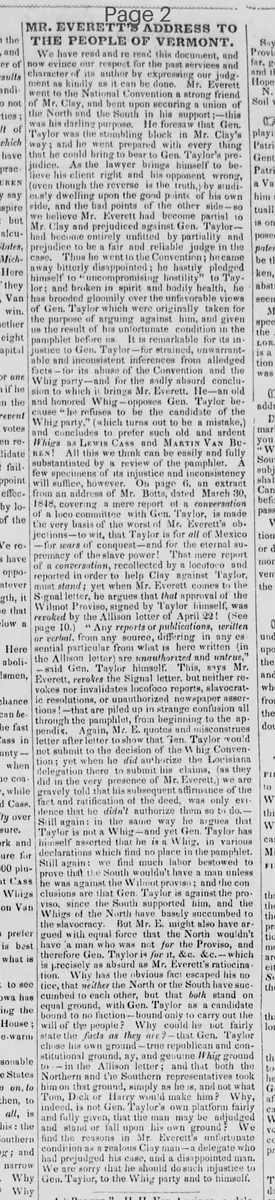
We have read and re-read this document, and now evince our respect for the past services and character of its author by expressing our judgment as kindly as it can be done. Mr. Everett went to the National Convention a strong friend of Mr. Clay, and bent upon securing a union of the North and the South in his support;-this was his darling purpose. He foresaw that Gen. Taylor was the stumbling block in Mr. Clay's way; and he went prepared with every thing that he could bring to bear to Gen. Taylor's prejudice. As the lawyer brings himself to believe his client right and his opponent wrong, (even though the reverse is the truth,) by studiously dwelling upon the good points of his own side, and the bad points of the other side-so we believe Mr. Everett had become partial to Mr. Clay and prejudiced against Gen. Taylor-had become entirely unfitted by partiality and prejudice to be a fair and reliable judge in the case. Thus he went to the Convention; came away bitterly disappointed: he hastily pledged himself to "uncompromising hostility" to Taylor: and broken in spirit and bodily health, he has brooded gloomily over the unfavorable views of Gen. Taylor which were originally taken for the purpose of arguing against him, and given us the result of his unfortunate condition in the pamphlet before us. It is remarkable for its injustice to Gen. Taylor-for strained, unwarrantable and inconsistent inferences from alleged facts -for its abuse of the Convention and the Whig party-and for the sadly absurd conclusion to which it brings Mr. Everett. He-an old and honored Whig -opposes Gen. Taylor because "he refuses to be the candidate of the Whig party," (which turns out to be a mistake,) and concludes to prefer such old and ardent Whigs as Lewis Cass and Martin Van Buren! All this we think can be easily and fully substantiated by a review of the pamphlet. A few specimens of its injustice and inconsistency will suffice, however. On page 6, an extract from an address of Mr. Botts, dated March 30, 1848, covering a mere report of a conversation of a loco committee with Gen. Taylor, is made the very basis of the worst of Mr. Everett's objections-to wit, that Taylor is for all of Mexico-for wars of conquest-and for the eternal supremacy of the slave power! That mere report of a conversation, recollected by a locofoco and reported in order to help Clay against Taylor, must stand; yet when Mr. Everett comes to the Signal letter, he argues that that approval of the Wilmot Proviso, signed by Taylor himself, was revoked by the Allison letter of April 22! (See page 10.) "Any reports or publications, written or verbal, from any source, differing in any essential particular from what is here written (in the Allison letter) are unauthorized and untrue,"-said Gen. Taylor himself. This, says Mr. Everett, revokes the Signal letter, but neither revokes nor invalidates locofoco reports, slavocratic resolutions, or unauthorized newspaper assertions!-that are piled up in strange confusion all through the pamphlet, from beginning to the appendix. Again, Mr. E. quotes and misconstrues letter after letter to show that Gen. Taylor would not submit to the decision of the Whig Convention; yet when he did authorize the Louisiana delegation there to submit his claims, (as they did in the very presence of Mr. Everett,) we are gravely told that his subsequent affirmance of the fact and ratification of the deed, was only evidence that he didn't authorize them so to do. Still again: in the same way he argues that Taylor is not a Whig-and yet Gen. Taylor has himself asserted that he is a Whig, in various declarations which find no place in the pamphlet. Still again: we find much labor bestowed to prove that the South wouldn't have a man unless he was against the Wilmot proviso; and the conclusions are that Gen. Taylor is against the proviso, since the South supported him, and the Whigs of the North have basely succumbed to the slavocracy. But Mr. E. might also have argued with equal force that the North wouldn't have a man who was not for the Proviso, and therefore Gen. Taylor is for it, &c. &c.--which is precisely as absurd as Mr. Everett's ratiocination. Why has the obvious fact escaped his notice, that neither the North or the South have succumbed to each other, but that both stand on equal ground, with Gen. Taylor as a candidate bound to no faction--bound only to carry out the will of the people? Why could he not fairly state the facts as they are ? -that Gen. Taylor chose his own ground-true republican and constitutional ground, and genuine Whig ground too -in the Allison letter; and that both the Northern and the Southern representatives took him on that ground, simply as he is, and not what Tom, Dick or Harry would make him? Why indeed, is not Gen. Taylor's own platform fairly and fully given, that the man may be adjudged and stand or fall upon his own ground? We find the reasons in Mr. Everett's unfortunate condition as a zealous Clay man-a delegate who had prejudged his case, and a disappointed man. We are sorry that he should do such injustice to Gen. Taylor.
THE PEOPLE OF VERMONT.
We have read and re-read this document, and now evince our respect for the past services and character of its author by expressing our judgment as kindly as it can be done. Mr. Everett went to the National Convention a strong friend of Mr. Clay, and bent upon securing a union of the North and the South in his support;-this was his darling purpose. He foresaw that Gen. Taylor was the stumbling block in Mr. Clay's way; and he went prepared with every thing that he could bring to bear to Gen. Taylor's prejudice. As the lawyer brings himself to believe his client right and his opponent wrong, (even though the reverse is the truth,) by studiously dwelling upon the good points of his own side, and the bad points of the other side-so we believe Mr. Everett had become partial to Mr. Clay and prejudiced against Gen. Taylor-had become entirely unfitted by partiality and prejudice to be a fair and reliable judge in the case. Thus he went to the Convention; came away bitterly disappointed: he hastily pledged himself to "uncompromising hostility" to Taylor: and broken in spirit and bodily health, he has brooded gloomily over the unfavorable views of Gen. Taylor which were originally taken for the purpose of arguing against him, and given us the result of his unfortunate condition in the pamphlet before us. It is remarkable for its injustice to Gen. Taylor-for strained, unwarrantable and inconsistent inferences from alleged facts -for its abuse of the Convention and the Whig party-and for the sadly absurd conclusion to which it brings Mr. Everett. He-an old and honored Whig -opposes Gen. Taylor because "he refuses to be the candidate of the Whig party," (which turns out to be a mistake,) and concludes to prefer such old and ardent Whigs as Lewis Cass and Martin Van Buren! All this we think can be easily and fully substantiated by a review of the pamphlet. A few specimens of its injustice and inconsistency will suffice, however. On page 6, an extract from an address of Mr. Botts, dated March 30, 1848, covering a mere report of a conversation of a loco committee with Gen. Taylor, is made the very basis of the worst of Mr. Everett's objections-to wit, that Taylor is for all of Mexico-for wars of conquest-and for the eternal supremacy of the slave power! That mere report of a conversation, recollected by a locofoco and reported in order to help Clay against Taylor, must stand; yet when Mr. Everett comes to the Signal letter, he argues that that approval of the Wilmot Proviso, signed by Taylor himself, was revoked by the Allison letter of April 22! (See page 10.) "Any reports or publications, written or verbal, from any source, differing in any essential particular from what is here written (in the Allison letter) are unauthorized and untrue,"-said Gen. Taylor himself. This, says Mr. Everett, revokes the Signal letter, but neither revokes nor invalidates locofoco reports, slavocratic resolutions, or unauthorized newspaper assertions!-that are piled up in strange confusion all through the pamphlet, from beginning to the appendix. Again, Mr. E. quotes and misconstrues letter after letter to show that Gen. Taylor would not submit to the decision of the Whig Convention; yet when he did authorize the Louisiana delegation there to submit his claims, (as they did in the very presence of Mr. Everett,) we are gravely told that his subsequent affirmance of the fact and ratification of the deed, was only evidence that he didn't authorize them so to do. Still again: in the same way he argues that Taylor is not a Whig-and yet Gen. Taylor has himself asserted that he is a Whig, in various declarations which find no place in the pamphlet. Still again: we find much labor bestowed to prove that the South wouldn't have a man unless he was against the Wilmot proviso; and the conclusions are that Gen. Taylor is against the proviso, since the South supported him, and the Whigs of the North have basely succumbed to the slavocracy. But Mr. E. might also have argued with equal force that the North wouldn't have a man who was not for the Proviso, and therefore Gen. Taylor is for it, &c. &c.--which is precisely as absurd as Mr. Everett's ratiocination. Why has the obvious fact escaped his notice, that neither the North or the South have succumbed to each other, but that both stand on equal ground, with Gen. Taylor as a candidate bound to no faction--bound only to carry out the will of the people? Why could he not fairly state the facts as they are ? -that Gen. Taylor chose his own ground-true republican and constitutional ground, and genuine Whig ground too -in the Allison letter; and that both the Northern and the Southern representatives took him on that ground, simply as he is, and not what Tom, Dick or Harry would make him? Why indeed, is not Gen. Taylor's own platform fairly and fully given, that the man may be adjudged and stand or fall upon his own ground? We find the reasons in Mr. Everett's unfortunate condition as a zealous Clay man-a delegate who had prejudged his case, and a disappointed man. We are sorry that he should do such injustice to Gen. Taylor.
What sub-type of article is it?
Partisan Politics
Slavery Abolition
What keywords are associated?
Whig Convention
Zachary Taylor
Henry Clay
Edward Everett
Wilmot Proviso
Slave Power
Partisan Prejudice
What entities or persons were involved?
Edward Everett
Zachary Taylor
Henry Clay
Whig National Convention
Lewis Cass
Martin Van Buren
John M. Botts
Editorial Details
Primary Topic
Critique Of Edward Everett's Opposition To Zachary Taylor
Stance / Tone
Strongly Pro Taylor And Anti Everett Bias
Key Figures
Edward Everett
Zachary Taylor
Henry Clay
Whig National Convention
Lewis Cass
Martin Van Buren
John M. Botts
Key Arguments
Everett's Prejudice Against Taylor Stems From Clay Support
Pamphlet Unjustly Accuses Taylor Of Conquest And Slave Power Supremacy Based On Biased Reports
Inconsistent Treatment Of Taylor's Letters On Wilmot Proviso
Misconstrues Taylor's Submission To Whig Convention
Absurd Conclusion To Support Democrats Like Cass And Van Buren Over Taylor
Taylor Stands On Neutral Ground Acceptable To Both North And South