Thank you for visiting SNEWPapers!
Sign up free
The Enquirer
Richmond, Henrico County, Virginia
What is this article about?
Analysis of French government's decision to cease Decrees on November 1st, conditional on British revocation or US resistance via non-intercourse act. Discusses implications for US trade with France, including Decree of Trianon on imports, and urges US to oppose Britain commercially.
Clipping
OCR Quality
Full Text
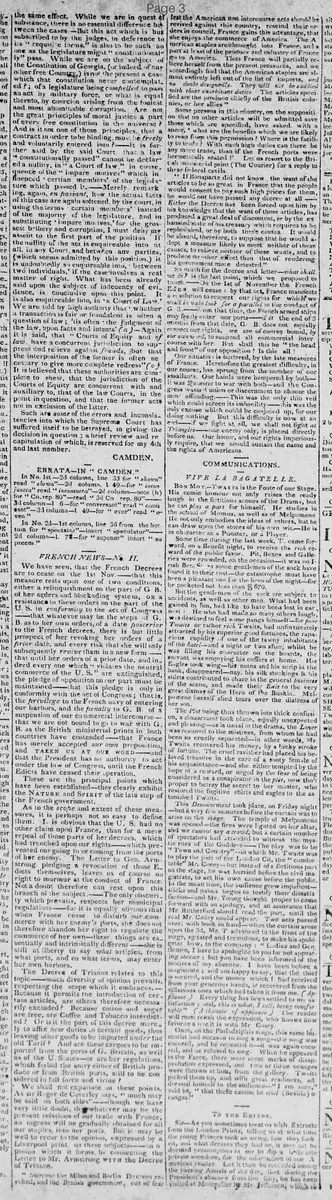
We have seen, that the French Decrees are to cease on the 1st Nov.--that this measure rests upon one of two conditions, either a relinquishment on the part of G B. of her orders and blockading system, or a resistance to these orders on the part of the U. S. in conformity to the act of Congress -that whatever may be the steps of G. B. as to her own orders, of a date posterior to the French decrees, there is but little prospect of her revoking her orders of a prior date, and every risk that she will only subsequently revive them in a new form. that until her orders of a prior date, and indeed every one which "violates the neutral commerce of the U. S." are extinguished, the pledge of opposition on our part must be maintained--that this pledge is only in conformity with the act of Congress; that is, the privilege to the French navy of entering our harbors, and the penalty to G. B. of a suspension of our commercial intercourse--- that we are not bound to go to war with G. B. as the British ministerial prints in both countries have contended--that France has merely accepted our own proposition, and TAKEN US AT OUR WORD-And that the President has no authority to act under the law of Congress, until the French Edicts have ceased their operation.
These are the principal points which have been established--they clearly exhibit the NATURE and SPIRIT of the late step of the French government.
As to the scope and extent of these measures, it is perhaps not so easy to define them. It is obvious that the U. S. had no other claim upon France, than for a mere repeal of those parts of her decrees, which had trenched upon our rights--which prevented our going to or coming from the ports of her enemy. The Letter to Gen. Armstrong pledging a revocation of those Edicts themselves, leaves us of course no right to murmur at the conduct of France. No doubt therefore can rest upon this branch of the subject.---The only obscurity which prevails, respects her municipal regulations--for it is equally obvious that when France ceases to disturb our commerce with her enemy's ports, she does not therefore abandon her right to regulate the commerce of her own-these things are essentially and intrinsically different -she is still at liberty to say what articles, from what ports, and on what terms, may enter her own harbors.
The Decree of Trianon relates to this topic--much diversity of opinion prevails, respecting the scope which it embraces.- Because it permits the introduction of certain articles, are others therefore necessarily excluded? Because cotton and sugar are free, are Coffee and Tobacco interdicted ? Or is it the part of this decree merely to affix new duties to certain goods, thus leaving other goods to be imported under the old Tariff ? And are these cargoes to be imported from the ports of G. Britain, as well as of the U. States-or are her regulations, which forbid the entry either of British produce or from British ports, still to be considered in full force and virtue ?
We shall not expatiate on these points. As sir Roger de Coverley says, "much may be said on both sides"--though we have very little doubt, that whatever may be the present relations of our trade with France, an ingress will be gradually obtained for all our staples, into her ports. But it may be well to recur to the opinion, expressed by a Liverpool print, on these subjects---in one dimension which it forms, by Connecting. the Letter to Mr. Armstrong with the Decree of Trianon.
"Suppose the Milan and Berlin Decrees revoked, and the British government, lest the American non intercourse acts should be revived against this country, rescind their orders in council, France gains this advantage, that she enjoys the commerce of America The American staples are brought into France, and a part at least of the produce and industry of France go to America. Thus France will partially relieve herself from the present pressures, and we accordingly find that the American staples are almost entirely left out of the list of imports, and no doubt designedly. They will not be saddled with those exorbitant duties The articles specified are the produce chiefly of the British colonies, or her allies"
Some persons in this country, on the supposition that no other articles will be admitted save those which are specified, have asked, with a sneer, 'what are the benefits which we are likely to reap from this permission ? Where is the facility to trade? with such high duties can there be any more trade, than if the French ports were hermetically sealed ?' Let us resort to the Bri. tish ministerial print (The Courier) for a reply to these federal cavils.
"If Bonaparte did not know the want of the articles to be so great in France that the people would consent to pay such high prices for them, he would not have passed any decree at all --- Either the Decree has been forced upon him by his knowledge that the want of those articles, has produced a great deal of discontent, or by the exhausted state of his treasury which requires to be replenished, or by both these causes. It would be absurd, therefore, to suppose that he would adopt a measure likely to meet neither of these causes, to relieve neither of these wants, and to produce no other effect than that of rendering his government more detested."
So much for the decree and letter-what shall we do? is the last point, which we proposed to touch.-On the 1st of November the French Edicts will cease : by that act, France manifests a resolution to respect our rights for which we shall in vain look for a parallel in the conduct of G B.-from that time, the French armed ships may freely enter our ports-n-if at the end of 3 months from that date, G. B. does not equally respect our rights, we are of course bound, by our own word, to suspend all commercial intercourse with her. But shall this be "the head and front" of our opposition? Is this all?
Our situation is bettered, by the late measures of France. Heretofore the greatest difficulty, in our course, has sprung from the number of our assailants. Our hands were hampered by both- it was Quixotic to war with both-and the Congress wanted union or discernment to choose the most offending.--This was the only thin veil which could screen its imbecility--this was the only excuse which could be conjured up, for our doing nothing But this difficulty is now at an end -if we fight at all, we shall not fight at Triangles-one enemy only, is placed directly before us. Our honor, and our rights imperiously require, that we should sustain the name and the rights of Americans.
What sub-type of article is it?
What keywords are associated?
What entities or persons were involved?
Where did it happen?
Foreign News Details
Primary Location
France
Event Date
1st Nov
Key Persons
Outcome
french decrees to cease on 1st nov under conditions; potential suspension of us commercial intercourse with gb after 3 months if orders not revoked; decree of trianon permits certain imports with duties, favoring american staples indirectly.
Event Details
French government pledges revocation of Decrees via Letter to Gen. Armstrong, ceasing on 1st Nov if GB revokes orders or US resists via Congress act. Decree of Trianon regulates imports into France, imposing duties on specified articles while leaving American staples like cotton and sugar relatively free. Analysis urges US to maintain opposition to GB's blockades through non-intercourse, now focusing on one enemy.