Thank you for visiting SNEWPapers!
Sign up free
Republican Herald
Providence, Providence County, Rhode Island
What is this article about?
Detailed proceedings of the Rhode Island House of Representatives from January 26-29, 1836, covering quorum formation, rule amendments, numerous petitions for bank charters and incorporations, resolutions on criminal law revision, election laws, state house repairs, militia changes, public lands distribution, and debates on convict liberations and international relations.
Merged-components note: These two components are a continuation of the General Assembly proceedings across pages 2 and 3, with sequential reading order
Clippings
1 of 2
OCR Quality
Full Text
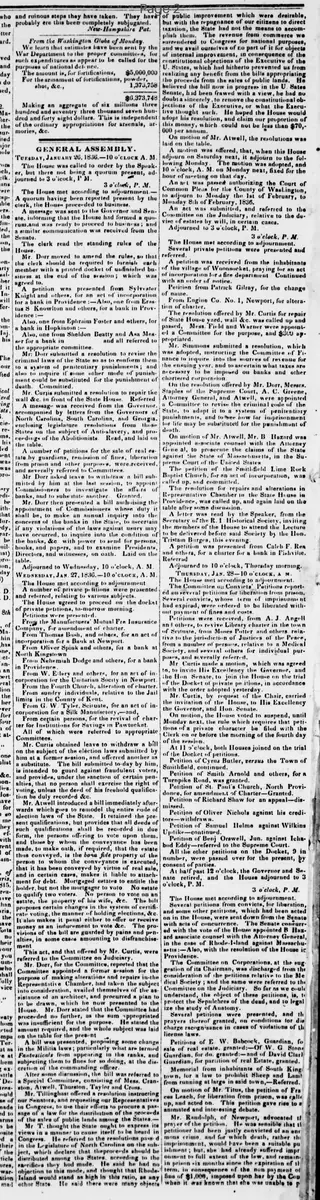
TUESDAY, JANUARY 26, 1836.—10 O'CLOCK A. M.
The House was called to order by the Speaker, but there not being a quorum present, adjourned to 3 o'clock, P.M.
3 o'clock, P. M.
The House met according to adjournment.—A quorum having been reported present by the clerk, the House proceeded to business.
A message was sent to the Governor and Senate, informing that the House had formed a quorum, and was ready to proceed to business; and a similar communication was received from the Senate.
The clerk read the standing rules of the House.
Mr. Dorr moved to amend the rules, so that the clerk should be required to furnish each member with a printed docket of unfinished business at the end of the session; which was agreed to.
A petition was presented from Sylvester Knight and others, for an act of incorporation for a bank in Providence:—Also, one from Erastus S. Knighton and others, for a bank in Providence:—
Also, one from Ephraim Foster and others, for a bank in Hopkinton :—
Also, one from Sheldon Beatty and Asa Messer for a bank in Scituate;—and all referred to the appropriate committee.
Mr. Dorr submitted a resolution to revise the criminal laws of the State so as to conform them to a system of penitentiary punishments; and also to inquire if some other mode of punishment could be substituted for the punishment of death. Committed.
Mr. Curtis submitted a resolution to repair the wall &c. in front of the State House. Referred.
A message was received from the Governor, accompanied by letters from the Governors of North Carolina, South Carolina, and Georgia, enclosing legislative resolutions from those States on the subject of Anti-slavery, and proceedings of the Abolitionists. Read, and laid on the table.
A number of petitions for the sale of real estate by guardians, remission of fines, liberation from prison and other purposes, were received, and severally referred to Committees.
Mr. Dorr asked leave to withdraw a bill submitted by him at the last session, to appoint Commissioners to investigate the affairs of banks, and to substitute another. Granted.
Mr. Dorr then presented a bill authorising the appointment of Commissioners whose duty it shall be, to make an annual inquiry into the concerns of the banks in the State, to ascertain if any violations of the laws against usury may have occurred, to inquire into the condition of the banks, &c. with power to send for persons, books, and papers, and to examine Presidents, Directors, and witnesses, on oath. Laid on the table.
Adjourned to Wednesday, 10 o'clock. A. M.
WEDNESDAY, JAN. 27, 1836.—10 O'CLOCK, A. M.
The House met according to adjournment.
A number of private petitions were presented and referred, relating to various subjects.
The House agreed to proceed on the docket of private petitions, to-morrow morning.
Petitions were presented.
From the Manufacturers' Mutual Fire Insurance Company, for amendment of charter.
From Thomas Bush, and others, for an act of incorporation for a Bank at Newport.
From Oliver Spink and others, for a bank at North Kingstown.
From Nehemiah Dodge and others, for a bank in Providence.
From W. Ellery and others, for an act of incorporation for the Unitarian Society in Newport.
From the Fourth Church, alteration of charter.
From sundry individuals, relative to the Jail limits in the County of Kent.
From G. W. Tyler, Scituate, for an act of incorporation for a Silk Manufactory,—and,
From certain persons, for the revival of charter for Institutions for Savings in Pawtucket.
All of which were referred to appropriate Committees.
Mr. Curtis obtained leave to withdraw a bill on the subject of the election laws submitted by him at a former session, and offered another as a substitute. The bill submitted to-day by him, is intended to guard against fraudulent voters, and provides, under the sanction of certain penalties, that no person shall exercise the right of voting, unless the deed of his freehold qualification be duly recorded &c.
Mr. Atwell introduced a bill immediately afterwards which goes to remodel the entire code of election laws of the State. It retained the present qualifications, but provides that all deeds of such qualifications shall be recorded in due form, the persons offering to vote upon them, and those by whom the conveyance has been made, to make oath, if required, that the estate thus conveyed, is the bona fide property of the person to whom the conveyance is executed, that it has been conveyed by virtue of real sale, and in certain cases, makes it liable to attachment for debt. Mortgaged estates to entitle the holder, but not the mortgager to vote. No estate to qualify two voters. No person to vote on an estate, the property of his wife, &c. The bill proposes certain changes in the system of certificate voting, the manner of holding elections, &c. It also makes it penal either to offer or receive money as an inducement to vote &c. The provisions of the bill are guarded by pains and penalties, in some cases amounting to disfranchisement.
This act, and that offered by Mr. Curtis, were referred to the Committee on Judiciary.
Mr. Dorr, for the Committee, reported that the Committee appointed a former session for the purpose of making alterations and repairs in the Representative Chamber, had taken the subject into consideration, availed themselves of the assistance of an architect, and procured a plan to be drawn, which he now presented to the House. Mr. Dorr stated that the Committee had proceeded no further, as the sum appropriated was insufficient for the purpose. He stated the amount required, and the whole subject was laid on the table for the present.
A bill was presented, proposing some change in the Militia laws; particularly what are termed Fantasticals from appearing in the ranks, and subjecting them to fines for so doing, at the discretion of the commanding officer.
After some discussion, the bill was referred to a Special Committee, consisting of Messrs. Cranston, Atwell, Thurston, Taylor and Cross.
Mr. Tillinghast offered a resolution instructing our Senators, and requesting our Representatives in Congress, to use their efforts to procure a passage of a law for the distribution of the proceeds of the sales of public lands among the States.—
Mr. T. thought the State ought to express its views in a manner to cause itself to be heard in Congress. He referred to the resolutions passed in the Legislature of North Carolina on the subject, which declare that the proceeds should be distributed among the States, according to the sacrifices they had made. He said he had no objection to this mode, and thought that Rhode-Island would stand as high in this ratio, as any other State. He said there were many objects of public improvement which were desirable, but with the repugnance of our citizens to direct taxation, the State had not the means to accomplish them. The revenue from commerce we surrendered to Congress for national purposes, and we avail ourselves of no part of it for objects of internal improvement, in consequence of the constitutional objections of the Executive of the U. States, which had hitherto prevented us from realizing any benefit from the bills appropriating the proceeds from the sales of public lands. He believed the bill now in progress in the U. States Senate, had been framed with a view, he had no doubt sincerely, to remove the constitutional objections of the Executive, or what the Executive thought such. He hoped the House would adopt his resolution, and claim our proportion of this money, which could not be less than $70,000 per annum.
On motion of Mr. Atwell, the resolution was laid on the table.
A motion was offered, that, when this House adjourn on Saturday next, it adjourn to the following Monday. The motion was adopted, and 10 o'clock, A. M. on Monday next, fixed for the hour of meeting on that day.
An act was passed authorizing the Court of Common Pleas for the County of Washington, to adjourn to Monday the 1st of February, to Monday 8th of February, 1836.
An act was submitted, and referred to the Committee on the Judiciary, relative to the devise of estates by will, in certain cases.
Adjourned to 3 o'clock, P. M.
3 o'clock, P. M.
The House met according to adjournment.
Several private petitions were presented and referred.
A petition was received from the inhabitants of the village of Woonsocket, praying for an act of incorporation for a fire department. Continued with an order of notice.
Petition from Patrick Gilray, for the change of name.
From Engine Co. No. 1, Newport, for alteration of charter.
The resolution offered by Mr. Curtis for repair of State House yard, wall &c. was called up and passed, Messrs. Field and Warner were appointed a Committee for the purpose, and $300 appropriated.
Mr. Simmons submitted a resolution, which was adopted, instructing the Committee of Finance to inquire into the sources of revenue for the ensuing year, and to ascertain what taxes are necessary to be imposed on banks and other chartered corporations.
On the resolution offered by Mr. Dorr, Messrs. Staples of the Supreme Court, A. C. Greene, Attorney General, and Atwell, were appointed a Committee to revise the criminal code of the State, to adapt it to a system of penitentiary punishments, and to see how far imprisonment for life may be substituted for the punishment of death.
On motion of Mr. Atwell, Mr. B. Hazard was appointed associate counsel with the Attorney General, to prosecute the claims of the State against the State of Massachusetts, in the Supreme Court of the United States.
The petition of the Smithfield Lime Rock Baptist Church, for an act of incorporation, was called up, and committed.
The resolution for repairs and alterations in Representative Chamber in the State House in Providence, was called up, and again laid on the table after some discussion.
A letter was read by the Speaker, from the Secretary of the R. I. Historical Society, inviting the members of the House to attend the Lecture to be delivered before said Society by the Hon. Tristram Burges, this evening.
A petition was presented from Caleb F. Ren and others, for a charter for a bank in Fishville. Referred.
Adjourned to 10 o'clock, Thursday morning.
THURSDAY, JAN. 28—10 O'CLOCK, A. M.
The House met according to adjournment.
The Committee on Convicts' Petitions reported on several petitions for liberation from prison. Several convicts, whose term of imprisonment had expired, were ordered to be liberated without payment of fines and costs.
Petitions were received, from A. J. Angell and others, to revive Library charter in the town of Scituate, from Moses Potter and others relative to the jurisdiction of Justices of the Peace, from a number of persons, relative to a Medical Society, and several others for individual purposes, and severally referred.
Mr. Curtis made a motion, which was agreed to, to invite His Excellency the Governor, and the Hon. Senate, to join the House on the trial of the Docket of private petitions, in accordance with the order adopted yesterday.
Mr. Curtis, by request of the Chair, carried the invitation of the House, to His Excellency the Governor, and Hon. Senate.
On motion, the House voted to suspend, until Monday next, the rule which requires that petitions of a private character be filed with the Clerk on or before the morning of the fourth day of the session.
At 11 o'clock, both Houses joined on the trial of the Docket of petitions.
Petition of Cyrus Butler, versus the Town of Smithfield, continued.
Petition of Smith Arnold and others, for a Turnpike Road, was granted.
Petition of St. Paul's Church, North, Providence, for amendment of Charter—Granted.
Petition of Richard Shaw for an appeal—dismissed.
Petition of Oliver Nichols against his creditors—withdrawn.
Petition of Samuel Helme against Wilkins Undike—continued.
Petition of Benj. Orswell, Jun. against Ichabod Eddy—referred to the Supreme Court.
All the other petitions on the Docket, 9 in number, were passed over for the present, by consent of parties.
At half past 12 o'clock, the Governor and Senate retired, and the House adjourned to 3 o'clock, P. M.
3 o'clock, P. M.
The House met according to adjournment.
Several petitions from convicts, for liberation, and some other petitions, which had been acted on in the House, were sent down from the Senate with acts of concurrence. The Senate concurred with the vote of the House appointing B. Hazard associate counsel with the Attorney General in the case of Rhode-Island against Massachusetts:—Also, with the resolution of the House in relation to repairs of the State House in Providence.
The Committee on Corporations, at the suggestion of its Chairman, was discharged from the consideration of the petitions relative to the Medical Society; and the same were referred to the Committee on the Judiciary. So far as we could understand, the object of these petitions, is, to protect the Sepulchres of the dead, and to legalize the study of Anatomy.
Several petitions were presented, and the prayers thereof granted, on conditions for discharge recognisance in cases of violations of the license laws.
Petitions of E. W. Babcock, Guardian, for sale of real estate, granted:—Of W. G. Stone Guardian, for do. granted: and of David Clark Guardian, for partition of real Estate, granted.
Memorial from inhabitants of South Kingstown, for a law to prohibit Sheep and Lambs from running at large in said town,—Referred.
On motion of Mr. Titus, the petition of Frances Leach, for liberation from prison, was called up, and acted on. This petition gave rise to a animated and interesting debate.
Mr. Randolph, of Newport, advocated the prayer of the petition. He was sensible that the petitioner had been justly convicted of an enormous crime, and for which death, rather than imprisonment, would have been a suitable punishment; but, she had already suffered imprisonment to full extent of the law, and remained in prison six months since the expiration of the term, in consequence of the non payment of fine of $1000, imposed upon her by the Court, when it was known that she was unable to pay.
1,000 cents. If the term of imprisonment were not sufficient, Mr. R. contended the law was in fault. He said, let the law award a definite term of imprisonment, long or short, and he would not interfere. But he would not give his vote to punish a person for poverty, and he could consider the extension of the term of imprisonment in this case, in no other light, because had she been a rich person, she would have paid the fine and obtained her liberty. He deprecated the principle, that the General Assembly should continue to hold convicts in confinement during pleasure, which under a thousand circumstances, such as a press of business, personal influence, &c. might become arbitrary and oppressive. He said he thought we lived under a government of laws; but, if such proceedings were to be had, we had nothing of liberty, and violated our constitution of government, and the spirit of our institutions.
Mr. Tillinghast replied. He contended that there was no injustice in the case: That the Supreme Court, considering the enormity of the offence, not thinking two years imprisonment sufficient, had imposed the fine, knowing it could not be paid, obviously with the intention of extending the term of imprisonment beyond what the law empowered them otherwise to do. He said that to liberate the prisoner, would be to defeat the intention of the Court, and to hold out an inducement to crime. He thought that terror was the most effectual means in the hands of Courts and Legislatures to prevent the commission of crime, and that, in this case particularly, the salutary example should be carried out. He disclaimed the idea, that the imprisonment which accrued from the non-payment of the fine was a punishment for poverty. It was a punishment for the crime; and would be so considered by a person who was able to pay it. The pardoning power, he said, was lodged in the legislature: and as the legislature had the power to pardon or not to pardon, at its option, this implied the authority to continue imprisonment at its option, &c.
Mr. Randolph rejoined—Mr. Tillinghast replied—several other gentlemen offered some remarks, but the above contained the principal points and substance of the arguments.
A motion to postpone, was made but did not prevail; and, finally, the prayer of the petition was granted, on condition that the petitioner leave the State.
Adjourned to 10 o'clock, to-morrow morning.
FRIDAY. January 29—10 o'clock. A. M.
The House met according to adjournment.
Several private petitions, the prayers of which had been granted by the House came down from the Senate, with votes of concurrence.
A resolution was also received from the Senate, requiring Clerks of towns, &c. to make returns of the number of deaf and dumb persons in the State, their ages, circumstances, &c.
Mr. D'Wolf of Bristol, moved the appointment of a committee, to report resolutions expressing the sense of the General Assembly, on the question of war with France. Mr. D'Wolf made some remarks on the extent of the commerce in Rhode Island, and the dangers to which it would be exposed, in the result of a war with France. Mr. D'Wolf said he was a fighting character, and would not give back when the honor of the country was at stake, but thought the contingency had not arrived. France owed us money, but has not denied the debt, and although some difficulties existed, thought they might be easily removed. He did not wish that our government should precipitately enter into a war, and thought that they ought to be admonished of it by the States. It might be kept off one or two years, and perhaps forever.
Mr. Titus, with a view to an understanding on the subject, wished to lay the motion on the table, for the present, that no undue feelings might be created.
Mr. Randolph saw no objection to an immediate commitment of the subject, inasmuch as a committee could do nothing more than propose resolutions on which the House might act as they thought proper. Mr. Randolph thought no man in the State would wish to compromise the honor of the government to avoid a war.
Mr. Tillinghast hoped the resolution would not be immediately acted on. He thought the legislature had not yet had sufficient information to enable them to act understandingly on the subject—was opposed to acting at present, or to interfere with the government, until something more definite shall be known. He thought that the action of the States might have an important bearing. On one side, they might induce the French to hold on, and our government to take steps which might involve us in war. The difficulties between the two countries, he averred, originated in a mere question of etiquette, which he hoped might yet be adjusted. He was opposed to acting on the question at present.
Mr. D'Wolf finally consented to the suggestion of Mr. Titus, and the motion was withdrawn for the present.
The petition of Amtress Waterman and others for a new trustee—granted.
On petition of Thomas Warren, Guardian of George E. Warren, minor, for liberty to sell real estate, a long debate ensued, which occupied the remainder of the morning session.
During the debate, a Message was received from the Governor, enclosing the resignation of W. R. Staples as a member of State Prison Committee. Accepted.
The petition of Thomas Warren, rejected.
Adjourned to half past three, P. M.
The proceedings of the afternoon were of little interest, and we omit them till Wednesday, as we did not receive them till a late hour.
What sub-type of article is it?
What keywords are associated?
What entities or persons were involved?
Where did it happen?
Domestic News Details
Primary Location
Providence, Rhode Island
Event Date
January 26 29, 1836
Key Persons
Outcome
various petitions granted, referred, or rejected; resolutions adopted or tabled; committees appointed; convict liberations ordered with conditions; bills introduced and referred.
Event Details
The Rhode Island House of Representatives convened over four days, handling quorum, rules amendments, multiple petitions for bank incorporations in Providence, Hopkinton, Scituate, Newport, North Kingstown, and Fishville, church charters, fire departments, and other incorporations. Resolutions addressed criminal law revision to penitentiary system and alternatives to death penalty, state house repairs, bank investigations, election law reforms against fraud, militia changes, public lands distribution, and revenue inquiries. Debates occurred on convict liberations, including Frances Leach's case granted on condition of leaving the state, and potential war with France. Joint sessions processed private petitions with grants, dismissals, continuations, and referrals.