Thank you for visiting SNEWPapers!
Sign up free
Editorial
October 14, 1811
Virginia Argus
Richmond, Virginia
What is this article about?
Editorial from Federal Republican attacks Federalists' pro-British stance in Jay's Treaty, focusing on rejected twelfth article that restricted U.S. West Indies trade to small vessels, banned key exports, and favored British shipping, crediting Republicans for opposition.
Clipping
OCR Quality
98%
Excellent
Full Text
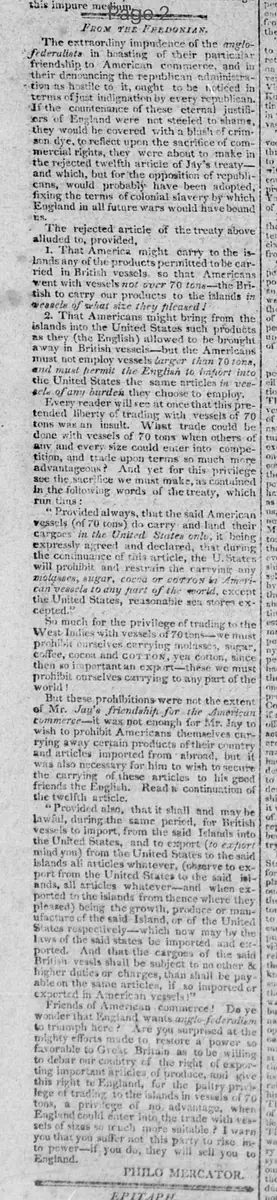
FROM THE FEDERAL REPUBLICAN.
The extraordinary impudence of the anglo-federalists in boasting of their particular friendship to American commerce, and in their denouncing the republican administration as hostile to it, ought to be noticed in terms of just indignation by every republican. If the countenance of these eternal justificrs of England were not steeled to shame, they would be covered with a blush of crimson dye, to reflect upon the sacrifice of commercial rights, they were about to make in the rejected twelfth article of Jay's treaty—and which, but for the opposition of republicans, would probably have been adopted, fixing the terms of colonial slavery by which England in all future wars would have bound us.
The rejected article of the treaty above alluded to, provided,
1. That America might carry to the islands any of the products permitted to be carried in British vessels, so that Americans went with vessels not over 70 tons—the British to carry our products to the islands in vessels of what size they pleased!
2. That Americans might bring from the islands into the United States such products as they (the English) allowed to be brought away in British vessels—but the Americans must not employ vessels larger than 70 tons, and must permit the English to import into the United States the same articles in vessels of any burden they choose to employ.
Every reader will see at once that this pretended liberty of trading with vessels of 70 tons was an insult. What trade could be done with vessels of 70 tons when others of any and every size could enter into competition, and trade upon terms so much more advantageous? And yet for this privilege some the sacrifice we must make, as contained in the following words of the treaty, which run thus:
"Provided always, that the said American vessels (of 70 tons) do carry and land their cargoes in the United States only, it being expressly agreed and declared, that during the continuance of this article, the U. States will prohibit and restrain the carrying any molasses, sugar, cocoa or cotton in American vessels to any part of the world, except the United States, reasonable sea stores excepted."
So much for the privilege of trading to the West Indies with vessels of 70 tons—we must prohibit ourselves carrying molasses, sugar, coffee, cocoa and cotton, yea cotton, since then so important an export—these we must prohibit ourselves carrying to any part of the world!
But these prohibitions were not the extent of Mr. Jay's friendship for the American commerce—it was not enough for Mr. Jay to wish to prohibit Americans themselves carrying away certain products of their country and articles imported from abroad, but it was also necessary for him to wish to secure the carrying of these articles to his good friends the English. Read a Continuation of the twelfth article.
"Provided also, that it shall and may be lawful, during the same period, for British vessels to import, from the said Islands into the United States, and to export (to export mind you) from the United States to the said islands all articles whatever, (observe to export from the United States to the said islands, all articles whatever—and when exported to the islands from thence where they pleased) being the growth, produce or manufacture of the said Island, or of the United States respectively—which now may by the laws of the said states be imported and exported. And that the cargoes of the said British vessels shall be subject to no other & higher duties or charges, than shall be payable on the same articles, if so imported or exported in American vessels!"
Friends of American Commerce! Do ye wonder that England wants anglo-federalism to triumph here? Are you surprised at the mighty efforts made to restore a power so favorable to Great Britain as to be willing to debar our country of the right of exporting important articles of produce, and give this right to England, for the paltry privilege of trading to the islands in vessels of 70 tons, a privilege of no advantage, when England could enter into the trade with vessels of sizes so much more suitable? I warn you that you suffer not this party to rise into power—if you do, they will sell you to England.
PHILO MERCATOR.
The extraordinary impudence of the anglo-federalists in boasting of their particular friendship to American commerce, and in their denouncing the republican administration as hostile to it, ought to be noticed in terms of just indignation by every republican. If the countenance of these eternal justificrs of England were not steeled to shame, they would be covered with a blush of crimson dye, to reflect upon the sacrifice of commercial rights, they were about to make in the rejected twelfth article of Jay's treaty—and which, but for the opposition of republicans, would probably have been adopted, fixing the terms of colonial slavery by which England in all future wars would have bound us.
The rejected article of the treaty above alluded to, provided,
1. That America might carry to the islands any of the products permitted to be carried in British vessels, so that Americans went with vessels not over 70 tons—the British to carry our products to the islands in vessels of what size they pleased!
2. That Americans might bring from the islands into the United States such products as they (the English) allowed to be brought away in British vessels—but the Americans must not employ vessels larger than 70 tons, and must permit the English to import into the United States the same articles in vessels of any burden they choose to employ.
Every reader will see at once that this pretended liberty of trading with vessels of 70 tons was an insult. What trade could be done with vessels of 70 tons when others of any and every size could enter into competition, and trade upon terms so much more advantageous? And yet for this privilege some the sacrifice we must make, as contained in the following words of the treaty, which run thus:
"Provided always, that the said American vessels (of 70 tons) do carry and land their cargoes in the United States only, it being expressly agreed and declared, that during the continuance of this article, the U. States will prohibit and restrain the carrying any molasses, sugar, cocoa or cotton in American vessels to any part of the world, except the United States, reasonable sea stores excepted."
So much for the privilege of trading to the West Indies with vessels of 70 tons—we must prohibit ourselves carrying molasses, sugar, coffee, cocoa and cotton, yea cotton, since then so important an export—these we must prohibit ourselves carrying to any part of the world!
But these prohibitions were not the extent of Mr. Jay's friendship for the American commerce—it was not enough for Mr. Jay to wish to prohibit Americans themselves carrying away certain products of their country and articles imported from abroad, but it was also necessary for him to wish to secure the carrying of these articles to his good friends the English. Read a Continuation of the twelfth article.
"Provided also, that it shall and may be lawful, during the same period, for British vessels to import, from the said Islands into the United States, and to export (to export mind you) from the United States to the said islands all articles whatever, (observe to export from the United States to the said islands, all articles whatever—and when exported to the islands from thence where they pleased) being the growth, produce or manufacture of the said Island, or of the United States respectively—which now may by the laws of the said states be imported and exported. And that the cargoes of the said British vessels shall be subject to no other & higher duties or charges, than shall be payable on the same articles, if so imported or exported in American vessels!"
Friends of American Commerce! Do ye wonder that England wants anglo-federalism to triumph here? Are you surprised at the mighty efforts made to restore a power so favorable to Great Britain as to be willing to debar our country of the right of exporting important articles of produce, and give this right to England, for the paltry privilege of trading to the islands in vessels of 70 tons, a privilege of no advantage, when England could enter into the trade with vessels of sizes so much more suitable? I warn you that you suffer not this party to rise into power—if you do, they will sell you to England.
PHILO MERCATOR.
What sub-type of article is it?
Trade Or Commerce
Foreign Affairs
Partisan Politics
What keywords are associated?
Jay's Treaty
West Indies Trade
American Commerce
Federalists
England
Vessel Restrictions
Export Prohibitions
What entities or persons were involved?
Anglo Federalists
Republican Administration
England
Mr. Jay
Philo Mercator
Editorial Details
Primary Topic
Criticism Of Jay's Treaty Twelfth Article On West Indies Trade
Stance / Tone
Strongly Anti Federalist And Pro Republican, Warning Against British Favoritism
Key Figures
Anglo Federalists
Republican Administration
England
Mr. Jay
Philo Mercator
Key Arguments
Federalists Boast Friendship To American Commerce While Supporting Jay's Treaty That Sacrificed It
Rejected Twelfth Article Limited American Vessels To 70 Tons For West Indies Trade, Allowing British Any Size
Article Prohibited U.S. From Exporting Molasses, Sugar, Coffee, Cocoa, Cotton To Anywhere But U.S.
British Vessels Could Import/Export Freely Between U.S. And Islands Without Restrictions
This Gave England Advantageous Trade Rights At U.S. Expense
Republicans Opposed The Article, Preventing Its Adoption
Federalists Would Sell U.S. Commerce To England If Returned To Power