Thank you for visiting SNEWPapers!
Sign up free
Story
July 29, 1892
Iowa County Democrat
Mineral Point, Iowa County, Wisconsin
What is this article about?
Cultural observation on Parisians' dedicated enjoyment of theater, attending with fixed intent, full absorption, and acute boredom if displeased, unlike American habits; they stay for full experience due to taste and economy. (214 characters)
Clipping
OCR Quality
95%
Excellent
Full Text
PARISIANS AT THE THEATER.
They Go There With the Fixed Purpose of Enjoying Themselves.
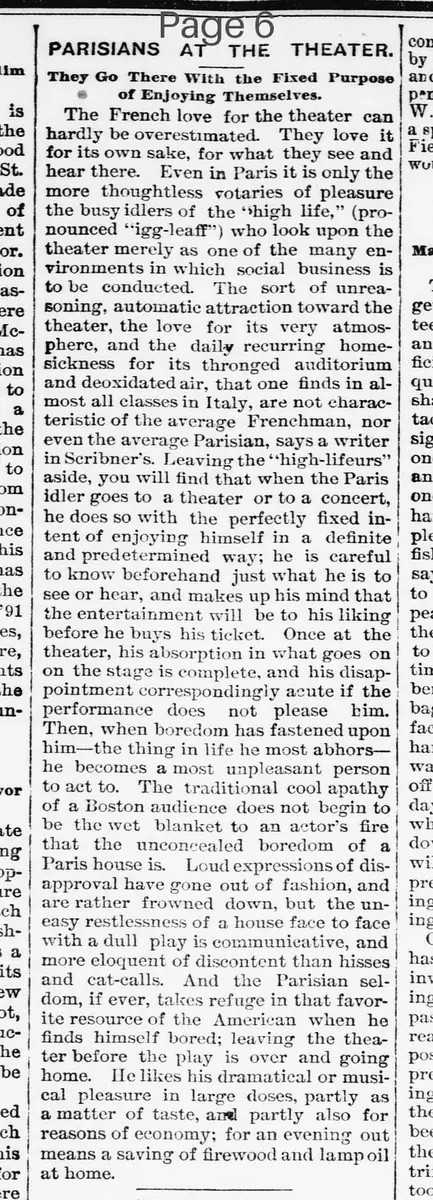
The French love for the theater can hardly be overestimated. They love it for its own sake, for what they see and hear there. Even in Paris it is only the more thoughtless votaries of pleasure the busy idlers of the 'high life,' (pronounced 'high-leaff') who look upon the theater merely as one of the many environments in which social business is to be conducted. The sort of unreasoning, automatic attraction toward the theater, the love for its very atmosphere, and the daily recurring home-sickness for its thronged auditorium and deoxidated air, that one finds in almost all classes in Italy, are not characteristic of the average Frenchman, nor even the average Parisian, says a writer in Scribner's. Leaving the 'high-lifeurs' aside, you will find that when the Paris idler goes to a theater or to a concert, he does so with the perfectly fixed intent of enjoying himself in a definite and predetermined way; he is careful to know beforehand just what he is to see or hear, and makes up his mind that the entertainment will be to his liking before he buys his ticket. Once at the theater, his absorption in what goes on on the stage is complete, and his disappointment correspondingly acute if the performance does not please him. Then, when boredom has fastened upon him—the thing in life he most abhors—he becomes a most unpleasant person to act to. The traditional cool apathy of a Boston audience does not begin to be the wet blanket to an actor's fire that the unconcealed boredom of a Paris house is. Loud expressions of disapproval have gone out of fashion, and are rather frowned down, but the uneasy restlessness of a house face to face with a dull play is communicative, and more eloquent of discontent than hisses and cat-calls. And the Parisian seldom, if ever, takes refuge in that favorite resource of the American when he finds himself bored; leaving the theater before the play is over and going home. He likes his dramatical or musical pleasure in large doses, partly as a matter of taste, and partly also for reasons of economy; for an evening out means a saving of firewood and lamp oil at home.
They Go There With the Fixed Purpose of Enjoying Themselves.
The French love for the theater can hardly be overestimated. They love it for its own sake, for what they see and hear there. Even in Paris it is only the more thoughtless votaries of pleasure the busy idlers of the 'high life,' (pronounced 'high-leaff') who look upon the theater merely as one of the many environments in which social business is to be conducted. The sort of unreasoning, automatic attraction toward the theater, the love for its very atmosphere, and the daily recurring home-sickness for its thronged auditorium and deoxidated air, that one finds in almost all classes in Italy, are not characteristic of the average Frenchman, nor even the average Parisian, says a writer in Scribner's. Leaving the 'high-lifeurs' aside, you will find that when the Paris idler goes to a theater or to a concert, he does so with the perfectly fixed intent of enjoying himself in a definite and predetermined way; he is careful to know beforehand just what he is to see or hear, and makes up his mind that the entertainment will be to his liking before he buys his ticket. Once at the theater, his absorption in what goes on on the stage is complete, and his disappointment correspondingly acute if the performance does not please him. Then, when boredom has fastened upon him—the thing in life he most abhors—he becomes a most unpleasant person to act to. The traditional cool apathy of a Boston audience does not begin to be the wet blanket to an actor's fire that the unconcealed boredom of a Paris house is. Loud expressions of disapproval have gone out of fashion, and are rather frowned down, but the uneasy restlessness of a house face to face with a dull play is communicative, and more eloquent of discontent than hisses and cat-calls. And the Parisian seldom, if ever, takes refuge in that favorite resource of the American when he finds himself bored; leaving the theater before the play is over and going home. He likes his dramatical or musical pleasure in large doses, partly as a matter of taste, and partly also for reasons of economy; for an evening out means a saving of firewood and lamp oil at home.
What sub-type of article is it?
Curiosity
What themes does it cover?
Social Manners
What keywords are associated?
Parisian Theater
French Culture
Theater Enjoyment
Boredom Response
Social Idlers
Where did it happen?
Paris
Story Details
Location
Paris
Story Details
Description of French love for theater, contrasting with social uses; Parisians attend with intent to enjoy, become restless if bored, prefer staying despite dissatisfaction for economy and taste.