Thank you for visiting SNEWPapers!
Sign up free
Gazette Of The United States, & Daily Advertiser
Philadelphia, Philadelphia County, Pennsylvania
What is this article about?
A politician abroad suggests resemblances between Bonaparte and Hannibal as described by Livy. A translation from Livy's 21st book details Hannibal's arrival in Spain, his leadership virtues like vigor and endurance, balanced by vices like cruelty and perfidy, serving under Asdrubal.
Clipping
OCR Quality
Full Text
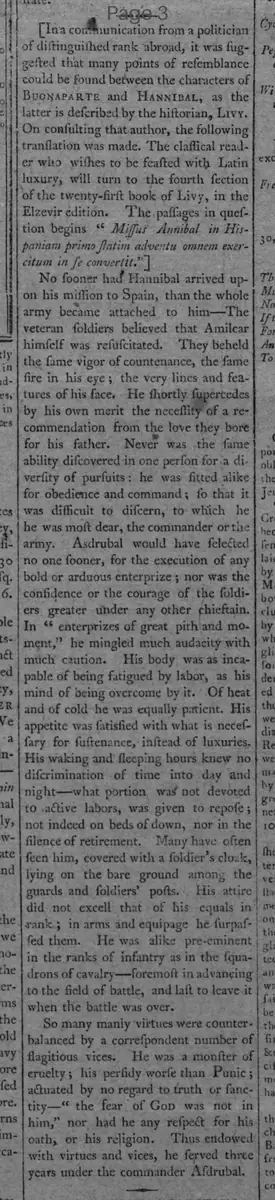
No sooner had Hannibal arrived upon his mission to Spain, than the whole army became attached to him—The veteran soldiers believed that Amilcar himself was resuscitated. They beheld the same vigor of countenance, the same fire in his eye; the very lines and features of his face. He shortly supersedes by his own merit the necessity of a recommendation from the love they bore for his father. Never was the same ability discovered in one person for a diversity of pursuits: he was fitted alike for obedience and command; so that it was difficult to discern, to which he he was most dear, the commander or the army. Asdrubal would have elected no one sooner, for the execution of any bold or arduous enterprize; nor was the confidence or the courage of the oldiers greater under any other chieftain.
In "enterprizes of great pith and moment," he mingled much audacity with much caution. His body was as incapable of being fatigued by labor, as his mind of being overcome by it. Of heat and of cold he was equally patient. His appetite was satisfied with what is necessary for sustenance, instead of luxuries. His waking and sleeping hours knew no discrimination of time into day and night—what portion was not devoted to active labors, was given to repose; not indeed on beds of down, nor in the silence of retirement. Many have often seen him, covered with a soldier's cloak, lying on the bare ground among the guards and soldiers' posts. His attire did not exceed that of his equals in rank; in arms and equipage he surpassed them. He was alike pre-eminent in the ranks of infantry as in the quadrons of cavalry—foremost in advancing to the field of battle, and last to leave it when the battle was over.
So many manly virtues were counterbalanced by a correspondent number of flagitious vices. He was a monster of cruelty; his perfidy worse than Punic; actuated by no regard to truth or sanctity—"the fear of God was not in him," nor had he any respect for his oath, or his religion. Thus endowed with virtues and vices, he served three years under the commander Asdrubal.
What sub-type of article is it?
What themes does it cover?
What keywords are associated?
What entities or persons were involved?
Where did it happen?
Story Details
Key Persons
Location
Spain
Event Date
Ancient Times (Livy, Book 21)
Story Details
Politician notes resemblances between Bonaparte and Hannibal; Livy translation describes Hannibal's rapid attachment of the army in Spain through inherited and personal merits, his versatile abilities, endurance, and leadership, offset by cruelty and perfidy, serving three years under Asdrubal.