Thank you for visiting SNEWPapers!
Sign up free
Editorial
February 6, 1890
Southern Christian Advocate
Charleston, Charleston County, South Carolina
What is this article about?
Bible study lesson by President James H. Carlisle on Luke 2:40-52, exploring Jesus' childhood growth, annual family Passover trips to Jerusalem, his temple visit at age 12, and contrast with apocryphal infancy gospel traditions. Emphasizes lessons in humility, obedience, and religious devotion for Sunday school students.
Clipping
OCR Quality
95%
Excellent
Full Text
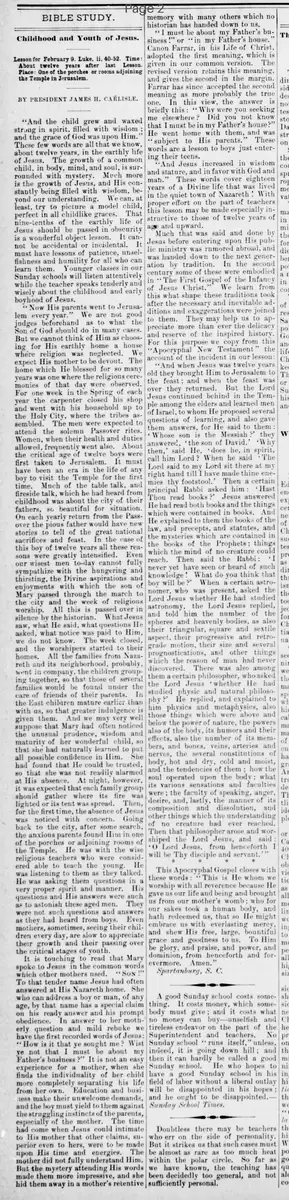
BIBLE STUDY.
Childhood and Youth of Jesus,
Lesson for February 9. Luke, ii, 40-52. Time:
About twelve years after last Lesson.
Place: One of the porches or rooms adjoining
the Temple in Jerusalem.
BY PRESIDENT JAMES H. CARLISLE.
"And the child grew and waxed
strong in spirit, filled with wisdom :
and the grace of God was upon Him."
These few words are all that we know.
about twelve years, in the earthly life
of Jesus. The growth of a common
child. in body, mind, and soul, is sur-
rounded with mystery. Much more
is the growth of Jesus, and His con-
stantly being filled with wisdom, be-
yond our understanding. We can, at
least. try to picture a model child,
perfect in all childlike graces. That
nine-tenths of the earthly life of
Jesus should be passed in obscurity
is a wonderful object lesson. It can-
not be accidental or incidental. It
must have lessons of patience. unsel-
fishness and humility for all who can
learn them. Younger classes in our
Sundav schools will listen attentively
while the teacher speaks tenderly and
wisely about the childhood and early
boyhoodof Jesus.
"Now His parents went to Jerusa-
lem every year." We are not good
judges beforehand as to what the
Son of God should do in many cases.
But we cannot think of Him as choos-
ing for His earthly home a house
where religion was neglected. We
expect His mother to be devout. The
home which He blessed for so many
years was one where the religious cere-
monies of that day were observed.
For one week in the Spring of each
year the carpenter closed his shop
and went with his household up to
the Holy City, where the tribes as-
sembled. The men were expected to
attend the solemn Passover rites.
Women. when their health and duties
allowed. frequently went also. About
the critical age of twelve boys were
first taken to Jerusalem. It must
have been an era in the life of any
boy to visit the Temple for the first
time. Much of the table talk. and
fireside talk, which he had heard from
childhood was about the city of their
fathers. sc beautiful for situation.
On each yearly return from the Pass-
over the pious father would have new
stories to tell of the great national
sacrifices and feast. In the case of
this boy of twelve years all these rea-
sons were greatly intensified. Even
our wisest men to-day cannot fully
sympathize with the hungering and
thirsting, the Divine aspirations and
enjoyments with which the son of
Mary passed through the march to
the city and the week of religious
worship. All this is passed over in
silence by the historian. What Jesus
saw, what He said, what questions He
asked. what notice was paid to Him.
we do not know. The week closed.
and the worshipers started to their
homes. All tbe families from Naza-
reth and its neighborhood, probably,
went in company, the children group-
ing together, so that those of several
families would be found under the
care of friends of their parents. In
the East chilaren mature earlier than
with us, so that greater indulgence is
given them. And we may very well
suppose that Mary had often noticed
the unusual prudence. wisdom and
maturity of her wonderful child, so
that she had naturally learned to put
all possible confidence in Him. She
had" found that He could be trusted.
so that she was not readily alarmed
at His absence. At night, however,
it was expected that each family group
should gather where its fire was
lighted or its tent was spread. Then,
for the first time. the absence of Jesus
was noticed with concern. Going
back to the city. after some search,
the anxious parents found Him in one
of the porches or adjoining rooms of
the Temple. He was with the wise
religious teachers who were consid-
ered able to teach the young. He
was listening to them as they talked.
He was asking them questions in a
very proper spirit and manner. His
questions and His answers were such
as to astonish these aged men. They
were not such questions and answers
as they had heard from boys. Even
mothers, sometimes, seeing their chil-
dren every dav, are slow to appreciate
their growth and their passing over
the critical stages of youth.
It is touching to read that Mary
spoke to Jesusin the common words
which other mothers used. "Son""
To that tender name Jesus had often
answered at His Nazareth home. She
who can address a boy or man, of any
age, by that name has a special claim
on his ready answer and his prompt
obedience. In answer to her moth-
erly question and mild rebuke we
have the first recorded words of Jesus:
"How is it that ye sought me? Wist
ye not that I must be about my
Father's business ?" It is not an easy
experience for a mother, when she
finds the individuality of her child
more completely separating his life
from her own. Education and busi-
ness make their unwelcome demands,
and the boy must yield to them against
the struggling instinctsof the parents,
especially of the mother. The time
had come when Jesus could intimate
to His mother that other claims. su-
perior even to hers. were to be made
upon His time and energies. The
mother did not fully understand Him.
But the mystery attending His words
made them more impressive, and she
hid them away in a mother's retentive
memory with many others which the
historian has handed down to us.
"I must be about my Father's bu-
siness!" or "in mv Father's house.'
Canon Farrar. in his Life of Christ.
adopted the first meaning, which is
given in our common version. The
revised version retains this meaning.
and gives the second in the margin.
Farrar has since accepted the second
meaning as more probably the true
one. In this view, the answer is
briefly this : " Why were vou seeking
me elsewhere? Did vou not know
that I must be in my Father's house?"
He went home with them. and was
"subject to His parents." These
words are a lesson to boys just enter-
ing their teens.
"And Jesus increased in wisdom
and stature, and in favor with God and
man." These words cover eighteen
years of a Divine life that was lived
in the quiet town of Nazareth ! With
proper effort on the part of teachers
this lesson mav be made especiallv in-
structive to those of twelve years of
age and upward.
Much that was said and done by
Jesus before entering upon His pub-
lic ministry was rnmored abroad, and
was handed down to the next gener-
ation by tradition. In the second
centurv some of these were embodied
in The First Gospel of the Infancy
of Jesus Christ." We learn from
this what shape these traditions took
after the necessarv and inevitable ad-
ditions and exaggerations were joined
to them. They may help us to ap-
preciate more than ever the delicacy
and reserve of the inspired historv.
For this purpose we copv from this
"Apocryphal"New Testament" the
account of the incident in our lesson:
"And when Jesus was twelve vears
old they brought Him to .Jerusalem to
the feast: and when the feast was
over they returned. But the Lord
Jesus continued behind in the Tem-
ple among the elders and learned men
of Israel, to whom He proposed several
questions of learning, and also gave
them answers.for He said to them :
Whose son is the Messiah ?" they
answered. 'the son of David.''W hy
then.' said He, 'does he, in spirit,
call him Lord? When he said :The
Lord said to my Lord sit there at my
right hand till I have made thine ene-
mies thy footstool.' Then a certain
principal Rabbi asked him: Hast
Thou read books:' Jesus answered
He had read both books and the things
which were contained in books. And
He explained to them the books of the
law, and precepts, and statutes, and
the mvsteries which are contained in
the books of the Prophets: things
which the mind of no creature could
reach. Then said the Rabbi: 'I
never vet have seen or heard of such
knowledge! What do vou think that
boy will be ?' When a certain astro-
nomer. who was present, asked the
Lord Jesus whether He had studied
astronomy, the Lord Jesus replied.
and told him the number of the
spheres and heavenly bodies, as also
their triangular, square and sextile
aspect, their progressive and retro-
grade motion, their size and several
prognostications, and other things
which the reason of man had never
discovered. There was also among
them a certain philosopher. whoasked
the Lord Jesus 'whether HIe had
studied physic and natural philoso
phy ?' He replied, and explained to
him phvsics and metaphvsics, also
those things which were above and
below the power of nature, the powers
also of the body. its humors and their
effects. also the number of its mem-
bers, and bones, veins, arteries and
nerves, the several constitutions of
body, hot and dry, cold and moist.
and the tendencies of them : how the
soul operated upon the body: what
its various sensations and faculties
were: the faculty of speaking. anger.
desire, and, lastlv. the manner of its
composition and dissolution, and
other things which the understanding
of no creature had ever reached.
Then that philosopher arose and wor:
shiped the Lord "Jesus. and said
•O Lord Jesus. from henceforth I
will be Thy disciple and servant.'"
This Apocrvphal Gospel closes with
these words : " This is He whom we
worship with all reverence because He
gave us our life and being and brought
us from our mother's womb; who for
our sakes took a human bodv, and
hath redeemed us, that so He might
embrace us with everlasting mercy.
and shew His free. large. bountiful
grace and goodness to us. To Him
be glorv. and praise, and power, and
dominion, from henceforth and for-
evermore. Amen."
Spartanburg, S. C.
Childhood and Youth of Jesus,
Lesson for February 9. Luke, ii, 40-52. Time:
About twelve years after last Lesson.
Place: One of the porches or rooms adjoining
the Temple in Jerusalem.
BY PRESIDENT JAMES H. CARLISLE.
"And the child grew and waxed
strong in spirit, filled with wisdom :
and the grace of God was upon Him."
These few words are all that we know.
about twelve years, in the earthly life
of Jesus. The growth of a common
child. in body, mind, and soul, is sur-
rounded with mystery. Much more
is the growth of Jesus, and His con-
stantly being filled with wisdom, be-
yond our understanding. We can, at
least. try to picture a model child,
perfect in all childlike graces. That
nine-tenths of the earthly life of
Jesus should be passed in obscurity
is a wonderful object lesson. It can-
not be accidental or incidental. It
must have lessons of patience. unsel-
fishness and humility for all who can
learn them. Younger classes in our
Sundav schools will listen attentively
while the teacher speaks tenderly and
wisely about the childhood and early
boyhoodof Jesus.
"Now His parents went to Jerusa-
lem every year." We are not good
judges beforehand as to what the
Son of God should do in many cases.
But we cannot think of Him as choos-
ing for His earthly home a house
where religion was neglected. We
expect His mother to be devout. The
home which He blessed for so many
years was one where the religious cere-
monies of that day were observed.
For one week in the Spring of each
year the carpenter closed his shop
and went with his household up to
the Holy City, where the tribes as-
sembled. The men were expected to
attend the solemn Passover rites.
Women. when their health and duties
allowed. frequently went also. About
the critical age of twelve boys were
first taken to Jerusalem. It must
have been an era in the life of any
boy to visit the Temple for the first
time. Much of the table talk. and
fireside talk, which he had heard from
childhood was about the city of their
fathers. sc beautiful for situation.
On each yearly return from the Pass-
over the pious father would have new
stories to tell of the great national
sacrifices and feast. In the case of
this boy of twelve years all these rea-
sons were greatly intensified. Even
our wisest men to-day cannot fully
sympathize with the hungering and
thirsting, the Divine aspirations and
enjoyments with which the son of
Mary passed through the march to
the city and the week of religious
worship. All this is passed over in
silence by the historian. What Jesus
saw, what He said, what questions He
asked. what notice was paid to Him.
we do not know. The week closed.
and the worshipers started to their
homes. All tbe families from Naza-
reth and its neighborhood, probably,
went in company, the children group-
ing together, so that those of several
families would be found under the
care of friends of their parents. In
the East chilaren mature earlier than
with us, so that greater indulgence is
given them. And we may very well
suppose that Mary had often noticed
the unusual prudence. wisdom and
maturity of her wonderful child, so
that she had naturally learned to put
all possible confidence in Him. She
had" found that He could be trusted.
so that she was not readily alarmed
at His absence. At night, however,
it was expected that each family group
should gather where its fire was
lighted or its tent was spread. Then,
for the first time. the absence of Jesus
was noticed with concern. Going
back to the city. after some search,
the anxious parents found Him in one
of the porches or adjoining rooms of
the Temple. He was with the wise
religious teachers who were consid-
ered able to teach the young. He
was listening to them as they talked.
He was asking them questions in a
very proper spirit and manner. His
questions and His answers were such
as to astonish these aged men. They
were not such questions and answers
as they had heard from boys. Even
mothers, sometimes, seeing their chil-
dren every dav, are slow to appreciate
their growth and their passing over
the critical stages of youth.
It is touching to read that Mary
spoke to Jesusin the common words
which other mothers used. "Son""
To that tender name Jesus had often
answered at His Nazareth home. She
who can address a boy or man, of any
age, by that name has a special claim
on his ready answer and his prompt
obedience. In answer to her moth-
erly question and mild rebuke we
have the first recorded words of Jesus:
"How is it that ye sought me? Wist
ye not that I must be about my
Father's business ?" It is not an easy
experience for a mother, when she
finds the individuality of her child
more completely separating his life
from her own. Education and busi-
ness make their unwelcome demands,
and the boy must yield to them against
the struggling instinctsof the parents,
especially of the mother. The time
had come when Jesus could intimate
to His mother that other claims. su-
perior even to hers. were to be made
upon His time and energies. The
mother did not fully understand Him.
But the mystery attending His words
made them more impressive, and she
hid them away in a mother's retentive
memory with many others which the
historian has handed down to us.
"I must be about my Father's bu-
siness!" or "in mv Father's house.'
Canon Farrar. in his Life of Christ.
adopted the first meaning, which is
given in our common version. The
revised version retains this meaning.
and gives the second in the margin.
Farrar has since accepted the second
meaning as more probably the true
one. In this view, the answer is
briefly this : " Why were vou seeking
me elsewhere? Did vou not know
that I must be in my Father's house?"
He went home with them. and was
"subject to His parents." These
words are a lesson to boys just enter-
ing their teens.
"And Jesus increased in wisdom
and stature, and in favor with God and
man." These words cover eighteen
years of a Divine life that was lived
in the quiet town of Nazareth ! With
proper effort on the part of teachers
this lesson mav be made especiallv in-
structive to those of twelve years of
age and upward.
Much that was said and done by
Jesus before entering upon His pub-
lic ministry was rnmored abroad, and
was handed down to the next gener-
ation by tradition. In the second
centurv some of these were embodied
in The First Gospel of the Infancy
of Jesus Christ." We learn from
this what shape these traditions took
after the necessarv and inevitable ad-
ditions and exaggerations were joined
to them. They may help us to ap-
preciate more than ever the delicacy
and reserve of the inspired historv.
For this purpose we copv from this
"Apocryphal"New Testament" the
account of the incident in our lesson:
"And when Jesus was twelve vears
old they brought Him to .Jerusalem to
the feast: and when the feast was
over they returned. But the Lord
Jesus continued behind in the Tem-
ple among the elders and learned men
of Israel, to whom He proposed several
questions of learning, and also gave
them answers.for He said to them :
Whose son is the Messiah ?" they
answered. 'the son of David.''W hy
then.' said He, 'does he, in spirit,
call him Lord? When he said :The
Lord said to my Lord sit there at my
right hand till I have made thine ene-
mies thy footstool.' Then a certain
principal Rabbi asked him: Hast
Thou read books:' Jesus answered
He had read both books and the things
which were contained in books. And
He explained to them the books of the
law, and precepts, and statutes, and
the mvsteries which are contained in
the books of the Prophets: things
which the mind of no creature could
reach. Then said the Rabbi: 'I
never vet have seen or heard of such
knowledge! What do vou think that
boy will be ?' When a certain astro-
nomer. who was present, asked the
Lord Jesus whether He had studied
astronomy, the Lord Jesus replied.
and told him the number of the
spheres and heavenly bodies, as also
their triangular, square and sextile
aspect, their progressive and retro-
grade motion, their size and several
prognostications, and other things
which the reason of man had never
discovered. There was also among
them a certain philosopher. whoasked
the Lord Jesus 'whether HIe had
studied physic and natural philoso
phy ?' He replied, and explained to
him phvsics and metaphvsics, also
those things which were above and
below the power of nature, the powers
also of the body. its humors and their
effects. also the number of its mem-
bers, and bones, veins, arteries and
nerves, the several constitutions of
body, hot and dry, cold and moist.
and the tendencies of them : how the
soul operated upon the body: what
its various sensations and faculties
were: the faculty of speaking. anger.
desire, and, lastlv. the manner of its
composition and dissolution, and
other things which the understanding
of no creature had ever reached.
Then that philosopher arose and wor:
shiped the Lord "Jesus. and said
•O Lord Jesus. from henceforth I
will be Thy disciple and servant.'"
This Apocrvphal Gospel closes with
these words : " This is He whom we
worship with all reverence because He
gave us our life and being and brought
us from our mother's womb; who for
our sakes took a human bodv, and
hath redeemed us, that so He might
embrace us with everlasting mercy.
and shew His free. large. bountiful
grace and goodness to us. To Him
be glorv. and praise, and power, and
dominion, from henceforth and for-
evermore. Amen."
Spartanburg, S. C.
What sub-type of article is it?
Moral Or Religious
Education
What keywords are associated?
Bible Study
Jesus Childhood
Luke Gospel
Passover Jerusalem
Temple Visit
Sunday School Lesson
Apocryphal Gospel
Religious Education
What entities or persons were involved?
Jesus
Mary
Joseph
James H. Carlisle
Canon Farrar
Editorial Details
Primary Topic
Childhood And Youth Of Jesus From Luke 2:40 52
Stance / Tone
Devotional And Instructional
Key Figures
Jesus
Mary
Joseph
James H. Carlisle
Canon Farrar
Key Arguments
Jesus Grew In Wisdom And Grace During Obscure Childhood Years, Teaching Patience And Humility.
Annual Family Passover Trips To Jerusalem Emphasized Religious Devotion.
At Age 12, Jesus Stayed In The Temple, Astonishing Teachers With Questions And Answers.
Mary's Concern And Jesus' Response Highlight Emerging Divine Mission.
Contrast With Exaggerated Apocryphal Traditions Underscores Biblical Reserve.
Jesus Subject To Parents, Increasing In Wisdom And Favor.