Thank you for visiting SNEWPapers!
Sign up free
Literary
June 22, 1838
The Liberator
Boston, Suffolk County, Massachusetts
What is this article about?
Theological essay (section IV) argues that no real saints attain permanent sinless perfection in this life, despite the duty to pursue it. Cites biblical passages (Psalms, Ecclesiastes, Proverbs, John, Romans) and confessions of saints like Job, David, Paul, illustrating human frailty, inconstancy in obedience, and ongoing struggle against sin.
Clipping
OCR Quality
95%
Excellent
Full Text
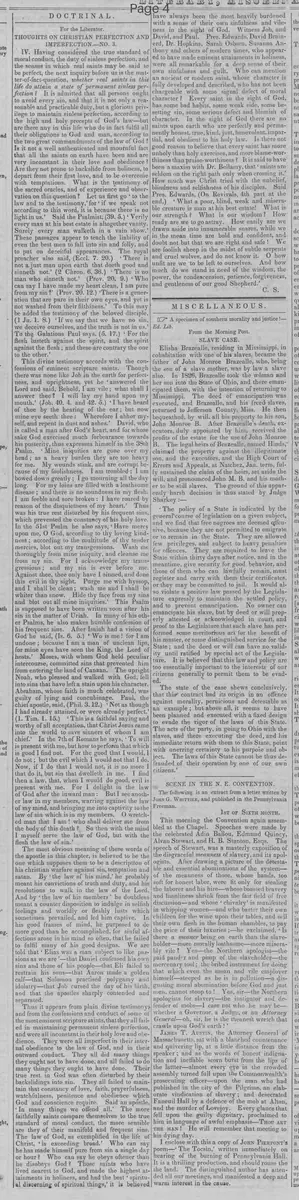
IV. Having considered the true standard of moral conduct, the duty of sinless perfection, and the senses in which real saints may be said to be perfect, the next inquiry before us is the matter-of-fact-question, whether real saints in this life do attain a state of permanent sinless perfection? It is admitted that all persons ought to avoid every sin, and that it is not only a reasonable and practicable duty, but a glorious privilege to maintain sinless perfection, according to the high and holy precepts of God's law—but are there any in this life who do in fact fulfil all their obligations to God and man, according to the two great commandments of the law of God? Is it not a well authenticated and mournful fact that all the saints on earth have been and are very inconstant in their love and obedience? Are they not prone to backslide from holiness, to depart from their first love, and to be overcome with temptations. What is the testimony of the sacred oracles, and of experience and observation on this question? Let us first go 'to the law and to the testimony,' for 'if we speak not according to this word, it is because there is no light in us.' Said the Psalmist; (Ps. 39:5.) 'Verily every man at his best estate is altogether vanity. Surely every man walketh in a vain show.' These passages appear to teach the liability of even the best men to fall into sin and folly, and to put on deceitful appearances. The royal preacher also said, (Eccl. 7:20.) There is not a just man upon earth that doeth good and sinneth not.' (2 Chron. 6:36.) 'There is no man who sinneth not.' (Prov. 20:9.) Who can say I have made my heart clean, I am pure from my sin?' (Prov. 20:12.) 'There is a generation that are pure in their own eyes, and yet is not washed from their filthiness.' To this may be added the testimony of the beloved disciple. (1 Jn. 1:8.) 'If we say that we have no sin, we deceive ourselves, and the truth is not in us.' To the Galatians Paul says, (5:17.) 'For the flesh lusteth against the spirit, and the spirit against the flesh; and these are contrary the one to the other.'
This divine testimony accords with the confessions of eminent scripture saints. Though there was none like Job in the earth for perfectness, and uprightness, yet he 'answered the Lord and said, Behold, I am vile; what shall I answer thee? I will lay my hand upon my mouth.' (Job. 40:4. and 42:5.) 'I have heard of thee by the hearing of the ear; but now mine eye seeth thee: Wherefore I abhor myself, and repent in dust and ashes.' David, who is called a man after God's heart, and for whose sake God exercised much forbearance towards his posterity, thus expresses himself in the 38th Psalm. 'Mine iniquities are gone over my head; as a heavy burden they are too heavy for me. My wounds stink, and are corrupt because of my foolishness. I am troubled; I am bowed down greatly; I go mourning all the day long. For my loins are filled with a loathsome disease; and there is no soundness in my flesh. I am feeble and sore broken: I have roared by reason of the disquietness of my heart.' Thus was his true rest disturbed by his frequent sins, which prevented the constancy of his holy love. In the 51st Psalm he also says, 'Have mercy upon me, O God, according to thy loving kindness; according to the multitude of thy tender mercies, blot out my transgressions. Wash me thoroughly from mine iniquity, and cleanse me from my sin. For I acknowledge my transgressions; and my sin is ever before me. Against thee, thee only have I sinned, and done this evil in thy sight.' 'Purge me with hyssop, and I shall be clean; wash me and I shall be whiter than snow. Hide thy face from my sins and blot out all mine iniquities.' This Psalm is supposed to have been written soon after his sin in the matter of Uriah. In many of his other Psalms, he also makes humble confession of his frequent sins. After Isaiah had a vision of God he said, (Is. 6:5.) 'Wo is me! for I am undone; because I am a man of unclean lips, for mine eyes have seen the King, the Lord of hosts.' Moses, with whom God held peculiar intercourse, committed sins that prevented him from entering the land of Canaan. The upright Noah, who pleased and walked with God, fell into sins that have left a stain upon his character. Abraham, whose faith is much celebrated, was guilty of lying and concubinage. Paul, the chief apostle, said, (Phil. 3:12.) 'Not as though I had already attained, or were already perfect.' (1 Tim. 1:15.) 'This is a faithful saying and worthy of all acceptation, that Christ Jesus came into the world to save sinners of whom I am chief.' In the 7th of Romans he says, 'To will is present with me, but how to perform that which is good I find not. For the good that I would, I do not; but the evil which I would not that I do. Now, if I do that I would not, it is no more I that do it, but sin that dwelleth in me. I find then a law, that, when I would do good, evil is present with me. For I delight in the law of God after the inward man: But I see another law in my members, warring against the law of my mind, and bringing me into captivity to the law of sin which is in my members. O wretched man that I am! who shall deliver me from the body of this death? So then with the mind I myself serve the law of God, but with the flesh the law of sin.'
The most obvious meaning of these words of the apostle in this chapter, is believed to be the one which supposes them to be a description of his christian warfare against sin, temptation and satan. By 'the law of his mind,' he probably meant his convictions of truth and duty, and his resolutions to walk in the law of the Lord. And by 'the law of his members' he doubtless meant a counter disposition to indulge in selfish feelings and worldly or fleshly lusts which sometimes prevailed, and led him captive. In his good frames of mind, he purposed to do more good than he accomplished, for sinful affections arose in his mind so often, that he failed to fulfil many of his good designs. We are told that 'Elias was a man subject to like passions as we are'—that Daniel confessed his own sins and those of his people—that Eli failed to restrain his sons—that Aaron made a golden calf—that Solomon practised polygamy and idolatry—that Job cursed the day of his birth. and that the apostles sharply contended and separated.
Thus it appears from plain divine testimony; and from the confessions and conduct of some of the most eminent scripture saints, that they all failed in maintaining permanent sinless perfection and were all inconstant in their holy love and obedience. They were all imperfect in their internal obedience to the law of God, and in their outward conduct. They all did many things they ought not to have done, and all failed to do many things they ought to have done. Their true rest in God was often disturbed by their backslidings into sin. They all failed to maintain that constancy of love, faith, prayerfulness. watchfulness, penitence and obedience which God and conscience require. Said an apostle 'In many things we offend all.' The more faithfully saints compare themselves to the true standard of moral conduct, the more sensible are they of their manifold and frequent sins. The law of God, as exemplified in the life of Christ, is exceeding broad.' Who can say he has made himself pure from sin a single day or hour? Who can say he obeys oftener than he disobeys God? Those saints who have lived nearest to God, and made the highest attainments in holiness, and had the best 'spiritual al discerning of spiritual things,' it is believed have always been the most heavily burdened with a sense of their own sinfulness and vileness in the sight of God. Witness Job, and David, and Paul. Pres. Edwards, David Brainerd, Dr. Hopkins, Sarah Osborn, Susanna Anthony and others of modern times, who appeared to have made eminent attainments in holiness, were all remarkable for a deep sense of their own sinfulness and guilt. Who can mention an ancient or modern saint, whose character is fully developed and described, who has not been chargeable with some signal defect of moral character? Every saint in the sight of God, has some bad habits, some weak side, some besetting sin, some serious defect and blemish of character. In the sight of God there are no saints upon earth who are perfectly and permanently honest, true, kind, just, benevolent, impartial, and obedient to his holy law. Is there not good reason to believe that every saint has more unholy than holy exercises, and more blame-worthiness than praise-worthiness? It is said to have been a maxim with Dr. Bellamy, that 'saints are seldom on the right path only when crossing it.' How much was Christ tried with the unbelief. blindness and selfishness of his disciples. Said Pres. Edwards, (On Revivals. 4th part at the end,) 'What a poor, blind, weak and miserable creature is man at his best estate! What is our strength? What is our wisdom? How ready are we to go astray. How easily are we drawn aside into innumerable snares, while we in the mean time are bold and confident, and doubt not but that we are right and safe! We are foolish sheep in the midst of subtle serpents and cruel wolves, and do not know it. O how unfit are we to be left to ourselves. And how much do we stand in need of the wisdom, the power, the condescension, patience, forgiveness, and gentleness of our good Shepherd.'
C. S.
This divine testimony accords with the confessions of eminent scripture saints. Though there was none like Job in the earth for perfectness, and uprightness, yet he 'answered the Lord and said, Behold, I am vile; what shall I answer thee? I will lay my hand upon my mouth.' (Job. 40:4. and 42:5.) 'I have heard of thee by the hearing of the ear; but now mine eye seeth thee: Wherefore I abhor myself, and repent in dust and ashes.' David, who is called a man after God's heart, and for whose sake God exercised much forbearance towards his posterity, thus expresses himself in the 38th Psalm. 'Mine iniquities are gone over my head; as a heavy burden they are too heavy for me. My wounds stink, and are corrupt because of my foolishness. I am troubled; I am bowed down greatly; I go mourning all the day long. For my loins are filled with a loathsome disease; and there is no soundness in my flesh. I am feeble and sore broken: I have roared by reason of the disquietness of my heart.' Thus was his true rest disturbed by his frequent sins, which prevented the constancy of his holy love. In the 51st Psalm he also says, 'Have mercy upon me, O God, according to thy loving kindness; according to the multitude of thy tender mercies, blot out my transgressions. Wash me thoroughly from mine iniquity, and cleanse me from my sin. For I acknowledge my transgressions; and my sin is ever before me. Against thee, thee only have I sinned, and done this evil in thy sight.' 'Purge me with hyssop, and I shall be clean; wash me and I shall be whiter than snow. Hide thy face from my sins and blot out all mine iniquities.' This Psalm is supposed to have been written soon after his sin in the matter of Uriah. In many of his other Psalms, he also makes humble confession of his frequent sins. After Isaiah had a vision of God he said, (Is. 6:5.) 'Wo is me! for I am undone; because I am a man of unclean lips, for mine eyes have seen the King, the Lord of hosts.' Moses, with whom God held peculiar intercourse, committed sins that prevented him from entering the land of Canaan. The upright Noah, who pleased and walked with God, fell into sins that have left a stain upon his character. Abraham, whose faith is much celebrated, was guilty of lying and concubinage. Paul, the chief apostle, said, (Phil. 3:12.) 'Not as though I had already attained, or were already perfect.' (1 Tim. 1:15.) 'This is a faithful saying and worthy of all acceptation, that Christ Jesus came into the world to save sinners of whom I am chief.' In the 7th of Romans he says, 'To will is present with me, but how to perform that which is good I find not. For the good that I would, I do not; but the evil which I would not that I do. Now, if I do that I would not, it is no more I that do it, but sin that dwelleth in me. I find then a law, that, when I would do good, evil is present with me. For I delight in the law of God after the inward man: But I see another law in my members, warring against the law of my mind, and bringing me into captivity to the law of sin which is in my members. O wretched man that I am! who shall deliver me from the body of this death? So then with the mind I myself serve the law of God, but with the flesh the law of sin.'
The most obvious meaning of these words of the apostle in this chapter, is believed to be the one which supposes them to be a description of his christian warfare against sin, temptation and satan. By 'the law of his mind,' he probably meant his convictions of truth and duty, and his resolutions to walk in the law of the Lord. And by 'the law of his members' he doubtless meant a counter disposition to indulge in selfish feelings and worldly or fleshly lusts which sometimes prevailed, and led him captive. In his good frames of mind, he purposed to do more good than he accomplished, for sinful affections arose in his mind so often, that he failed to fulfil many of his good designs. We are told that 'Elias was a man subject to like passions as we are'—that Daniel confessed his own sins and those of his people—that Eli failed to restrain his sons—that Aaron made a golden calf—that Solomon practised polygamy and idolatry—that Job cursed the day of his birth. and that the apostles sharply contended and separated.
Thus it appears from plain divine testimony; and from the confessions and conduct of some of the most eminent scripture saints, that they all failed in maintaining permanent sinless perfection and were all inconstant in their holy love and obedience. They were all imperfect in their internal obedience to the law of God, and in their outward conduct. They all did many things they ought not to have done, and all failed to do many things they ought to have done. Their true rest in God was often disturbed by their backslidings into sin. They all failed to maintain that constancy of love, faith, prayerfulness. watchfulness, penitence and obedience which God and conscience require. Said an apostle 'In many things we offend all.' The more faithfully saints compare themselves to the true standard of moral conduct, the more sensible are they of their manifold and frequent sins. The law of God, as exemplified in the life of Christ, is exceeding broad.' Who can say he has made himself pure from sin a single day or hour? Who can say he obeys oftener than he disobeys God? Those saints who have lived nearest to God, and made the highest attainments in holiness, and had the best 'spiritual al discerning of spiritual things,' it is believed have always been the most heavily burdened with a sense of their own sinfulness and vileness in the sight of God. Witness Job, and David, and Paul. Pres. Edwards, David Brainerd, Dr. Hopkins, Sarah Osborn, Susanna Anthony and others of modern times, who appeared to have made eminent attainments in holiness, were all remarkable for a deep sense of their own sinfulness and guilt. Who can mention an ancient or modern saint, whose character is fully developed and described, who has not been chargeable with some signal defect of moral character? Every saint in the sight of God, has some bad habits, some weak side, some besetting sin, some serious defect and blemish of character. In the sight of God there are no saints upon earth who are perfectly and permanently honest, true, kind, just, benevolent, impartial, and obedient to his holy law. Is there not good reason to believe that every saint has more unholy than holy exercises, and more blame-worthiness than praise-worthiness? It is said to have been a maxim with Dr. Bellamy, that 'saints are seldom on the right path only when crossing it.' How much was Christ tried with the unbelief. blindness and selfishness of his disciples. Said Pres. Edwards, (On Revivals. 4th part at the end,) 'What a poor, blind, weak and miserable creature is man at his best estate! What is our strength? What is our wisdom? How ready are we to go astray. How easily are we drawn aside into innumerable snares, while we in the mean time are bold and confident, and doubt not but that we are right and safe! We are foolish sheep in the midst of subtle serpents and cruel wolves, and do not know it. O how unfit are we to be left to ourselves. And how much do we stand in need of the wisdom, the power, the condescension, patience, forgiveness, and gentleness of our good Shepherd.'
C. S.
What sub-type of article is it?
Essay
What themes does it cover?
Religious
Moral Virtue
What keywords are associated?
Sinless Perfection
Saints
Biblical Testimony
Christian Warfare
Human Frailty
Moral Obedience
Scripture Saints
What entities or persons were involved?
C. S.
Literary Details
Author
C. S.
Subject
Whether Real Saints Attain Permanent Sinless Perfection
Form / Style
Theological Argument In Prose
Key Lines
Verily Every Man At His Best Estate Is Altogether Vanity. Surely Every Man Walketh In A Vain Show.
There Is Not A Just Man Upon Earth That Doeth Good And Sinneth Not.
If We Say That We Have No Sin, We Deceive Ourselves, And The Truth Is Not In Us.
O Wretched Man That I Am! Who Shall Deliver Me From The Body Of This Death?
In Many Things We Offend All.