Thank you for visiting SNEWPapers!
Sign up free
Letter to Editor
August 31, 1805
Virginia Argus
Richmond, Virginia
What is this article about?
Extract of a letter from Thomas Jefferson to Sir John Sinclair, dated March 23, 1798, deploring war's destructiveness and advocating for peaceful coercion of injustices, redirecting war funds to infrastructure like roads and canals for societal benefit.
Clipping
OCR Quality
98%
Excellent
Full Text
Extract of a letter from Mr. Jefferson to Sir John Sinclair, President of the Board of Agriculture at London, inclosing a description of an improvement in the Plough; dated March 23d, 1798.
(From the American Philosophical Transactions.)
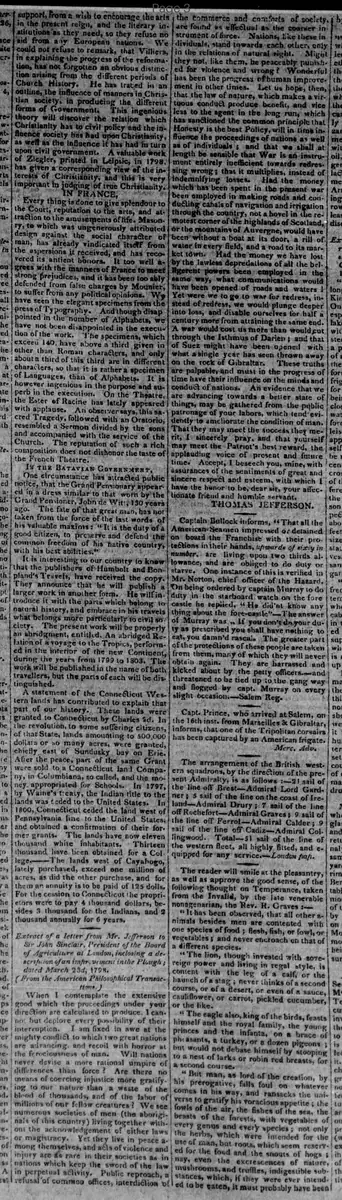
When I contemplate the extensive good which the proceedings under your direction are calculated to produce, I cannot but deplore every possibility of their interruption. I am fixed in awe at the mighty conflict to which two great nations are advancing, and recoil with horror at the ferociousness of man. Will nations never devise a more rational umpire of differences than force? Are there no means of coercing injustice more gratifying to our nature than a waste of the blood of thousands, and of the labor of millions of our fellow creatures? We see numerous societies of men (the aborigines of this country) living together without the acknowledgement of either laws or magistracy. Yet they live in peace among themselves, and acts of violence and injury are as rare in their societies as in nations which keep the sword of the law in perpetual activity. Public reproach, universal aversion of common offices, interdiction by the commerce and comforts of society, are found us effectual as the coarser instrument of force. Nations, like these individuals, stand towards each other, only in the relations of natural right. Might they not, like them, be peaceably punished for violence and wrong? Wonderful has been the progress of human improvement in other lines. Let us hope, then, that the law of nature, which makes a virtuous conduct produce benefit, and vice less to the agent in the long run, which has sanctioned the common principle that Honesty is the best Policy, will in time influence the proceedings of nations as well as of individuals; and that we shall at length be sensible that War is an instrument entirely inefficient towards redressing wrong; that it multiplies, instead of indemnifying losses. Had the money which has been spent in the present war been employed in making roads and conducting canals of navigation and irrigation through the country, not a hovel in the remotest corner of the highlands of Scotland, or the mountains of Auvergne, would have been without a boat at its door, a rill of water in every field, and a road to its market town. Had the money we have lost by the lawless depredations of all the belligerent powers been employed in the same way, what communications would have been opened of roads and waters! Yet were we to go to war for redress, instead of redress, we would plunge deeper into loss, and disable ourselves for half a century more from attaining the same end. A war would cost us more than would cut through the Isthmus of Darien; and that of Suez might have been opened with what a single year has seen thrown away on the rock of Gibraltar. These truths are palpable, and must in the progress of time have their influence on the minds and conduct of nations. An evidence that we are advancing towards a better state of things, may be gathered from the public patronage of your labors, which tend evidently to ameliorate the condition of man. That they may meet the success they merit, I sincerely pray, and that yourself may meet the Patriot's best reward, the applauding voice of present and future time. Accept, I beseech you, mine, with assurances of the sentiments of great and sincere respect and esteem, with which I have the honor to be, dear sir, your affectionate friend and humble servant,
THOMAS JEFFERSON.
(From the American Philosophical Transactions.)
When I contemplate the extensive good which the proceedings under your direction are calculated to produce, I cannot but deplore every possibility of their interruption. I am fixed in awe at the mighty conflict to which two great nations are advancing, and recoil with horror at the ferociousness of man. Will nations never devise a more rational umpire of differences than force? Are there no means of coercing injustice more gratifying to our nature than a waste of the blood of thousands, and of the labor of millions of our fellow creatures? We see numerous societies of men (the aborigines of this country) living together without the acknowledgement of either laws or magistracy. Yet they live in peace among themselves, and acts of violence and injury are as rare in their societies as in nations which keep the sword of the law in perpetual activity. Public reproach, universal aversion of common offices, interdiction by the commerce and comforts of society, are found us effectual as the coarser instrument of force. Nations, like these individuals, stand towards each other, only in the relations of natural right. Might they not, like them, be peaceably punished for violence and wrong? Wonderful has been the progress of human improvement in other lines. Let us hope, then, that the law of nature, which makes a virtuous conduct produce benefit, and vice less to the agent in the long run, which has sanctioned the common principle that Honesty is the best Policy, will in time influence the proceedings of nations as well as of individuals; and that we shall at length be sensible that War is an instrument entirely inefficient towards redressing wrong; that it multiplies, instead of indemnifying losses. Had the money which has been spent in the present war been employed in making roads and conducting canals of navigation and irrigation through the country, not a hovel in the remotest corner of the highlands of Scotland, or the mountains of Auvergne, would have been without a boat at its door, a rill of water in every field, and a road to its market town. Had the money we have lost by the lawless depredations of all the belligerent powers been employed in the same way, what communications would have been opened of roads and waters! Yet were we to go to war for redress, instead of redress, we would plunge deeper into loss, and disable ourselves for half a century more from attaining the same end. A war would cost us more than would cut through the Isthmus of Darien; and that of Suez might have been opened with what a single year has seen thrown away on the rock of Gibraltar. These truths are palpable, and must in the progress of time have their influence on the minds and conduct of nations. An evidence that we are advancing towards a better state of things, may be gathered from the public patronage of your labors, which tend evidently to ameliorate the condition of man. That they may meet the success they merit, I sincerely pray, and that yourself may meet the Patriot's best reward, the applauding voice of present and future time. Accept, I beseech you, mine, with assurances of the sentiments of great and sincere respect and esteem, with which I have the honor to be, dear sir, your affectionate friend and humble servant,
THOMAS JEFFERSON.
What sub-type of article is it?
Philosophical
Reflective
Persuasive
What themes does it cover?
Military War
Infrastructure
Morality
What keywords are associated?
Thomas Jefferson
War Criticism
Peace Advocacy
Infrastructure Improvements
Sir John Sinclair
Rational Umpires
Natural Right
What entities or persons were involved?
Thomas Jefferson
Sir John Sinclair
Letter to Editor Details
Author
Thomas Jefferson
Recipient
Sir John Sinclair
Main Argument
war is inefficient for redressing wrongs and multiplies losses; nations should seek rational, peaceful umpires like social reproach, and redirect war expenditures to beneficial infrastructure such as roads and canals.
Notable Details
References To Aborigines' Peaceful Societies Without Laws
Law Of Nature And 'Honesty Is The Best Policy'
Examples Of Isthmus Of Darien, Suez, Gibraltar
Praise For Sinclair's Agricultural Labors