Thank you for visiting SNEWPapers!
Sign up free
Fowle's New Hampshire Gazette And General Advertiser
Portsmouth, Rockingham County, New Hampshire
What is this article about?
A letter addressed to 'Candidus' in the New-Hampshire Gazette challenges the patriotism of a gubernatorial candidate by posing queries about his actions during the Revolutionary War, including protests against American measures, associations with British sympathizers, and suspicious travels to England.
Merged-components note: The text continues seamlessly from the first part on page 1 to this part on page 2, forming a single letter to Candidus.
Clippings
1 of 2
OCR Quality
Full Text
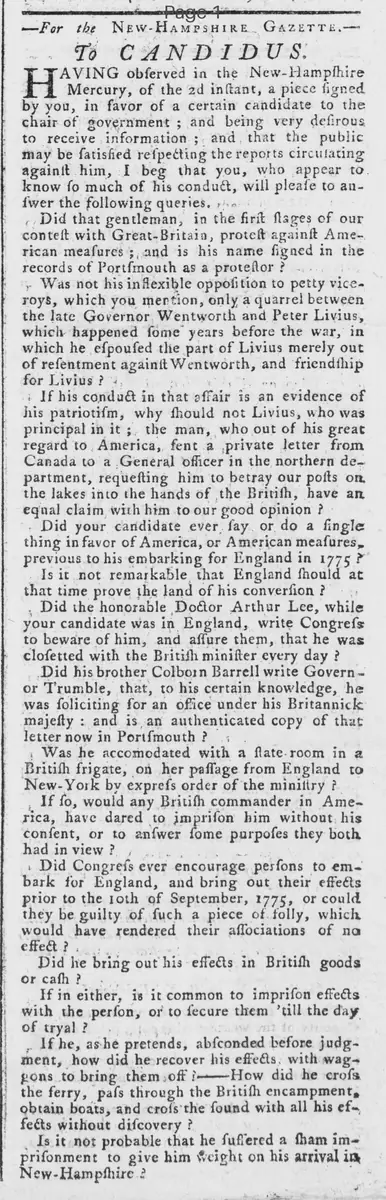
To CANDIDUS.
In the Mercury, of the 2d instant, a piece signed by you, in favor of a certain candidate to the chair of government : and being very desirous to receive information ; and, that the public may be satisfied respecting the reports circulating against him, I beg that you, who appear to know so much of his conduct, will please to answer the following queries.
1. Did that gentleman, in the first stages of our contest with Great-Britain, protest against American measures : and is his name signed in the records of Portsmouth as a protestor?
2. Was not his inflexible opposition to petty viceroys, which you mention, only a quarrel between the late Governor Wentworth and Peter Livius, which happened some years before the war, in which he espoused the part of Livius merely out of resentment against Wentworth, and friendship for Livius?
If his conduct in that affair is an evidence of his patriotism, why should not Livius, who was principal in it ; the man, who out of his great regard to America, sent a private letter from Canada to a General officer in the northern department, requesting him to betray our posts on the lakes into the hands of the British, have an equal claim with him to our good opinion?
Did your candidate ever say or do a single thing in favor of America, or American measures previous to his embarking for England in 1775?
Is it not remarkable that England should at that time prove the land of his conversion?
Did the honorable Doctor Arthur Lee, while your candidate was in England, write Congress to beware of him, and assure them, that he was closetted with the British minister every day?
Did his brother Colborn Barrell write Governor Trumble, that, to his certain knowledge, he was soliciting for an office under his Britannick majesty : and is an authenticated copy of that letter now in Portsmouth?
Was he accommodated with a state-room in a British frigate, on her passage from England to New-York by express order of the ministry?
If so, would any British commander in America, have dared to imprison him without his consent, or to answer some purposes they both had in view?
Did Congress ever encourage persons to embark for England, and bring out their effects prior to the 10th of September, 1775, or could they be guilty of such a piece of folly, which would have rendered their associations of no effect?
Did he bring out his effects in British goods or cash?
If in either, is it common to imprison effects with the person, or to secure them 'till the day of tryal?
If he, as he pretends, absconded before judgment, how did he recover his effects, with waggons to bring them off? How did he cross the ferry, pass through the British encampment, obtain boats, and cross the sound with all his effects without discovery?
Is it not probable that he suffered a sham imprisonment to give him weight on his arrival in New-Hampshire?
Has not his conduct since that period, been regulated by the sudden change of affairs in our favor; and his admirable talent of holding with the strongest side? Was his being concerned in privateers evidence of his real patriotism; and does he not even at this day, stigmatize as tories, those who were concerned in them at the same time; and has it not been common for persons in the late war to pursue that business who were uniformly against the American opposition? Is the dispatch, you mention, as peculiar to him, evidence of his sagacity and judgment; or is it owing to his having his opinion suddenly made up on every question in the General Court, and almost compelling committee-men and others to join him, and if they will not, refusing to act with them? Has his promotions in State affairs been the consequence of the good opinion people have formed of his character, or the effect of the indefatigable industry of the emissaries, which he annually employs to answer his purposes, and to deceive the people? Has he most votes in Portsmouth and other towns where he is known, or in towns that know nothing of him but what they learn from his emissaries. Sir, the above queries are submitted for your answer: and lest you should think that there is any thing ungenerous in them, if you will please to give proper answers to them, and sign your real name, the author of these queries, will in reply, publish the evidence he is possessed of respecting them with his proper name affixed thereto.
A COUNTRY MAN, not easily deceived.
Liberty-Hall, March 7, 1785.
What sub-type of article is it?
What themes does it cover?
What keywords are associated?
What entities or persons were involved?
Letter to Editor Details
Author
A Country Man, Not Easily Deceived.
Recipient
Candidus
Main Argument
the writer urges candidus to answer queries disproving the gubernatorial candidate's patriotism, citing his protests against american measures, british associations, and suspicious actions during the revolution to counter circulating reports.
Notable Details