Thank you for visiting SNEWPapers!
Sign up free
The New Hampshire Gazette And General Advertiser
Portsmouth, Exeter, Rockingham County, New Hampshire
What is this article about?
Reports from the Hague, Bruges, and Utrecht detail escalating tensions between the Dutch Republic and Austrian forces: ship detentions on the Scheldt, military reinforcements, Duke of Brunswick's resignation, Imperial edict against emigration, and preparations for potential war in the Low Countries during October.
Clipping
OCR Quality
Full Text
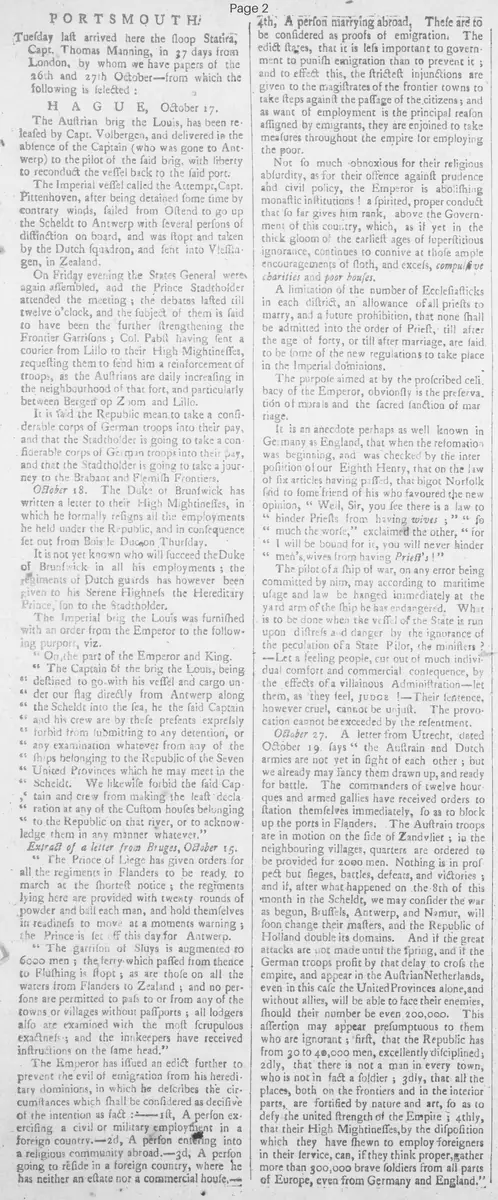
HAGUE, October 17.
The Austrian brig the Louis, has been released by Capt. Volbergen, and delivered in the absence of the Captain (who was gone to Antwerp) to the pilot of the said brig, with liberty to reconduct the vessel back to the said port.
The Imperial vessel called the Attempt, Capt. Pittenhoven, after being detained some time by contrary winds, sailed from Ostend to go up the Scheldt to Antwerp with several persons of distinction on board, and was stopped and taken by the Dutch squadron, and sent into Vlissingen, in Zealand.
On Friday evening the States General were again assembled, and the Prince Stadtholder attended the meeting: the debates lasted till twelve o'clock, and the subject of them is said to have been the further strengthening the Frontier Garrisons; Col. Pabst having sent a courier from Lillo to their High Mightinesses, requesting them to send him a reinforcement of troops, as the Austrians are daily increasing in the neighbourhood of that fort, and particularly between Bergen op Zoom and Lillo.
It is said the Republic means to take a considerable corps of German troops into their pay, and that the Stadtholder is going to take a journey to the Brabant and Flemish Frontiers.
October 18.
The Duke of Brunswick has written a letter to their High Mightinesses, in which he formally resigns all the employments he held under the Republic, and in consequence set out from Bois le Duc on Thursday.
It is not yet known who will succeed the Duke of Brunswick in all his employments; the regiments of Dutch guards has however been given to his Serene Highness the Hereditary Prince, son to the Stadtholder.
The Imperial brig the Louis was furnished with an order from the Emperor to the following purport, viz.
On the part of the Emperor and King.
"The Captain of the brig the Louis, being destined to go with his vessel and cargo under our flag directly from Antwerp along the Scheldt into the sea, he the said Captain and his crew are by these presents expressly forbid from submitting to any detention, or any examination whatever from any of the ships belonging to the Republic of the Seven United Provinces which he may meet in the Scheldt. We likewise forbid the said Captain and crew from making the least declaration at any of the Custom houses belonging to the Republic on that river, or to acknowledge them in any manner whatever."
Extract of a letter from Bruges, October 15.
“The Prince of Liege has given orders for all the regiments in Flanders to be ready to march at the shortest notice; the regiments lying here are provided with twenty rounds of powder and ball each man, and hold themselves in readiness to move at a moment's warning; the Prince is set off this day for Antwerp.
The garrison of Sluys is augmented to 6000 men; the ferry which passed from thence to Flushing is stopped; as are those on all the waters from Flanders to Zealand; and no persons are permitted to pass to or from any of the towns or villages without passports; all lodgers also are examined with the most scrupulous exactness; and the innkeepers have received instructions on the same head."
The Emperor has issued an edict further to prevent the evil of emigration from his hereditary dominions, in which he describes the circumstances which shall be considered as decisive of the intention to abscond := 1st, A person exercising a civil or military employment in a foreign country.—2d, A person entering into a religious community abroad. 3d, A person going to reside in a foreign country, where he has neither an estate nor a commercial house,
4th, A person marrying abroad. These are to be considered as proofs of emigration. The edict states, that it is less important to government to punish emigration than to prevent it; and to effect this, the strictest injunctions are given to the magistrates of the frontier towns to take steps against the passage of the citizens; and as want of employment is the principal reason assigned by emigrants, they are enjoined to take measures throughout the empire for employing the poor.
Not so much obnoxious for their religious absurdity, as for their offence against prudence and civil policy, the Emperor is abolishing monastic institutions! a spirited, proper conduct that so far gives him rank above the Government of this country, which, as if yet in the thick gloom of the earliest ages of superstitious ignorance, continues to connive at those ample encouragements of sloth, and idleness, compulsory charities and poor houses.
A limitation of the number of Ecclesiastics in each district, an allowance of all priests to marry, and a future prohibition, that none shall be admitted into the order of Priest. till after the age of forty, or till after marriage, are said to be some of the new regulations to take place in the Imperial dominions.
The purpose aimed at by the proscribed celibacy of the Emperor, obviously is the preservation of morals and the sacred sanction of marriage.
It is an anecdote perhaps as well known in Germany as England, that when the reformation was beginning, and was checked by the interposition of our Eighth Henry, that on the law of six articles having passed, that bigot Norfolk said to some friend of his who favoured the new opinion, "Well, Sir, you see there is a law to hinder Priests from having wives;" "so much the worse," exclaimed the other, "for I will be bound for it, you will never hinder men's wives from having Priests!"
The pilot of a ship of war, on any error being committed by him, may according to maritime usage and law be hanged immediately at the yard arm of the ship he has endangered. What is to be done when the vessel of the State is run upon distress and danger by the ignorance of the peculation of a State Pilot, the ministers? Let a feeling people, cut out of much individual comfort and commercial consequence, by the effects of a villainous Administration—let them, as they feel, judge!—Their sentence, however cruel, cannot be unjust. The provocation cannot be exceeded by the resentment.
October 27. A letter from Utrecht, dated October 19, says "the Austrian and Dutch armies are not yet in sight of each other; but we already may fancy them drawn up, and ready for battle. The commanders of twelve hourques and armed gallies have received orders to station themselves immediately, so as to block up the ports in Flanders: The Austrian troops are in motion on the side of Zandvliet: in the neighbouring villages, quarters are ordered to be provided for 2000 men. Nothing is in prospect but sieges, battles, defeats, and victories; and if, after what happened on the 8th of this month in the Scheldt, we may consider the war as begun, Brussels, Antwerp, and Namur, will soon change their masters, and the Republic of Holland double its domains. And if the great attacks are not made till the spring, and if the German troops profit by that delay to cross the empire, and appear in the Austrian Netherlands, even in this case the United Provinces alone, and without allies, will be able to face their enemies, should their number be even 200,000. This assertion may appear presumptuous to them who are ignorant; first, that the Republic has from 30 to 40,000 men, excellently disciplined; 2dly, that there is not a man in every town, who is not in fact a soldier; 3dly, that all the places, both on the frontiers and in the interior parts, are fortified by nature and art, so as to defy the united strength of the Empire; 4thly, that their High Mightinesses, by the disposition which they have shewn to employ foreigners in their service, can, if they think proper, gather more than 300,000 brave soldiers from all parts of Europe, even from Germany and England."
What sub-type of article is it?
What keywords are associated?
What entities or persons were involved?
Where did it happen?
Foreign News Details
Primary Location
Dutch Republic
Event Date
October 15 19
Key Persons
Outcome
austrian brig louis released; imperial vessel attempt detained and sent to vlissingen; duke of brunswick resigns employments; regiments given to hereditary prince; emperor issues edict against emigration and reforms on monastic institutions and clergy; troops mobilized and garrisons strengthened; blockades and restrictions imposed.
Event Details
News from the Hague reports release of Austrian brig Louis and detention of Imperial vessel Attempt by Dutch forces on the Scheldt; States General debates strengthening frontier garrisons amid Austrian troop increases; plans to hire German troops and Stadtholder's journey to frontiers; Duke of Brunswick resigns; Imperial order to brig Louis forbidding Dutch interference. From Bruges, Prince of Liege orders regiments ready, garrison of Sluys augmented to 6000, ferries stopped, passports required. Emperor's edict defines and prevents emigration, abolishes monastic institutions, limits ecclesiastics, allows priest marriage. Utrecht letter describes armies preparing for battle, blockades of Flemish ports, Austrian troop motions, prospects of war with potential territorial changes.