Thank you for visiting SNEWPapers!
Sign up free
The Virginia Gazette
Williamsburg, Virginia
What is this article about?
Extracts of letters from General Washington to Congress describe British forces' retreat from Brunswick to Amboy, subsequent advance to Westfield, skirmishes with American light parties, and enemy losses in New Jersey, June 25-30, 1777. Correspondent analyzes Howe's tactics.
Merged-components note: These components form a single coherent report compiling extracts of letters from General Washington dated June 25, 28, and 29, 1777, along with related commentary on British military movements, split across pages 2 and 3 with sequential reading order.
Clippings
1 of 2
OCR Quality
Full Text
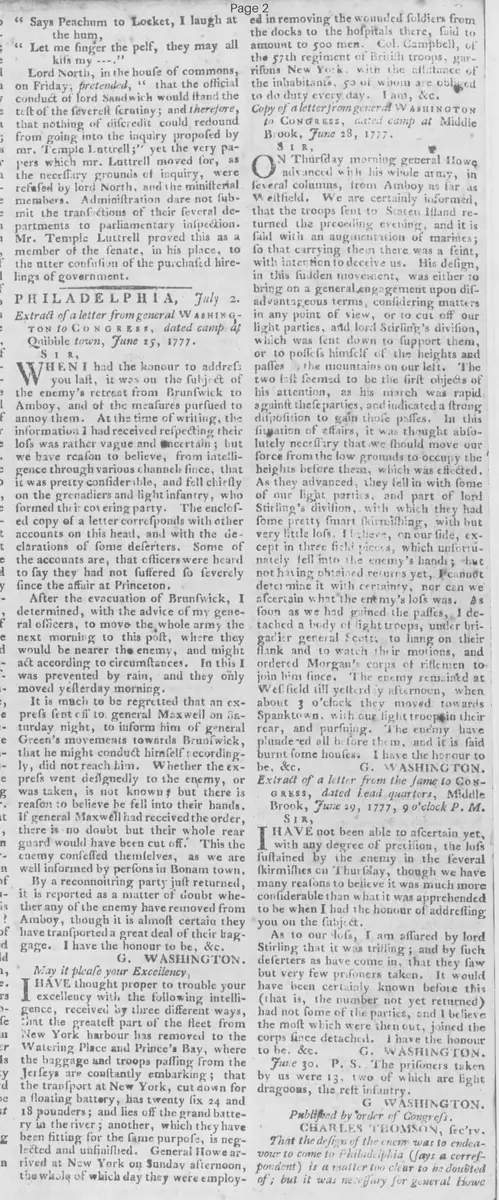
Extract of a letter from general WASHINGTON to CONGRESS, dated camp at Quibbletown, June 25, 1777.
SIR,
WHEN I had the honour to address you last, it was on the subject of the enemy's retreat from Brunswick to Amboy, and of the measures pursued to annoy them. At the time of writing, the information I had received respecting their loss was rather vague and uncertain; but we have reason to believe, from intelligence through various channels since, that it was pretty considerable, and fell chiefly on the grenadiers and light infantry, who formed this covering party. The enclosed copy of a letter corresponds with other accounts on this head, and with the declarations of some deserters. Some of the accounts are, that officers were heard to say they had not suffered so severely since the affair at Princeton.
After the evacuation of Brunswick, I determined, with the advice of my general officers, to move the whole army the next morning to this post, where they would be nearer the enemy, and might act according to circumstances. In this I was prevented by rain, and they only moved yesterday morning.
It is much to be regretted that an express sent to general Maxwell on Saturday night, to inform him of general Greene's movements towards Brunswick, that he might conduct himself accordingly, did not reach him. Whether the express went designedly to the enemy, or was taken, is not known; but there is reason to believe he fell into their hands. If general Maxwell had received the order, there is no doubt but their whole rear guard would have been cut off. This the enemy confessed themselves, as we are well informed by persons in Bonhamtown.
By a reconnoitring party just returned, it is reported as a matter of doubt whether any of the enemy have removed from Amboy, though it is almost certain they have transported a great deal of their baggage. I have the honour to be, &c.
G. WASHINGTON.
May it please your Excellency.
HAVE thought proper to trouble your excellency with the following intelligence, received by three different ways, that the greatest part of the fleet from New York harbour has removed to the Watering Place and Prince's Bay, where the baggage and troops passing from the Jerseys are constantly embarking; that the transport at New York, cut down for a floating battery, has twenty six 24 and 18 pounders; and lies off the grand battery in the river; another, which they have been fitting for the same purpose, is neglected and unfinished. General Howe arrived at New York on Sunday afternoon, the whole of which day they were employed in removing the wounded soldiers from the docks to the hospitals there, and to amount to 500 men. Col. Campbell, of the 57th regiment of British troops, garrison's New York, with the assistance of the inhabitants, 50 of whom are obliged to do duty every day. I am, &c.
Copy of a letter from general WASHINGTON to CONGRESS, dated camp at Middle Brook, June 28, 1777.
SIR,
On Thursday morning general Howe advanced with his whole army, in several columns, from Amboy as far as Westfield. We are certainly informed, that the troops sent to Staten Island returned the preceding evening, and it is said with an augmentation of marines; so that carrying them there was a feint, with intention to deceive us. His design, in this sudden movement, was either to bring on a general engagement upon disadvantageous terms considering matters in any point of view, or to cut off our light parties, and lord Stirling's division, which was sent down to support them, or to possess himself of the heights and passes of the mountains on our left. The two last seemed to be the first objects of his attention, as his march was rapid against these parties, and indicated a strong disposition to gain those passes. In this situation of affairs, it was thought absolutely necessary that we should move our force from the low grounds to occupy the heights before them, which was effected.
As they advanced, they fell in with some of our light parties, and part of lord Stirling's division, with which they had some pretty smart skirmishing, with but very little loss. I believe, on our side, except in three field pieces, which unfortunately fell into the enemy's hands; but not having obtained returns yet, I cannot determine it with certainty, nor can we ascertain what the enemy's loss was. As soon as we had gained the passes, I detached a body of light troops, under brigadier general Scott, to hang on their flank and to watch their motions, and ordered Morgan's corps of riflemen to join him since. The enemy remained at Westfield till yesterday afternoon, when about 3 o'clock they moved towards Spanktown, with our light troop in their rear, and pursuing. The enemy have plundered all before them, and it is said burnt some houses. I have the honour to be, &c.
G. WASHINGTON.
Extract of a letter from the same to CONGRESS, dated head quarters, Middle Brook, June 29, 1777, 9 o'clock P. M.
SIR,
I HAVE not been able to ascertain yet, with any degree of precision, the loss attained by the enemy in the several skirmishes on Thursday, though we have many reasons to believe it was much more considerable than what it was apprehended to be when I had the honour of addressing you on the subject.
As to our loss, I am assured by lord Stirling that it was trifling; and by such deserters as have come in, that they saw but very few prisoners taken. It would have been certainly known before this (that is, the number not yet returned) had not some of the parties, and I believe the most which were then out, joined the corps since detached. I have the honour to be, &c.
G. WASHINGTON.
June 30. P. S. The prisoners taken by us were 13, two of which are light dragoons, the rest infantry.
G. WASHINGTON.
Published by order of Congress.
CHARLES THOMSON, SEC'RY.
That the design of the enemy was so endeavour to come to Philadelphia (says a correspondent) is a matter too clear to be doubted of; but it was necessary for general Howe
to make some little movement, by which he might try the disposition of the militia in the two states of New Jersey and Pennsylvania, before he ventured to make his grand movement to this city. His march from Brunswick to Somerset was intended to procure this knowledge, and he soon found that he should not only have general Washington upon his back, but the militia of both states about his ears, if he stirred any farther. Finding this to be the case, he retreated to Amboy, hoping thereby that the militia would be dismissed, and likewise the 3000 men which had been ordered from general Putnam's camp countermanded. This I take to be the true reason of Howe's two movements to Somerset and Amboy. If Howe means to bring on a general action, why don't he march for the Delaware at once? When I say a general action, I mean his whole force against our whole force, and not his whole force, against a part of ours, which is what he was trying at. Howe is a sleepy sulking general: When our force is collected, he runs away, and when a part of it is dismissed, he comes back again; and at this bo-peep kind of game he'll go on till he gets his head broke, and then he'll be quiet.
What sub-type of article is it?
What keywords are associated?
What entities or persons were involved?
Where did it happen?
Domestic News Details
Primary Location
New Jersey
Event Date
June 25 30, 1777
Key Persons
Outcome
enemy losses considerable, chiefly grenadiers and light infantry; about 500 wounded; americans lost three field pieces and took 13 prisoners; minimal american casualties; some houses plundered and burnt.
Event Details
British retreated from Brunswick to Amboy after losses; Washington moved army to Quibbletown then Middle Brook; express to Maxwell failed; Howe advanced to Westfield, skirmished with American parties; Americans occupied heights and pursued; fleet movements to Watering Place and Prince's Bay; Howe arrived in New York.