Thank you for visiting SNEWPapers!
Sign up free
Virginia Argus
Richmond, Virginia
What is this article about?
N. Webster contributes to the Connecticut Herald a historical overview of severe winters in America and Europe, comparing past extremes (e.g., 1740-41, 1779-80) to the current severe winter, noting its impacts on the poor and concluding it ranks second to the most intense ones.
Clipping
OCR Quality
Full Text
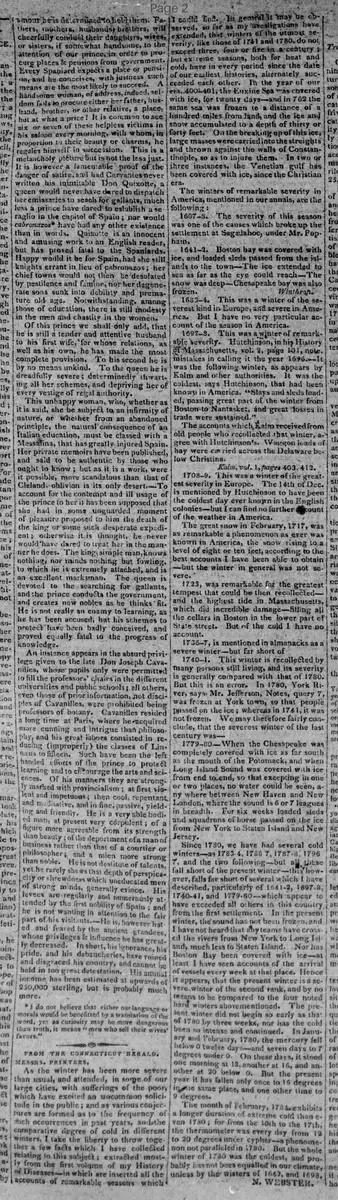
MESSRS. PRINTERS,
As the winter has been more severe than usual, and attended, in some of our large cities, with sufferings of the poor, which have excited an uncommon solicitude in the public; and as various conjectures are formed as to the frequency of such occurrences in past years, and the comparative degree of cold in different winters, I take the liberty to throw together a few facts which I have collected relating to this subject: extracted mostly from the first volume of my History of Diseases—in which are inserted all the accounts of remarkable seasons which I could find. In general it may be observed, so far as my investigations have extended, that winters of the utmost severity, like those of 1741 and 1780, do not exceed three, four or five in a century; but extreme seasons, both for heat and cold, have in every period since the date of our earliest histories, alternately succeeded each other. In the year of our era 401, the Euxine Sea was covered with ice, for twenty days—and in 762 the same sea was frozen to a distance of a hundred miles from land, and the ice and snow accumulated to a depth of thirty or forty feet. On the breaking up of this ice, large masses were carried into the straits and thrown against the walls of Constantinople, so as to injure them. In two or three instances, the Venetian gulf has been covered with ice, since the Christian era.
The winters of remarkable severity in America, mentioned in our annals, are the following:
1607-8. The severity of this season was one of the causes which broke up the settlement at Sagadahoc, under Mr. Popham.
1641-3. Boston bay was covered with ice, and loaded sleds passed from the islands to the town—The ice extended to sea as far as the eye could reach—The snow was deep—Chesapeake bay was also frozen.
1683-4. This was a winter of the severest kind in Europe, and severe in America. But I have no very particular account of the season in America.
1697-8. This was a winter of remarkable severity. Hutchinson, in his History of Massachusetts, vol. 2, page 101, note, mistakes in calling it the year 1696.—It was the following winter, as appears by Kalm and other authorities. It was the coldest, says Hutchinson, that had been known in America. "Sleys and sleds loaded, passing great part of the winter from Boston to Nantasket, and great losses in trade were sustained."
The accounts which Kalm received from old people who recollected that winter, agree with Hutchinson's. Waggon loads of hay were carried across the Delaware below Christina. Kalm, vol. 1, pages 403, 412.
1708-9. This was a winter of the greatest severity in Europe. The 14th of Dec. is mentioned by Hutchinson to have been the coldest day ever known in the English colonies—but I can find no further count of the weather in America.
The great snow in February, 1717, was as remarkable a phenomenon as ever was known in America, the snow rising to a level of eight or ten feet, according to the best accounts I have been able to obtain—but the winter in general was not severe.
1723, was remarkable for the greatest tempest that could be then recollected—and the highest tide in Massachusetts, which did incredible damage—filling all the cellars in Boston in the lower part of State street. But of the cold I have no account.
1734-5, is mentioned in almanacks as a severe winter—but far short of 1740-1. This winter is recollected by many persons still living, and its severity is generally compared with that of 1780. But this is an error. In 1780, York River, says, Mr. Jefferson, Notes, query 7, was frozen at York town, so that people passed on the ice; whereas in 1741, it was not frozen. We may therefore fairly conclude, that the severest winter of the last century was—
1779-80—When the Chesapeake was completely covered with ice as far south as the mouth of the Potomac, and when Long Island Sound was covered with ice from end to end, so that excepting in one or two places, no water could be seen, any where between New Haven and New London, where the sound is 6 or 7 leagues in breadth. For six weeks loaded sleds and squadrons of horse passed on the ice from New York to Staten Island and New Jersey.
Since 1780, we have had several cold winters—as 1783-4, 1786-7, 1787-8, 1796-7, and the two following—but all these fall short of the present winter—this however, falls far short of several which I have described, particularly of 1541-2, 1697-8, 1740-41, and 1779-80—which appear to have exceeded all others in this country from the first settlement. In the present winter, the sound has not been frozen, and I have not heard that any teams have crossed the rivers from New York to Long Island, and, much less to Staten Island, Nor has Boston Bay been covered with ice—at least I have seen accounts of the arrival of vessels every week at that place. Hence it appears, that the present winter is a severe winter of the second rank, and by no means to be compared to the four noted hard winters abovementioned. The present winter did not begin so early as that of 1780 by three weeks, nor has the cold been so intense and continued. In January and February, 1780, the mercury fell below 0 twelve days—and seven days to 7 degrees under 0. On these days, it stood one morning at 15, another at 16, and another at 20 below 0. But the present year it has fallen only once to 16 degrees in the same place, and one other time to 9 degrees.
The month of February, 1784, exhibits a longer duration of extreme cold than even 1780; for from the 10th to the 17th, the thermometer was every day from 12 to 20 degrees under cypher—a phenomenon not paralleled in 1780. But the whole winter of 1780 was the coldest, and probably has not been equalled in our climate, unless by the winters of 1642, and 1698.
N. WEBSTER.
What sub-type of article is it?
What keywords are associated?
What entities or persons were involved?
Where did it happen?
Domestic News Details
Primary Location
Connecticut
Key Persons
Outcome
sufferings of the poor in large cities due to severe winter; historical trade losses, settlement breakups, and property damage from past extreme winters.
Event Details
N. Webster compiles historical accounts of severe winters in America and Europe from annals and his History of Diseases, listing notable cold seasons from 1607-8 to 1779-80, comparing their severity to the current winter, which he ranks as second-tier based on ice coverage, temperatures, and durations.