Thank you for visiting SNEWPapers!
Sign up free
The Virginia Gazette
Richmond, Williamsburg, Richmond County, Virginia
What is this article about?
In British Parliament, Lord North proposes a resolution allowing American colonies to raise their own contributions for common defense in lieu of direct taxation by Parliament, if they support civil government. Governor Pownall endorses it as a path to peace amid rebellion. The Restraining Act restricts trade of New Jersey, Pennsylvania, Maryland, Virginia, and South Carolina from July 1, 1775, until obedience is restored.
Merged-components note: These components form a continuous article on British parliamentary speeches by Lord North and Governor Pownall, followed by the Act of Parliament restraining colonial trade; text flows directly across components despite label differences.
Clippings
1 of 2
OCR Quality
Full Text
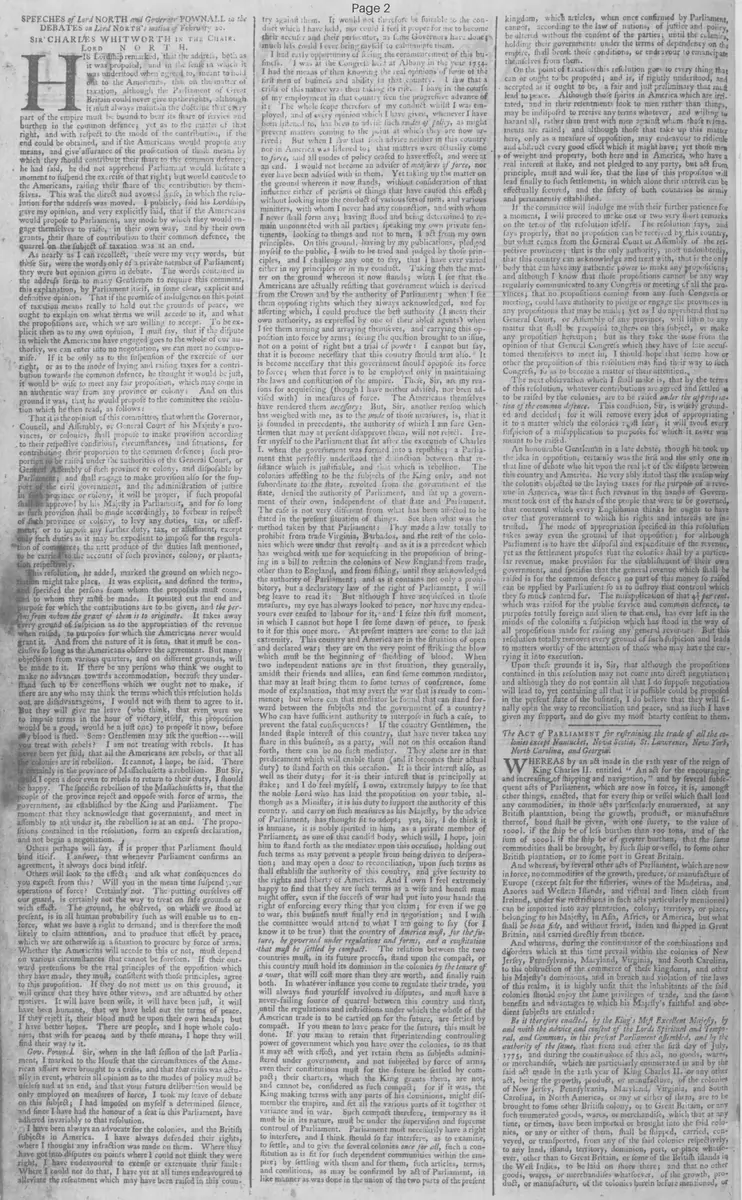
SIR CHARLES WHITWORTH IN THE CHAIR.
His Lordship remarked, that the address, both as it was proposed, and in the sense in which it was understood when agreed to, meant to hold out to the Americans, that, on the matter of taxation, although the Parliament of Great Britain could never give up their rights, although it must always maintain the doctrine that every part of the empire must be bound to bear its share of service and burden in the common defence; yet as to the matter of that right, and with respect to the mode of the contribution, if the end could be obtained, and if the Americans would propose any means, and give assurance of the prosecution of those means by which they should contribute their share to the common defence; he had said, he did not apprehend Parliament would hesitate a moment to suspend the exercise of that right; but would concede to the Americans, raising their share of the contribution by themselves. This was the direct and avowed sense, in which the resolution for the address was moved. I publicly, said his Lordship, gave my opinion, and very explicitly said, that if the Americans would propose to Parliament, any mode by which they would engage themselves to raise, in their own way, and by their own grants, their share of contribution to the common defence, the quarrel on the subject of taxation was at an end.
As nearly as I can recollect, these were my very words, but these Sir, were the words only of a private member of Parliament; they were but opinion given in debate. The words contained in the address seem to many Gentlemen to require this comment, this explanation, by Parliament itself, in some clear, explicit and definitive opinion. That if the promise of indulgence on this point of taxation means really to hold out the grounds of peace, we ought to explain on what terms we will accede to it, and what the propositions are, which we are willing to accept. To be explicit then as to my own opinion, I must say, that if the dispute in which the Americans have engaged goes to the whole of our authority, we can enter into no negotiation, we can meet no compromise. If it be only as to the suspension of the exercise of our right, or as to the mode of laying and raising taxes for a contribution towards the common defence, he thought it would be just, it would be wise to meet any fair proposition, which may come in an authentic way from any province or colony: And on this ground it was, that he would propose to the committee the resolution which he then read, as follows:
That it is the opinion of this committee, that when the Governor, Council, and Assembly, or General Court of his Majesty's provinces, or colonies, shall propose to make provision according to their respective conditions, circumstances, and situations, for contributing their proportion to the common defence; such proportion to be raised under the authorities of the General Court, or General Assembly of such province or colony, and disposable by Parliament; and shall engage to make provision also for the support of the civil government, and the administration of justice in such province or colony, it will be proper, if such proposal shall be approved by his Majesty in Parliament, and for so long as such provision shall be made accordingly, to forbear in respect of such province or colony, to levy any duties, tax, or assessment, or to impose any further duty, tax, or assessment, except only such duties as it may be expedient to impose for the regulation of commerce; the net produce of the duties last mentioned, to be carried to the account of such province, colony, or plantation respectively.
This resolution, he added, marked the ground on which negotiation might take place. It was explicit, and defined the terms, and specified the persons from whom the proposals must come, and to whom they must be made. It pointed out the end and purpose for which the contributions are to be given, and the persons from whom the grant of them is to originate. It takes away every ground of suspicion as to the appropriation of the revenue when raised, to purposes for which the Americans never would grant it. And from the nature of it is seen, that it must be conclusive so long as the Americans observe the agreement. But many objections from various quarters, and on different grounds, will be made to it. If there be any persons who think we ought to make no advances towards accommodation, because they understand such to be concessions which we ought not to make, if there are any who may think the terms which this resolution holds out are disadvantageous, I would not wish them to agree to it.
But they will give me leave (who think, that even were we to impose terms in the hour of victory itself, this proposition would be a good, would be a just one) to propose it now, before any blood is shed. Some Gentlemen may ask the question --- will you treat with rebels? I am not treating with rebels. It has never been yet said, that all the Americans are rebels, or that all the colonies are in rebellion. It cannot, I hope, be said. There is certainly in the province of Massachusetts a rebellion. But Sir, could I open a door even to rebels to return to their duty, I should be happy. The specific rebellion of the Massachusetts is, that the people of the province reject and oppose with force of arms, the government, as established by the King and Parliament. The moment that they acknowledge that government, and meet in assembly to act under it, the rebellion is at an end. The propositions contained in the resolution, form an express declaration, and not begin a negotiation.
Others perhaps will say, it is proper that Parliament should bind itself. I answer, that whenever Parliament confirms an agreement, it always does bind itself.
Others will look to the effect; and ask what consequences do you expect from this? Will you in the mean time suspend your operations of force? Certainly not. The putting ourselves off our guard, is certainly not the way to treat on safe grounds or with effect. The ground, he observed, on which we stood at present, is in all human probability such as will enable us to enforce, what we have a right to demand, and is therefore the most likely to claim attention, and to produce that effect by peace, which we are otherwise in a situation to procure by force of arms.
Whether the Americans will accede to this or not, must depend on various circumstances that cannot be foreseen. If their outward pretensions be the real principles of the opposition which they have made, they must, consistent with those principles, agree to this proposition. If they do not meet us on this ground, it will evince that they have other views, and are actuated by other motives. It will have been wise, it will have been just, it will have been humane, that we have held out the terms of peace.
If they reject it, their blood must be upon their own heads; but I have better hopes. There are people, and I hope whole colonies, that wish for peace; and by these means, I hope they will find their way to it.
Gov. Pownall. Sir, when in the last session of the last Parliament, I moved to the House that the circumstances of the American affairs were brought to a crisis, and that that crisis was actually in event, wherein all opinion as to the modes of policy must be useless and at an end, and that your future deliberation would be only employed on measures of force, I took my leave of debate on this subject; I had imposed on myself a determined silence and since I have had the honour of a seat in this Parliament, have adhered invariably to that resolution.
I have been always an advocate for the colonies, and the British subjects in America. I have always defended their rights, where I thought any infraction was made on them. Where they have got into disputes on points where I could not think they were right, I have endeavoured to excuse or extenuate their fault: Where I could not do that, I have yet at all times endeavoured to alleviate the resentment which may have been raised in this country against them. It would not therefore be suitable to the conduct which I have held, nor could I feel it proper for me to become their accuser and their persecutor, as some Governors have done; much less could I ever bring myself to calumniate them.
I had early opportunity of seeing the commencement of this business. I was at the Congress held at Albany in the year 1754. I had the means of then knowing the real opinions of some of the first men of business and ability in that country. I saw that a crisis of this nature was then taking its rise. I have in the course of my employment in that country seen the progressive advance of it: The whole scope therefore of my conduct whilst I was employed, and of every opinion which I have given, whenever I have been listened to, has been to advise such rules of policy, as might prevent matters coming to the point at which they are now arrived: But when I saw that such advice neither in this country nor in America was listened to; that matters were actually come to force, and all modes of policy ceased to have effect, and were at an end. I would not become an adviser of measures of force, nor ever have been advised with in them. Yet taking up the matter on the ground whereon it now stands, without consideration of that influence either of persons or things that have caused this effect; without looking into the conduct of various sets of men, and various ministers, with whom I never had any connection, and with whom I never shall form any; having stood and being determined to remain unconnected with all parties; speaking my own private sentiments, looking to things and not to men, I act from my own principles. On this ground, having by my publications, pledged myself to the public, I wish to be tried and judged by those principles, and I challenge any one to say, that I have ever varied either in my principles or in my conduct. Taking then the matter on the ground whereon it now stands; when I see that the Americans are actually resisting that government which is derived from the Crown and by the authority of Parliament; when I see them opposing rights which they always acknowledged, and for asserting which, I could produce the best authority (I mean their own authority, as expressed by one of their ablest agents) when I see them arming and arraying themselves, and carrying this opposition into force by arms; seeing the question brought to an issue, not on a point of right but a trial of power : I cannot but say, that it is become necessary that this country should arm also. It is become necessary that this government should oppose its force to force; when that force is to be employed only in maintaining the laws and constitution of the empire. These, Sir, are my reasons for acquiescing (though I have neither advised, nor been advised with) in measures of force. The Americans themselves have rendered them necessary: But, Sir, another reason which has weighed with me, as to the mode of those measures, is, that it is founded in precedents, the authority of which I am sure Gentlemen that may at present disapprove them, will not reject. I refer myself to the Parliament that sat after the execution of Charles I. when the government was formed into a republic; a Parliament that perfectly understood the distinction between that resistance which is justifiable, and that which is rebellion. The colonies affecting to be the subjects of the King only, and not subordinate to the state, revolted from the government of the state, denied the authority of Parliament, and set up a government of their own, independent of that state and Parliament.
The case is not very different from what has been alleged to be stated in the present situation of things. See then what was the method taken by that Parliament: They made a law totally to prohibit from trade Virginia, Barbados, and the rest of the colonies which were under that revolt; and as it is a precedent which has weighed with me for acquiescing in the proposition of bringing in a bill to restrain the colonies of New England from trade, other than to England, and from fishing, until they acknowledged the authority of Parliament; and as it contains not only a prohibitory, but a declaratory law of the right of Parliament, I will beg leave to read it: But although I have acquiesced in those measures, my eye has always looked to peace, nor have my endeavours ever ceased to labour for it, and I seize this first moment, in which I cannot but hope I see some dawn of peace, to speak to it for this once more. At present matters are come to the last extremity. This country and America are in the situation of open and declared war; they are on the very point of striking the blow which must be the beginning of shedding of blood. When two independent nations are in that situation, they generally, amidst their friends and allies, can find some common mediator, that may at least bring them to some terms of conference, some mode of explanation, that may avert the war that is ready to commence; but where can that mediator be found that can stand forward between the subjects and the government of a country?
Who can have sufficient authority to interpose in such a case, to prevent the fatal consequences? If the country Gentlemen, the landed staple interest of this country, that have never taken any share in this business, as a party, will not on this occasion stand forth, there can be no such mediator. They alone are in that predicament which will enable them (and it becomes their actual duty) to stand forth on this occasion. It is their interest also, as well as their duty; for it is their interest that is principally at stake; and I do feel myself, I own, extremely happy to see that the noble Lord who has laid the proposition on your table, although as a Minister, it is his duty to support the authority of this country, and carry on such measures as his Majesty, by the advice of Parliament, has thought fit to adopt; yet, Sir, I do think it is humane, it is nobly spirited in him, as a private member of Parliament, as one of that candid body, which will, I hope, join him to stand forth as the mediator upon this occasion, holding out such terms as may prevent a people from being driven to desperation; and may open a door to reconciliation, upon such terms as shall establish the authority of this country, and give security to the rights and liberty of America. And I own I feel extremely happy to find that they are such terms as a wise and honest man might offer, even if the success of war had put into your hands the right of enforcing every thing that you claim; for even if we go to war, this business must finally end in negotiation; and I wish the committee would attend to what I am going to say (for I know it to be true) that the country of America must, for the future, be governed under regulations and forms, and a constitution that must be settled by compact. The relation between the two countries must, in its future process, stand upon the compact, or this country must hold its dominion in the colonies by the tenure of a war, that will cost more than they are worth, and finally ruin both. In whatever instance you come to regulate their trade, you will always find yourself involved in disputes, and must have a never-failing source of quarrel between this country and that, until the regulations and restrictions under which the whole of the American trade is to be carried on for the future, are settled by compact. If you mean to have peace for the future, this must be done. If you mean to retain that superintending controlling power of government which you have over the colonies, so as that it may act with effect, and yet retain them as subjects administered under government, and not subjected by force of arms, even their constitutions must for the future be settled by compact; their charters, which the King grants them, are not, and cannot be, considered as such compact; for if it was, the King making terms with any parts of his dominions, might dismember the empire, and set all the various parts of it together at variance and in war. Such compact therefore, temporary as it must be in its nature, must be under the supervision and supreme control of Parliament. Parliament most necessarily have a right to interfere, and I think should so far interfere, as to examine, to settle, and to give the several colonies once for all, such a constitution as is fit for such dependent communities within the empire; by settling with them and for them, such articles, terms, and conditions, as may be confirmed by act of Parliament, in like manner as was done in the union of the two parts of the present
kingdom, which articles, when once confirmed by Parliament, cannot, according to the law of nations, of justice and policy, be altered without the consent of the parties; until the colonies, holding their governments under the terms of dependency on the empire, shall break those conditions, or endeavour to emancipate themselves from them.
On the point of taxation this resolution goes to every thing that can or ought to be proposed; and is, if rightly understood, and accepted as it ought to be, a fair and just preliminary that must lead to peace. Although those spirits in America which are irritated, and in their resentments look to men rather than things, may be indisposed to receive any terms whatever, and willing to hazard all, rather than treat with men against whom those resentments are raised; and although those that take up this matter here, only as a measure of opposition, may endeavour to ridicule and obstruct every good effect which it might have; yet those men of weight and property, both here and in America, who have a real interest at stake, and not pledged to any party, but act from principle, must and will see, that the line of this proposition will lead finally to such settlement, in which alone their interest can be effectually secured, and the safety of both countries be firmly and permanently established.
If the committee will indulge me with their further patience for a moment, I will proceed to make one or two very short remarks on the tenor of the resolution itself. The resolution says, and says properly, that no proposition can be received by this country, but what comes from the General Court or Assembly of the respective provinces; that is the only authority, most undoubtedly, that this country can acknowledge and treat with, that is the only body that can have any authentic power to make any propositions; and although I know that those propositions cannot be any way regularly communicated to any Congress or meeting of all the provinces; that no propositions coming from any such Congress or meeting, could have authority to pledge or engage the provinces in any propositions that may be made; yet as I do apprehend that no General Court, or Assembly of any province, will listen to any matter that shall be proposed to them on this subject, or make any proposition hereupon; but as they take the tone from the opinion of that General Congress which they have of late accustomed themselves to meet in, I should hope that some how or other the proposition of this resolution may find their way to such Congress, so as to become a matter of their attention.
The next observation which I shall make is, that by the terms of this resolution, whatever contributions are agreed and settled to be raised by the colonies, are to be raised under the appropriation of the common defence. This condition, Sir, is wisely grounded and decided; for it will remove every idea of appropriating it to a matter which the colonies do not fear; it will avoid every suspicion of a misapplication to purposes for which it never was meant to be raised.
An honourable Gentleman in a late debate, though he took up the idea in opposition, certainly was the first and the only one in that line of debate who hit upon the real gist of the dispute between this country and America. He very ably stated that the reason why the colonies objected to the laying taxes for the purpose of a revenue in America, was that such revenue in the hands of Government took out of the hands of the people that were to be governed, that control which every Englishman thinks he ought to have over that government to which his rights and interests are intrusted. The mode of appropriation specified in this resolution takes away even the ground of that opposition; for although Parliament is to have the disposal and expenditure of the revenue, yet as the settlement proposes that the colonies shall by a particular revenue, make provision for the establishment of their own government, and specifies that the general revenue which shall be raised is for the common defence; no part of this money so raised can be applied by Parliament so as to destroy that control which they so much contend for. The misapplication of that 4 per cent. which was raised for the public service and common defence, to purposes totally foreign and alien to that end, has ever left in the minds of the colonies a suspicion which has stood in the way of all propositions made for raising any general revenue: But this resolution totally removes every ground of such suspicion and leads to matters worthy of the attention of those who may have the carrying it into execution.
Upon these grounds it is, Sir, that although the propositions contained in this resolution may not come into direct negotiation; and although they do not contain all that I do suppose negotiation will lead to, yet containing all that it is possible could be proposed in the present state of the business, I do believe that they will finally open the way to reconciliation and peace, and as such I have given my support, and do give my most hearty consent to them.
The Act of PARLIAMENT for restraining the trade of all the colonies except Nantucket, Nova Scotia, St. Lawrence, New York, North Carolina, and Georgia.
WHEREAS King Charles II. entitled "An act for the encouraging and increasing of shipping and navigation," and by several subsequent acts of Parliament, which are now in force, it is, amongst other things, enacted, that for every ship or vessel which shall load any commodities, in those acts particularly enumerated, at any British plantation, being the growth, product, or manufacture thereof, bond shall be given, with one surety, to the value of 100l. if the ship be of less burthen than 100 tons, and of the sum of 2000l. if the ship be of greater burthen, that the same commodities shall be brought, by such ship or vessel, to some other British plantation, or to some port in Great Britain.
And whereas, by several other acts of Parliament, which are now in force, no commodities of the growth, produce, or manufacture of Europe (except salt for the fisheries, wines of the Madeiras, and Azores and Western Islands, and victual and linen cloth from Ireland, under the restrictions in such acts particularly mentioned) can be imported into any plantation, colony, territory, or place, belonging to his Majesty, in Asia, Africa, or America, but what shall be bona fide, and without fraud, laden and shipped in Great Britain, and carried directly from thence.
And whereas, during the continuance of the combinations and disorders which at this time prevail within the colonies of New Jersey, Pennsylvania, Maryland, Virginia, and South Carolina, to the obstruction of the commerce of these kingdoms, and other his Majesty's dominions, and in breach and violation of the laws of this realm, it is highly unfit that the inhabitants of the said colonies should enjoy the same privileges of trade, and the same benefits and advantages to which his Majesty's faithful and obedient subjects are entitled:
Be it therefore enacted, by the King's Most Excellent Majesty, by and with the advice and consent of the Lords Spiritual and Temporal, and Commons, in this present Parliament assembled, and by the authority of the same, that from and after the first day of July, 1775, and during the continuance of this act, no goods, wares, or merchandise, which are particularly enumerated in and by the said act made in the 12th year of King Charles II. or any other act, being the growth, product, or manufacture, of the colonies of New Jersey, Pennsylvania, Maryland, Virginia, and South Carolina, in North America, or any or either of them, are to be brought to some other British colony, or to Great Britain, or any such enumerated goods, wares, or merchandise, which that at any time, or times, have been imported or brought into the said colonies, or any or either of them, shall be shipped, carried, conveyed, or transported, from any of the said colonies respectively, to any land, island, territory, dominion, port, or place whatsoever, other than to Great Britain, or some of those British islands in the West Indies, to be laid on shore there; and that no other goods, wares, or merchandises whatsoever, of the growth, produce, or manufacture, of the colonies herein before mentioned, or
which shall at any time, or times, have been imported or brought into the same, shall, from and after the said first day of July, and during the continuance of this act, be shipped, carried, conveyed, or transported, from any of the said colonies respectively, to any other land, island, territory, dominion, port, or place whatsoever, except to the kingdoms of Great Britain or Ireland, or to some of the British islands in the West Indies, to be laid on shore there; any law, custom, or usage, to the contrary, notwithstanding.
And be it further enacted, by the authority aforesaid, that from and after the said first day of July, before any ship or vessel shall have or take on board any goods as aforesaid, in any or either of the colonies before mentioned, sufficient bond, with one surety, besides the master of such ship or vessel, shall be given to the Collector, or other principal officer of the customs at the port or place where such goods are intended to be laden or taken on board, in the penalty of 1000l. if the ship be of less burthen than 100 tons, and of the sum of 2000l. if the ship shall be of that or any greater burthen, with condition that such enumerated goods shall not be landed or put on shore at or upon any other land, island, territory, dominion, port, or place whatsoever, except some port or place within the kingdom of Great Britain, or some of the British plantations in the West Indies; and that all other goods, wares, or merchandises, so intended to be laden as aforesaid, shall not be landed or put on shore at or upon any land, island, territory, dominion, port, or place whatsoever, other than and except some port or place within the kingdoms of Great Britain or Ireland, or some of the British islands of the West Indies; and with further condition, to bring a certificate, in discharge thereof, within 18 months from the date of such bond, for such of the said goods as shall be entered for or landed in Great Britain or Ireland respectively, and within six months for such of the said goods as shall be entered for or landed in any of the British islands in the West Indies; which respective certificates shall be under the hands and seals of office of the Collector and Comptroller, or other principal officer of the customs resident at the port or place where such goods shall be landed, testifying the landing thereof; or such bond, or bonds, shall and may be discharged, by proof, upon oath made by credible persons, that the said goods were taken by enemies, or perished in the seas.
And it is hereby further enacted, by the authority aforesaid, that where any such bond, or bonds, shall be given as aforesaid, in pursuance of this act, the collector or other principal officer of the customs to whom such bond, or bonds, shall have been given, shall deliver, under his hand and seal of office, without fee or reward, to the master of the ship or vessel taking in such goods, for the securing of her navigation, a certificate that such bond, or bonds, hath or have been given, expressing therein the quantity and species of the goods, with the marks and numbers of the packages, and the port or place for which they were entered; and if any such goods shall be laden on board any such ship or vessel, in any of the colonies in this act before mentioned, before such bond, or bonds, shall be given, or shall be found on board any ship or vessel, without the certificate herein before directed, that such bond or bonds hath or have been given, the goods so laden, together with the ship or vessel, with her guns, ammunition, tackle, apparel, and furniture, shall be forfeited. And if any goods so laden as aforesaid shall be landed or discharged at any port or place contrary to the intent and meaning of this act, over and above the penalty of the bond, or bonds, the shipper and owner of such goods, and the master or person taking charge of the vessel on board which they were laden, shall respectively forfeit the full value of the goods so landed or discharged, to be estimated according to the highest price or value which sort of goods bear in the colony where, and at the time when, they were shipped and laden; which ship and goods may be seized and prosecuted, or the value of such goods prosecuted for, by any Admiral, chief commander, or commissioned officer of his Majesty's fleet or ships of war, or by any officer of his Majesty's customs, in the manner herein after directed.
And it is hereby further enacted, by the authority aforesaid, that from and after the first day of September 1775, and during the continuance of this act, no sort of wines, salt, or any goods or commodities whatsoever (except horses, victual, and linen cloth, the produce and manufacture of Ireland, imported directly from thence) shall be imported into any of the said colonies herein before respectively mentioned, upon any pretence whatsoever, unless such goods shall be, bona fide, and without fraud, laden and shipped in Great Britain, and carried directly from thence, upon forfeiture thereof, and of the ship or vessel on board which such goods shall be laden; and it shall be lawful for any Admiral, chief commander, or commissioned officer of his Majesty's fleet or ships of war, or any officer of his Majesty's customs, to seize any ship or vessel arriving at any of the said colonies before mentioned, or which shall be discovered within two leagues of any shore thereof, having such goods on board, and goods laden thereon (except as before excepted) for which the master, or other person taking charge of such ship or vessel, shall not produce a cocket or clearance, from the collector or proper officer of his Majesty's customs, certifying that the said goods were laden on board the said ship or vessel in some port of Great Britain; any law, custom, or usage, to the contrary, notwithstanding.
Provided always, and it is hereby enacted, by the authority aforesaid, that this act, or any thing therein contained, shall not extend, or be construed to extend, to prohibit the exportation or carrying out from any of the colonies before mentioned, or the importation into the same, of any goods or commodities whatsoever, for the victualling or providing any of his Majesty's ships of war, or other ships or vessels in his Majesty's service, or for his Majesty's forces, forts, or garrisons, any thing herein contained to the contrary notwithstanding. And provided also, that nothing herein contained, shall extend or be construed to extend, to hinder or restrain the lawful importation into any or either of the said colonies herein before mentioned, from any of the British islands in the West Indies, of any such goods or commodities, being the growth or produce thereof, as may now by law be imported from thence into the said colonies, or any or either of them. And whereas it is the intent and meaning of this act, that the several prohibitions and restraints, herein before enacted, should be discontinued and cease as soon as the trade and commerce of his Majesty's subjects may be carried on without interruption within the said colonies, Be it enacted therefore, by the authority aforesaid, that whenever it shall be made appear, to the satisfaction of his Majesty's Governor or commander in chief, and the majority of the Council, of the colonies of New Jersey, Pennsylvania, Maryland, Virginia, and South Carolina, that peace and obedience to the laws shall be so far restored within the said colonies, or either of them, that the trade and commerce of his Majesty's subjects may be carried on without interruption within the same, and that goods, wares, and merchandize, have been freely imported into the said colonies, or either of them, from Great Britain, Ireland, and the British West India islands, and exposed to sale without any lett, hinderance, or molestation, from or by reason of any unlawful combinations to prevent or obstruct the same; and that goods, wares, and merchandize, have, in like manner, been exported from the said colonies, or either of them respectively, to Great Britain, Ireland, and the British West Indies, for and during the term of one calendar month preceding; that then, and in such case, it shall and may be lawful for the Governor or commander in chief, with the advice of the Council of such colonies respectively, by proclamation, under the seal of such respective colony, to notify the same to the several officers of the customs, and all others; and after such proclamation, this act, with respect to such colony within which such proclamation or proclamations have been issued as aforesaid, shall be discontinued and cease (except as herein provided) and all officers of his Majesty's customs, and all other persons having charge of the execution of this act, having received due notice of such proclamation
What sub-type of article is it?
What keywords are associated?
What entities or persons were involved?
Where did it happen?
Foreign News Details
Primary Location
American Colonies
Event Date
February 20, 1775
Key Persons
Outcome
proposed resolution for colonies to raise contributions for common defence and support civil government in exchange for forbearance on taxation except for commerce regulation; restraining act prohibits trade from new jersey, pennsylvania, maryland, virginia, and south carolina except to great britain, ireland, or british west indies, effective july 1, 1775, until obedience restored.
Event Details
In parliamentary debate chaired by Sir Charles Whitworth, Lord North explains his motion offering to suspend taxation if American colonies propose and execute their own contributions to common defence and civil government support, emphasizing it as grounds for peace without compromising authority, and reads the resolution. He rejects treating with rebels but opens door for reconciliation, refusing to suspend force operations. Governor Pownall supports the resolution, recounting his advocacy for colonies, acquiescence in force measures due to rebellion, historical precedents like post-Charles I Parliament's trade prohibitions, and urges it as mediator for peace via compact, addressing taxation suspicions. The text of the Restraining Act follows, enacting trade restrictions on specified rebellious colonies to enforce obedience.