Thank you for visiting SNEWPapers!
Sign up free
Editorial
August 4, 1795
Gazette Of The United States
Philadelphia, Philadelphia County, Pennsylvania
What is this article about?
In this installment of Cato's series, the author criticizes John Jay's treaty negotiations with Britain for neglecting demands for compensation on property losses (est. $1M+) from treaty violations and redress for trade injuries, including vessel captures, flag insults, and seamen impressment, attributing these to British government orders rather than individual acts.
Clipping
OCR Quality
95%
Excellent
Full Text
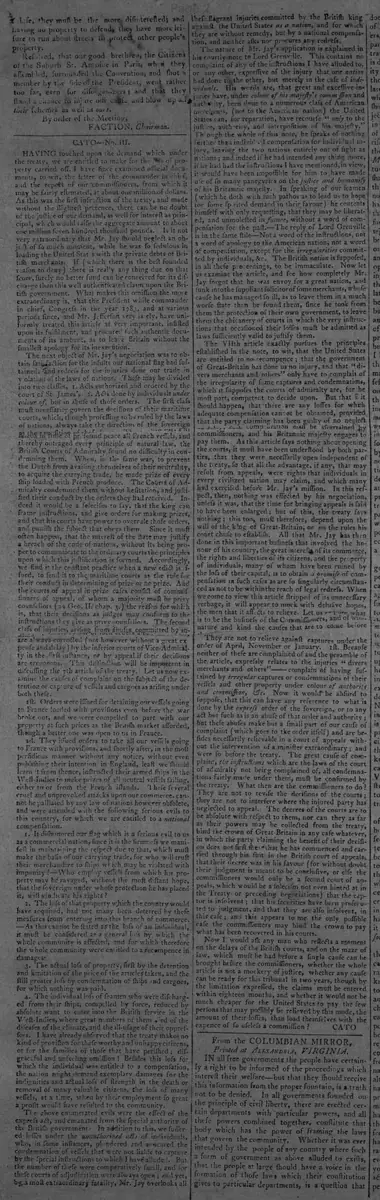
CATO—No. III.
HAVING touched upon the demand which under the treaty, we are entitled to make for the loss of property carried off, I have since examined official documents, to wit, the letter of the commander in chief, and the report of our commissioners, from which it may be fairly estimated, at about one million of dollars.
As this was the first infraction of the treaty, and made without the slightest pretence, there can be no doubt of the justice of our demand, as well for interest as principal, which would raise the aggregate amount to about one million seven hundred thousand pounds. Is it not very extraordinary that Mr. Jay should neglect an object of so much moment, while he was so sedulous in loading the United States with the private debts of British merchants. If (which there is the best founded reason to deny) there is really any thing due on that score, surely no better fund can be conceived for its discharge than this well authenticated claim upon the British government. What makes this omission the more extraordinary is, that the President while commander in chief, Congress in the year 1783, and at various periods since, and Mr. Jefferson very lately, have uniformly treated this article as very important, insisted upon its fulfillment, and procured such authentic documents of its amount, as to leave Britain without the smallest apology for its inexecution.
The next object of Mr. Jay's negociation was to obtain satisfaction for the insults our national flag had sustained, and redress for the injuries done our trade in violation of the laws of nations. These may be divided into two classes, 1. Acts authorized and ordered by the court of St. James's. 2. Acts done by individuals under colour of, but in abuse of those orders. The first class must necessarily govern the decisions of their maritime courts, which, though professing to be ruled by the laws of nations, always take the direction of the sovereign.
thereby outraged every principle of natural law, the British Courts of Admiralty found no difficulty in condemning them. When, in the same war, to prevent the Dutch from availing themselves of their neutrality, to acquire the carrying trade, he made prize of every ship loaded with French produce. The Courts of Admiralty condemned them without hesitation, and justified their conduct by the orders they had received. Indeed it would be a solecism to say, that the king can frame instructions, and give orders for making prizes, and that his courts have power to overrule those orders, and punish the subject that obeys them. Since it must often happen, that the interest of the state may justify a breach of the code of nations, without its being proper to communicate to the ordinary courts the principles upon which this justification is formed. Accordingly, we find it the constant practice when a new edict is issued, to send it to the maritime courts as the rule for their conduct in determining of prize or no prize. And the courts of appeal in prize cases consist of commissioners of appeal, of whom a majority must be privy councillors (22 Geo. II. chap. 3.) the reason for which is, that their decisions as judges may conform to the instructions they give as privy councillors. The second class of injuries, arising from abuses committed by individuals...
...are always corrected (not however without a great expense and delay) by the inferior courts of Vice-Admiralty in the first instance, or by appeal if their decisions are erroneous. This distinction will be important in discussing the 7th article of the treaty. Let us now examine the causes of complaint on the subject of the detention or capture of vessels and cargoes as arising under both these.
1st. Orders were issued for detaining our vessels going to France loaded with provisions even before the war broke out, and we were compelled to part with our property at such prices as the British market afforded, though a better one was open to us in France.
2d. They issued orders to take all our vessels going to France with provisions, and shortly after, in the most perfidious manner without any notice, without even publishing their intention in England, lest we should learn it from thence, instructed their armed ships in the West-Indies to make prizes of all neutral vessels sailing, either to or from the French islands. These several cruel and unprovoked attacks upon our commerce, cannot be palliated by any law of nations however obsolete, and were attended with the following serious evils to this country, for which we are entitled to a national compensation.
I. It dishonored our flag which is a serious evil to us as a commercial nation, since it is the firmness we manifest in maintaining the respect due to that, which must make the basis of our carrying trade, for who will trust their merchandize to ships which may be violated with impunity?—Who employ vessels from which his property may be ravaged, without the most distant hope, that the sovereign under whose protection he has placed it, will vindicate his rights?
2. The loss of that property which the country would have acquired, had not many been deterred by these measures from entering into this branch of commerce.—As this cannot be stated as the loss of an individual, it must be considered as a general loss by which the whole community is affected, and for which therefore the whole community were entitled to a recompence in damages.
3. The actual loss of property, first by the detention and limitation of the price of the articles taken, and the still greater loss by condemnation of ships and cargoes, for which nothing was paid.
4. The individual loss of seamen who were discharged from their ships, compelled by force, reduced by absolute want to enter into the British service in the West-Indies, where great numbers of them died of the diseases of the climate, and the ill-usage of their oppressors. I have already observed that the treaty makes no kind of provision for these worthy and unhappy citizens, or for the families of those that have perished; disgraceful and unfeeling omission! Besides this loss for which the individual was entitled to a compensation, the nation might demand exemplary damages for the indignities and actual loss of strength in the death or removal of many valuable citizens, the loss of many vessels, at a time, when by their employment so great a profit would have resulted to the community.
The above enumerated evils were the effect of the express act, and emanated from the special authority of the British government. In addition to this, we suffered losses under the unauthorized acts of individuals, who, in some instances, plundered and procured the condemnation of vessels that were not liable to capture by the special instructions to which I have alluded. But the number of these were comparatively small, and for these courts of adjudication were always open; and yet, by a most extraordinary fatality, Mr. Jay overlooks all these flagrant injuries committed by the British king against the United States as a nation, and for which they are without remedy, but by a national compensation, and neither asks nor procures any redress.
The nature of Mr. Jay's application is explained in his courtly note to Lord Grenville. This contains no complaint of any of the instructions I have alluded to, or any other, expressive of the injury that one nation had done to the other, but merely in the case of individuals. His words are, that great and excessive injuries have, under colour of his majesty's commission and authority, been done to a numerous class of American merchants, (not to the American nation) the United States can, for reparation, have recourse "only to the justice, authority, and interposition of his majesty."
Though the whole of this note, he speaks of nothing further than individual compensation for individual injury, leaving the two nations entirely out of sight as nations; and indeed if he had intended any thing more, if he had had the instructions I have mentioned, in view, it would have been impossible for him to have made use of so many panegyrics on the justice and humanity of his Britannic majesty. In speaking of our seamen (which he doth with such pathos as to lead us to hope for some spirited demand in their favour) he contents himself with only requesting, that they may be liberated, and unmolested in future, without a word of compensation for the past.—The reply of Lord Grenville is in the same style—Not a word of the instructions, not a word of apology to the American nation, not a word of compensation, except for the irregularities committed by individuals, &c. The British nation is supposed, in all these proceedings, to be immaculate. Now let us examine the article, and see how completely Mr. Jay forgot that he was envoy for a great nation, and sunk into the supplicant solicitor of some merchants, whose cause he has managed so ill, as to leave them in a much worse state than he found them, since he took from them the protection of their own government, to leave them to the chicanery of courts in which the very instructions that occasioned their losses must be admitted as laws sufficiently valid to justify them.
The VIIth article exactly pursues the principles established in the note, to wit, that the United States are entitled to no recompence; that the government of Great-Britain has done us no injury, and that "divers merchants and others" only have to complain of the irregularity of some captures and condemnations, which it supposes the courts of admiralty are, for the most part, competent to decide upon. But that if it should happen, that there are any losses for which adequate compensation cannot be obtained, provided that the party claiming has been guilty of no neglect or delay, legal compensation may be ascertained by commissioners, and his Britannic majesty engages to pay them. As this article says nothing about opening the courts, it must have been understood by both parties, that they were necessarily open independent of the treaty, so that all the advantage, if any, that may result from appeals, were rights that individuals in every civilized nation may claim, and which many had exercised before Mr. Jay's mission. In this respect, then, nothing was effected by his negociation, unless it was, that the time for bringing appeals is said to have been enlarged; but of this, the treaty says nothing; this too, must therefore, depend upon the will of the king of Great-Britain, or on the rules his courts choose to establish. All that Mr. Jay has then done in this important business that involved the honour of his country, the great interest of its commerce, the rights and liberties of its citizens, and the property of individuals, many of whom have been ruined by the loss of their capital, is to obtain a promise of compensation in such cases as are so singularly circumstanced as not to be within the reach of legal redress. When we come to view this article stripped of its unnecessary verbiage, it will appear to mock with delusive hopes, the men that it affects to relieve. Let us enquire what is to be the business of the Commissioners, and of what nature and kind the causes that are to come before them.
They are not to relieve against captures under the order of April, November or January. 1st. Because neither of these are complained of and the preamble of the, article, expressly relates to the injuries "divers merchants and others"—complain of having sustained by irregular captures or condemnations of their vessels and other property under colour of authority and commission, &c. Now it would be absurd to suppose, that this can have any reference to what is done by the express order of the sovereign, or to any act but such as is an abuse of that order and authority; but these abuses make but a small part of our cause of complaint (which goes to the order itself) and are besides necessarily relievable in a court of appeals without the intervention of a minister extraordinary; and were so before the treaty. The great cause of complaint, the instructions which are the laws of the court of admiralty not being complained of, all condemnations fairly made under them, must be confirmed by the treaty. What then are the commissioners to do?
They are not to review the decisions of the courts; they are not to interfere where the injured party has neglected to appeal. The decrees of the courts are to be absolute with respect to them, nor can they as far as their powers may be collected from the treaty, bind the crown of Great-Britain in any case whatever, in which the party claiming the benefit of their decision does not first shew that he has commenced and carried through his suit in the British court of appeals, that their decree was in his favour (for without doubt their judgment is meant to be conclusive, or else the commissioners would only be a second court of appeals, which would be a solecism not even hinted at in the Treaty or preceding negociations) that the captor is insolvent; that his securities have been prosecuted to judgment, and that they are also insolvent, in this case; and this appears to me the only possible case the commissioners may bind the crown to pay what has been recovered in his courts.
Now I would ask any man who reflects a moment on the delays of the British courts, and on the maze of law, which must be had before a single cause can be brought before the commissioners, whether the whole article is not a mockery of justice, whether any cause can be ready for this tribunal in two years, though by the limitation expressed, the claims must be entered within eighteen months, and whether it would not be much cheaper for the United States to pay the few persons that may possibly be relieved by this mode, the amount of their losses, than load themselves with the expence of so useless a commission?
CATO
HAVING touched upon the demand which under the treaty, we are entitled to make for the loss of property carried off, I have since examined official documents, to wit, the letter of the commander in chief, and the report of our commissioners, from which it may be fairly estimated, at about one million of dollars.
As this was the first infraction of the treaty, and made without the slightest pretence, there can be no doubt of the justice of our demand, as well for interest as principal, which would raise the aggregate amount to about one million seven hundred thousand pounds. Is it not very extraordinary that Mr. Jay should neglect an object of so much moment, while he was so sedulous in loading the United States with the private debts of British merchants. If (which there is the best founded reason to deny) there is really any thing due on that score, surely no better fund can be conceived for its discharge than this well authenticated claim upon the British government. What makes this omission the more extraordinary is, that the President while commander in chief, Congress in the year 1783, and at various periods since, and Mr. Jefferson very lately, have uniformly treated this article as very important, insisted upon its fulfillment, and procured such authentic documents of its amount, as to leave Britain without the smallest apology for its inexecution.
The next object of Mr. Jay's negociation was to obtain satisfaction for the insults our national flag had sustained, and redress for the injuries done our trade in violation of the laws of nations. These may be divided into two classes, 1. Acts authorized and ordered by the court of St. James's. 2. Acts done by individuals under colour of, but in abuse of those orders. The first class must necessarily govern the decisions of their maritime courts, which, though professing to be ruled by the laws of nations, always take the direction of the sovereign.
thereby outraged every principle of natural law, the British Courts of Admiralty found no difficulty in condemning them. When, in the same war, to prevent the Dutch from availing themselves of their neutrality, to acquire the carrying trade, he made prize of every ship loaded with French produce. The Courts of Admiralty condemned them without hesitation, and justified their conduct by the orders they had received. Indeed it would be a solecism to say, that the king can frame instructions, and give orders for making prizes, and that his courts have power to overrule those orders, and punish the subject that obeys them. Since it must often happen, that the interest of the state may justify a breach of the code of nations, without its being proper to communicate to the ordinary courts the principles upon which this justification is formed. Accordingly, we find it the constant practice when a new edict is issued, to send it to the maritime courts as the rule for their conduct in determining of prize or no prize. And the courts of appeal in prize cases consist of commissioners of appeal, of whom a majority must be privy councillors (22 Geo. II. chap. 3.) the reason for which is, that their decisions as judges may conform to the instructions they give as privy councillors. The second class of injuries, arising from abuses committed by individuals...
...are always corrected (not however without a great expense and delay) by the inferior courts of Vice-Admiralty in the first instance, or by appeal if their decisions are erroneous. This distinction will be important in discussing the 7th article of the treaty. Let us now examine the causes of complaint on the subject of the detention or capture of vessels and cargoes as arising under both these.
1st. Orders were issued for detaining our vessels going to France loaded with provisions even before the war broke out, and we were compelled to part with our property at such prices as the British market afforded, though a better one was open to us in France.
2d. They issued orders to take all our vessels going to France with provisions, and shortly after, in the most perfidious manner without any notice, without even publishing their intention in England, lest we should learn it from thence, instructed their armed ships in the West-Indies to make prizes of all neutral vessels sailing, either to or from the French islands. These several cruel and unprovoked attacks upon our commerce, cannot be palliated by any law of nations however obsolete, and were attended with the following serious evils to this country, for which we are entitled to a national compensation.
I. It dishonored our flag which is a serious evil to us as a commercial nation, since it is the firmness we manifest in maintaining the respect due to that, which must make the basis of our carrying trade, for who will trust their merchandize to ships which may be violated with impunity?—Who employ vessels from which his property may be ravaged, without the most distant hope, that the sovereign under whose protection he has placed it, will vindicate his rights?
2. The loss of that property which the country would have acquired, had not many been deterred by these measures from entering into this branch of commerce.—As this cannot be stated as the loss of an individual, it must be considered as a general loss by which the whole community is affected, and for which therefore the whole community were entitled to a recompence in damages.
3. The actual loss of property, first by the detention and limitation of the price of the articles taken, and the still greater loss by condemnation of ships and cargoes, for which nothing was paid.
4. The individual loss of seamen who were discharged from their ships, compelled by force, reduced by absolute want to enter into the British service in the West-Indies, where great numbers of them died of the diseases of the climate, and the ill-usage of their oppressors. I have already observed that the treaty makes no kind of provision for these worthy and unhappy citizens, or for the families of those that have perished; disgraceful and unfeeling omission! Besides this loss for which the individual was entitled to a compensation, the nation might demand exemplary damages for the indignities and actual loss of strength in the death or removal of many valuable citizens, the loss of many vessels, at a time, when by their employment so great a profit would have resulted to the community.
The above enumerated evils were the effect of the express act, and emanated from the special authority of the British government. In addition to this, we suffered losses under the unauthorized acts of individuals, who, in some instances, plundered and procured the condemnation of vessels that were not liable to capture by the special instructions to which I have alluded. But the number of these were comparatively small, and for these courts of adjudication were always open; and yet, by a most extraordinary fatality, Mr. Jay overlooks all these flagrant injuries committed by the British king against the United States as a nation, and for which they are without remedy, but by a national compensation, and neither asks nor procures any redress.
The nature of Mr. Jay's application is explained in his courtly note to Lord Grenville. This contains no complaint of any of the instructions I have alluded to, or any other, expressive of the injury that one nation had done to the other, but merely in the case of individuals. His words are, that great and excessive injuries have, under colour of his majesty's commission and authority, been done to a numerous class of American merchants, (not to the American nation) the United States can, for reparation, have recourse "only to the justice, authority, and interposition of his majesty."
Though the whole of this note, he speaks of nothing further than individual compensation for individual injury, leaving the two nations entirely out of sight as nations; and indeed if he had intended any thing more, if he had had the instructions I have mentioned, in view, it would have been impossible for him to have made use of so many panegyrics on the justice and humanity of his Britannic majesty. In speaking of our seamen (which he doth with such pathos as to lead us to hope for some spirited demand in their favour) he contents himself with only requesting, that they may be liberated, and unmolested in future, without a word of compensation for the past.—The reply of Lord Grenville is in the same style—Not a word of the instructions, not a word of apology to the American nation, not a word of compensation, except for the irregularities committed by individuals, &c. The British nation is supposed, in all these proceedings, to be immaculate. Now let us examine the article, and see how completely Mr. Jay forgot that he was envoy for a great nation, and sunk into the supplicant solicitor of some merchants, whose cause he has managed so ill, as to leave them in a much worse state than he found them, since he took from them the protection of their own government, to leave them to the chicanery of courts in which the very instructions that occasioned their losses must be admitted as laws sufficiently valid to justify them.
The VIIth article exactly pursues the principles established in the note, to wit, that the United States are entitled to no recompence; that the government of Great-Britain has done us no injury, and that "divers merchants and others" only have to complain of the irregularity of some captures and condemnations, which it supposes the courts of admiralty are, for the most part, competent to decide upon. But that if it should happen, that there are any losses for which adequate compensation cannot be obtained, provided that the party claiming has been guilty of no neglect or delay, legal compensation may be ascertained by commissioners, and his Britannic majesty engages to pay them. As this article says nothing about opening the courts, it must have been understood by both parties, that they were necessarily open independent of the treaty, so that all the advantage, if any, that may result from appeals, were rights that individuals in every civilized nation may claim, and which many had exercised before Mr. Jay's mission. In this respect, then, nothing was effected by his negociation, unless it was, that the time for bringing appeals is said to have been enlarged; but of this, the treaty says nothing; this too, must therefore, depend upon the will of the king of Great-Britain, or on the rules his courts choose to establish. All that Mr. Jay has then done in this important business that involved the honour of his country, the great interest of its commerce, the rights and liberties of its citizens, and the property of individuals, many of whom have been ruined by the loss of their capital, is to obtain a promise of compensation in such cases as are so singularly circumstanced as not to be within the reach of legal redress. When we come to view this article stripped of its unnecessary verbiage, it will appear to mock with delusive hopes, the men that it affects to relieve. Let us enquire what is to be the business of the Commissioners, and of what nature and kind the causes that are to come before them.
They are not to relieve against captures under the order of April, November or January. 1st. Because neither of these are complained of and the preamble of the, article, expressly relates to the injuries "divers merchants and others"—complain of having sustained by irregular captures or condemnations of their vessels and other property under colour of authority and commission, &c. Now it would be absurd to suppose, that this can have any reference to what is done by the express order of the sovereign, or to any act but such as is an abuse of that order and authority; but these abuses make but a small part of our cause of complaint (which goes to the order itself) and are besides necessarily relievable in a court of appeals without the intervention of a minister extraordinary; and were so before the treaty. The great cause of complaint, the instructions which are the laws of the court of admiralty not being complained of, all condemnations fairly made under them, must be confirmed by the treaty. What then are the commissioners to do?
They are not to review the decisions of the courts; they are not to interfere where the injured party has neglected to appeal. The decrees of the courts are to be absolute with respect to them, nor can they as far as their powers may be collected from the treaty, bind the crown of Great-Britain in any case whatever, in which the party claiming the benefit of their decision does not first shew that he has commenced and carried through his suit in the British court of appeals, that their decree was in his favour (for without doubt their judgment is meant to be conclusive, or else the commissioners would only be a second court of appeals, which would be a solecism not even hinted at in the Treaty or preceding negociations) that the captor is insolvent; that his securities have been prosecuted to judgment, and that they are also insolvent, in this case; and this appears to me the only possible case the commissioners may bind the crown to pay what has been recovered in his courts.
Now I would ask any man who reflects a moment on the delays of the British courts, and on the maze of law, which must be had before a single cause can be brought before the commissioners, whether the whole article is not a mockery of justice, whether any cause can be ready for this tribunal in two years, though by the limitation expressed, the claims must be entered within eighteen months, and whether it would not be much cheaper for the United States to pay the few persons that may possibly be relieved by this mode, the amount of their losses, than load themselves with the expence of so useless a commission?
CATO
What sub-type of article is it?
Foreign Affairs
Trade Or Commerce
Partisan Politics
What keywords are associated?
Jay Treaty
British Violations
Trade Injuries
Property Compensation
Seamen Impressment
Diplomatic Criticism
National Redress
What entities or persons were involved?
Mr. Jay
Lord Grenville
British Government
United States
President
Congress
Mr. Jefferson
Cato
Editorial Details
Primary Topic
Criticism Of Jay's Treaty For Neglecting Compensation For British Violations
Stance / Tone
Strongly Critical Of Jay's Diplomatic Omissions
Key Figures
Mr. Jay
Lord Grenville
British Government
United States
President
Congress
Mr. Jefferson
Cato
Key Arguments
Neglect Of Demand For $1m+ Property Losses From Treaty Infraction
Failure To Seek National Redress For Flag Insults And Trade Injuries
Oversight Of British Orders Authorizing Vessel Captures And Seamen Impressment
Treaty Only Addresses Individual Irregularities, Not Government Acts
Article Vii Mocks Justice By Limiting Compensation To Rare Cases After Exhaustive Appeals
Jay's Note Treats Issues As Individual Merchant Complaints, Not National Injuries