Thank you for visiting SNEWPapers!
Sign up free
The National Intelligencer And Washington Advertiser
Washington, District Of Columbia
What is this article about?
In Dublin Sheriff's Court on July 14, Catharine Byrne won £250 damages against Charles Frazer Frizel for trespass and assault by him and soldiers on her Rathfarnham home on February 3, protecting Rev. Mr. Ledwich. Mr. Curran's speech highlighted political bigotry and government inaction.
Clipping
OCR Quality
Full Text
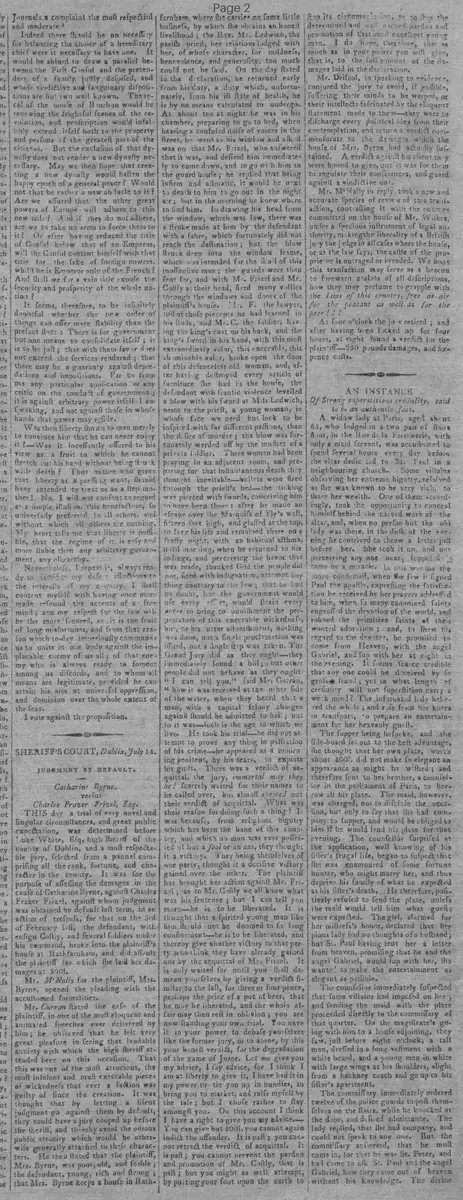
JUDGEMENT BY DEFAULT.
Catharine Byrne versus Charles Frazer Frizel, Esq.
THIS day a trial of very novel and singular circumstances, and great public expectation, was determined before Luke White, Esq. high sheriff of the county of Dublin, and a most respectable jury, elected from a panel comprising all the rank, fortune, and character in the county. It was for the purpose of assessing the damages in the cause of Catharine Byrne, against Charles Frazer Frizel, against whom judgment was obtained by default last term, in an action of trespass, for that on the 3rd of February last, the defendant, with Ensign Colly, and several soldiers under his command, broke into the plaintiff's house at Rathfarnham, and did assault the plaintiff for which he laid her damages at £500.
Mr. M'Nally for the plaintiff, Mrs. Byrne, opened the pleading with the accustomed formalities.
Mr. Curran stated the case of the plaintiff, in one of the most eloquent and animated speeches ever delivered by him; he observed 'that he felt very great pleasure in seeing that laudable anxiety with which the high sheriff attended here on this occasion. That this was one of the most atrocious, the most insolent and most execrable pieces of wickedness that ever a faction was guilty of since the creation. It was thought that by letting a silent judgment go against them by default, they could have a jury cooped up before the sheriff, and thereby avoid the odious public atrocity which would be otherwise generally attached to their characters. He then stated that the plaintiff, Mrs. Byrne, was poor, old, and feeble; the defendant, young, rich and strong; that Mrs. Byrne keeps a house in Rathfarnham, where she carries on some little business, by which she obtains an honest livelihood; the Rev. Mr. Ledwich, the parish priest, her relations lodged with her, of whose character, for mildness, benevolence, and generosity, too much could not be said. On the day stated in the declaration, he returned early from his duty, a duty which, unfortunately, from his ill state of health, he is by no means calculated to undergo.
At about ten at night he was in his chamber, preparing to go to bed, when hearing a confused noise of voices in the street, he went to his window and asked was no that Mr. Frizel, who answered that it was, and desired him immediately to come down, and to go with him to the guard house; he replied that being infirm and asthmatic, it would be next to death to him to go out in the night air; but in the morning he knew where to find him. In drawing his head from the window, which was low, there was a stroke made at him by the defendant with a sabre, which fortunately did not reach the destination; but the blow struck deep into the window frame, which was intended for the skull of this inoffensive man; the guards were then sent for, and with Mr. Frizel and Mr. Colly at their head, fired many vollies through the windows and doors of the plaintiff's house. I. F. the lawyer, full of those precepts he had learned in his study, and Mr. C. the soldier, having the king's coat on his back, and the king's sword in his hand, with this most extraordinary valor, this execrable, this abominable valor, broke open the door of this defenceless old woman, and, after having destroyed every article of furniture as bad in the house, the defendant with frantic violence levelled a blow with his sword at Miss Ledwich, niece to the priest, a young woman, in whose face we need but look to be inspired with far different passions, than the desire of murder: the blow was fortunately warded off by the musket of a private soldier. Three women had been praying in an adjacent room, and preparing for that instantaneous death they thought inevitable bullets were fired through the priest's bed the ticking was pierced with swords, conceiving him to have been there: after he made an escape over the Marquis of Ely's wall, fifteen feet high, and glazed at the top, to save his life and remained there on a frosty night, with an habitual asthma, until morning, when he returned to his lodgings, and perceiving the havoc that was made, thanked God the people did not, fired with indignation, attempt any thing contrary to the law; that he had no doubt, but the government would use every effort, would strain every nerve to bring to punishment the perpetrators of this execrable wickedness, but, to his utter astonishment, nothing was done, not a single proclamation was issued, not a single step was taken. The Grand Jury did as they ought-they immediately found a bill; but other people did not behave as they ought
"I can tell you," said Mr. Curran, "how it was received at the other side of the water, when they heard that a man, with a capital felony charged against should be admitted to bail; but so it was-such is the age in which we live. He took his trial he did not attempt to prove any thing in palliation of his crime--he appeared as a mourning penitent, by his tears, to expiate his guilt. There was a verdict of acquittal, the jury, immortal may they be! scarcely waited for their names to be called over, but almost spewed out their verdict of acquittal. What was their reason for doing such a thing? It was because, from religious bigotry which has been the bane of this country, and which no man was ever possessed of but a fool or an ass, they thought it a victory. They being themselves of one party, thought it a decisive victory gained over the other. The plaintiff has brought her action against Mr. Frizel; as to Mr. Colly we all know what was his sentence; but I can tell you more--he is to be liberated. It is thought that a spirited young man like him should not be doomed to so long confinement--he is to be liberated, and thereby give another victory to that party who think they have already gained one by the acquittal of Mr. Frizel. It is only waited for until you shall demean yourselves by giving a verdict similar to the last, for three or four pence, perhaps the price of a pot of beer, that he may be liberated, and the whole affair may then rest in oblivion; you are now standing your own trial. You have it in your power to debase yourselves like the former jury, or to atone, by this your honest verdict, for the degradation of the name of Juror. Let me give you my advice, I say advice, for I think I am at liberty to give it, I have had it in my power to tie you up in bundles, to bring you to market, and raise myself by the sale; but I choose rather to stay amongst you. On this account I think I have a right to give you my advice.— You can give but £500l. you cannot again indict the offender. It is past: you cannot retract the verdict of acquittal. It is past; you cannot prevent the pardon and promotion of Mr. Colly, that is past; but you might as well attempt, by putting your foot upon the earth to top its circumvection or, not to stop the determined and well earned pardon and promotion of that most excellent young man. I do hope, therefore, that as much as in your power you will give, that is, to the full amount of the damages laid in the declaration.
Mr. Driscoll, in speaking to evidence, conjured the jury to avoid, if possible, suffering their minds to be warped, or their intellects fascinated by the eloquent statement made to them-they were to discharge every political idea from their contemplation, and return a verdict commensurate to the damages which the house of Mrs. Byrne had actually sustained. A verdict against his client they were bound to give, but it was for them to regulate their consciences, and guard against a vindictive one.
Mr. M'Nally in reply, took a new and accurate species of review of this transaction, contrasting it with the outrage committed on the house of Mr. Wilkes, under a specious instrument of legal authority, making the liberality of a British jury the judge in all cases where the house, or as the law says, the castle of the proprietor is outraged or invaded. We hope this transaction may serve as a beacon to forewarn zealots of all descriptions, how they may presume to grapple with the laws of this country, free as air for the peasant as well as for the peer!!!
At four o'clock the jury retired: and after having been locked up for four hours, at eight found a verdict for the plaintiff, £250 pounds damages, and six-pence costs.
What sub-type of article is it?
What keywords are associated?
What entities or persons were involved?
Where did it happen?
Foreign News Details
Primary Location
Dublin
Event Date
July 14
Key Persons
Outcome
verdict for the plaintiff, £250 pounds damages, and six-pence costs
Event Details
Trial for damages in trespass action where defendant Charles Frazer Frizel, with Ensign Colly and soldiers, broke into plaintiff Catharine Byrne's house in Rathfarnham on 3rd of February last, assaulting her and attempting to arrest Rev. Mr. Ledwich; involved firing volleys, destroying furniture, and sword attacks; Mr. Curran delivered eloquent speech on atrocity, religious bigotry, and government inaction; jury awarded £250 after deliberation.