Thank you for visiting SNEWPapers!
Sign up free
The Virginia Gazette
Richmond, Williamsburg, Richmond County, Virginia
What is this article about?
A physician writing to the Virginia Gazette printers describes a malignant, contagious fever affecting humans and horned cattle in America, akin to undescribed diseases observed in 1763 and 1768-69. He details symptoms, critiques prevailing medical theories, and shares a specific, universal cure method practicable without doctors, contrasting it with smallpox treatments.
Clipping
OCR Quality
Full Text
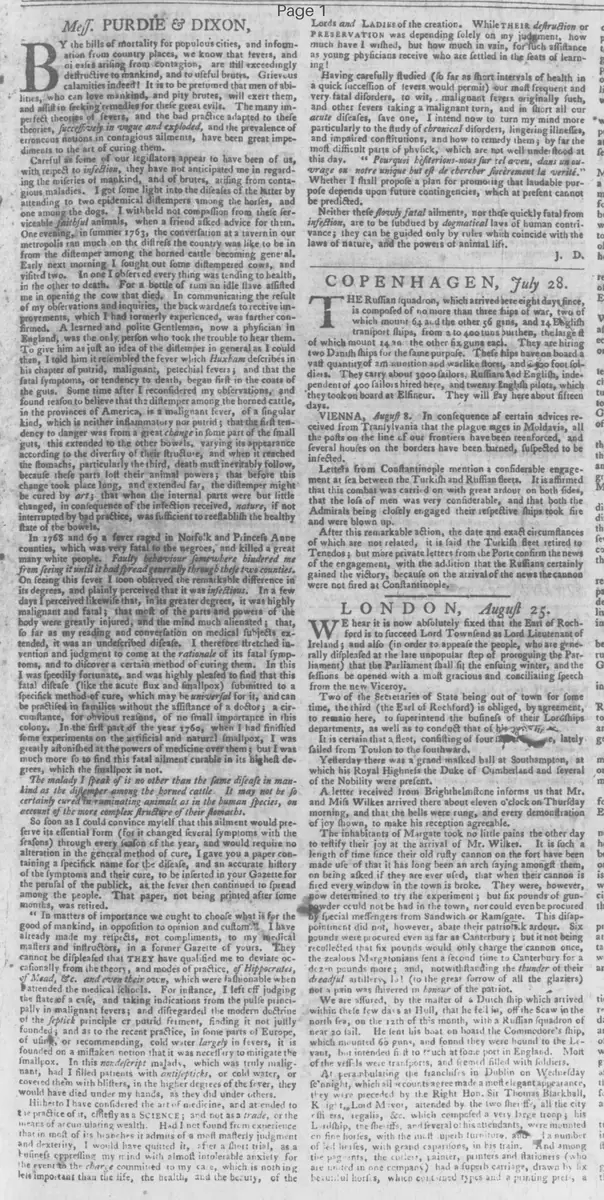
By the bills of mortality for populous cities, and information from country places, we know that fevers, and other diseases arising from contagion, are still exceedingly destructive to mankind, and to useful brutes. Grievous calamities indeed! It is to be presumed that men of abilities, who can love mankind, and pity brutes, will exert themselves, and assist in seeking remedies for these great evils. The many imperfect theories of fevers, and the bad practice adapted to these theories, successively in vogue and exploded, and the prevalence of erroneous notions in contagious ailments, have been great impediments to the art of curing them.
Careful as some of our legislators appear to have been of us, with respect to infection, they have not anticipated me in regarding the miseries of mankind, and of brutes, arising from contagious maladies. I got some light into the diseases of the latter by attending to two epidemical distempers among the horses, and one among the dogs. I withheld not compassion from these serviceable faithful animals, when a friend asked advice for them.
One evening, in summer 1763, the conversation at a tavern in our metropolis ran much on the distress the country was like to be in from the distemper among the horned cattle becoming general. Early next morning I sought out some distempered cows, and visited two. In one I observed every thing was tending to health, in the other to death. For a bottle of rum an idle slave waited me in opening the cow that died. In communicating the result of my observations and inquiries, the backwardness to receive improvements, which I had formerly experienced, was farther confirmed. A learned and polite Gentleman, now a physician in England, was the only person who took the trouble to hear them.
To give him as just an idea of the distemper in general as I could then, I told him it resembled the fever which Huxham describes in his chapter of putrid, malignant, petechial fevers; and that the fatal symptoms, or tendency to death, began first in the coats of the guts. Some time after I reconsidered my observations, and found reason to believe that the distemper among the horned cattle, in the provinces of America, is a malignant fever, of a singular kind, which is neither inflammatory nor putrid; that the first tendency to danger was from a great change in some part of the small guts, this extended to the other bowels, varying its appearance according to the diversity of their structure, and when it reached the stomachs, particularly the third, death must inevitably follow, because these parts lost their animal powers; that before this change took place long, and extended far, the distemper might be cured by art; that when the internal parts were but little changed, in consequence of the infection received, nature, if not interrupted by bad practice, was sufficient to reestablish the healthy state of the bowels.
In 1768 and 69 a fever raged in Norfolk and Princess Anne counties, which was very fatal to the negroes, and killed a great many white people. Faulty behaviour somewhere hindered me from seeing it until it had spread generally through these two counties. On seeing this fever I soon observed the remarkable difference in its degrees, and plainly perceived that it was infectious. In a few days I perceived likewise that, in its greater degrees, it was highly malignant and fatal; that most of the parts and powers of the body were greatly injured, and the mind much alienated; that, so far as my reading and conversation on medical subjects extended, it was an undescribed disease. I therefore stretched invention and judgment to come at the rationale of its fatal symptoms, and to discover a certain method of curing them. In this I was speedily fortunate, and was highly pleased to find that this fatal disease (like the acute flux and smallpox) submitted to a specifick method of cure, which may be universal for it, and can be practised in families without the assistance of a doctor; a circumstance, for obvious reasons, of no small importance in this colony.
In the first part of the year 1769, when I had finished some experiments on the artificial and natural smallpox, I was greatly astonished at the powers of medicine over them; but I was much more so to find this fatal ailment curable in its highest degrees, which the smallpox is not.
The malady I speak of is no other than the same disease in mankind as the distemper among the horned cattle. It may not be so certainly cured in ruminating animals as in the human species, on account of the more complex structure of their stomachs.
So soon as I could convince myself that this ailment would preserve its essential form (for it changed several symptoms with the seasons) through every season of the year, and would require no alteration in the general method of cure, I gave you a paper containing a specifick name for the disease, and an accurate history of the symptoms and their cure, to be inserted in your Gazette for the perusal of the publick, as the fever then continued to spread among the people. That paper, not being printed after some months, was returned.
"In matters of importance we ought to choose what is for the good of mankind, in opposition to opinion and custom." I have already made my respects, not compliments, to my medical masters and instructors, in a former Gazette of yours. They cannot be displeased that they have qualified me to deviate occasionally from the theories, and modes of practice, of Hippocrates, of Mead, &c. and even their own, which were fashionable when I attended the medical schools. For instance, I left off judging the state of a case, and taking indications from the pulse principally in malignant fevers; and disregarded the modern doctrine of the septick principle or putrid ferment, finding it not justly founded; and as to the recent practice, in some parts of Europe, of using, or recommending, cold water largely in fevers, it is founded on a mistaken notion that it was necessary to mitigate the smallpox. In this non-descript malady, which was truly malignant, had I filled patients with antiseptics, or cold water, or covered them with blisters, in the higher degrees of the fever, they would have died under my hands, as they did under others.
Hitherto I have considered the art of medicine, and attended to the practice of it, chiefly as a Science; and not as a trade, or the means of accumulating wealth. Had I not found from experience that in most of its branches it admits of a most masterly judgment and dexterity, I would have quitted it, after a short trial, as a business oppressing my mind with almost intolerable anxiety for the event to the charge committed to my care, which is nothing less important than the life, the health, and the beauty, of the Lords and Ladies of the creation. While their destruction or preservation was depending solely on my judgment, how much have I wished, but how much in vain, for such assistance as young physicians receive who are settled in the seats of learning!
Having carefully studied (so far as short intervals of health in a quick succession of fevers would permit) our most frequent and very fatal disorders, to wit, malignant fevers originally such, and other fevers taking a malignant turn, and in short all our acute diseases, save one, I intend now to turn my mind more particularly to the study of chronical disorders, lingering illnesses, and impaired constitutions, and how to remedy them; by far the most difficult parts of physick, which are not well understood at this day. "Pourquoi bestions-nous un tel aveu, dans un ouvrage ou notre unique but est de chercher sincerement la verité."
Whether I shall propose a plan for promoting that laudable purpose depends upon future contingencies, which at present cannot be predicted.
Neither these slowly fatal ailments, nor those quickly fatal from infection, are to be subdued by dogmatical laws of human contrivance; they can be guided only by rules which coincide with the laws of nature, and the powers of animal life.
J. D.
What sub-type of article is it?
What themes does it cover?
What keywords are associated?
What entities or persons were involved?
Letter to Editor Details
Author
J. D.
Recipient
Mess. Purdie & Dixon
Main Argument
the author identifies a singular malignant fever affecting humans and horned cattle, distinct from inflammatory or putrid types, originating in changes to the small guts; he discovered a specific, universal cure method effective even in advanced stages, practicable without physicians, contrasting with less curable diseases like smallpox.
Notable Details