Thank you for visiting SNEWPapers!
Sign up free
Story
December 10, 1882
New York Tribune
New York, New York County, New York
What is this article about?
Professor Kolbe's Leipzig experiment shows carbonic acid preserves beef in warm conditions for 4-5 weeks, keeping it fresh-tasting and free of bad odors, outperforming on mutton and veal; seafood preserves poorly.
Clipping
OCR Quality
98%
Excellent
Full Text
CARBONIC ACID AS AN ANTISEPTIC.
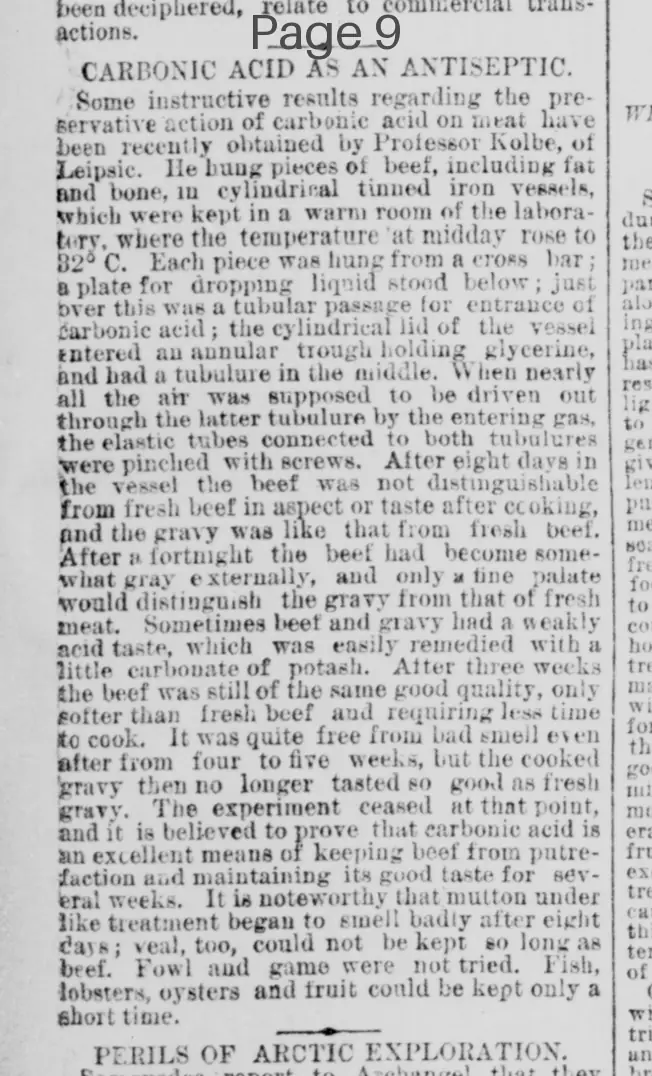
Some instructive results regarding the preservative action of carbonic acid on meat have been recently obtained by Professor Kolbe, of Leipsic. He hung pieces of beef, including fat and bone, in cylindrical tinned iron vessels, which were kept in a warm room of the laboratory, where the temperature at midday rose to 32° C. Each piece was hung from a cross bar; a plate for dropping liquid stood below; just over this was a tubular passage for entrance of carbonic acid; the cylindrical lid of the vessel entered an annular trough holding glycerine, and had a tubulure in the middle. When nearly all the air was supposed to be driven out through the latter tubulure by the entering gas, the elastic tubes connected to both tubulures were pinched with screws. After eight days in the vessel the beef was not distinguishable from fresh beef in aspect or taste after cooking, and the gravy was like that from fresh beef. After a fortnight the beef had become somewhat gray externally, and only a fine palate would distinguish the gravy from that of fresh meat. Sometimes beef and gravy had a weakly acid taste, which was easily remedied with a little carbonate of potash. After three weeks the beef was still of the same good quality, only softer than fresh beef and requiring less time to cook. It was quite free from bad smell even after from four to five weeks, but the cooked gravy then no longer tasted so good as fresh gravy. The experiment ceased at that point, and it is believed to prove that carbonic acid is an excellent means of keeping beef from putrefaction and maintaining its good taste for several weeks. It is noteworthy that mutton under like treatment began to smell badly after eight days; veal, too, could not be kept so long as beef. Fowl and game were not tried. Fish, lobsters, oysters and fruit could be kept only a short time.
Some instructive results regarding the preservative action of carbonic acid on meat have been recently obtained by Professor Kolbe, of Leipsic. He hung pieces of beef, including fat and bone, in cylindrical tinned iron vessels, which were kept in a warm room of the laboratory, where the temperature at midday rose to 32° C. Each piece was hung from a cross bar; a plate for dropping liquid stood below; just over this was a tubular passage for entrance of carbonic acid; the cylindrical lid of the vessel entered an annular trough holding glycerine, and had a tubulure in the middle. When nearly all the air was supposed to be driven out through the latter tubulure by the entering gas, the elastic tubes connected to both tubulures were pinched with screws. After eight days in the vessel the beef was not distinguishable from fresh beef in aspect or taste after cooking, and the gravy was like that from fresh beef. After a fortnight the beef had become somewhat gray externally, and only a fine palate would distinguish the gravy from that of fresh meat. Sometimes beef and gravy had a weakly acid taste, which was easily remedied with a little carbonate of potash. After three weeks the beef was still of the same good quality, only softer than fresh beef and requiring less time to cook. It was quite free from bad smell even after from four to five weeks, but the cooked gravy then no longer tasted so good as fresh gravy. The experiment ceased at that point, and it is believed to prove that carbonic acid is an excellent means of keeping beef from putrefaction and maintaining its good taste for several weeks. It is noteworthy that mutton under like treatment began to smell badly after eight days; veal, too, could not be kept so long as beef. Fowl and game were not tried. Fish, lobsters, oysters and fruit could be kept only a short time.
What sub-type of article is it?
Curiosity
What keywords are associated?
Carbonic Acid
Meat Preservation
Antiseptic
Beef Experiment
Putrefaction Prevention
What entities or persons were involved?
Professor Kolbe
Where did it happen?
Leipsic Laboratory
Story Details
Key Persons
Professor Kolbe
Location
Leipsic Laboratory
Event Date
Recently
Story Details
Professor Kolbe hung beef in tinned iron vessels filled with carbonic acid in a warm room; after weeks, the beef remained fresh-like in appearance, taste, and quality, proving carbonic acid's preservative action against putrefaction, though less effective for mutton, veal, and seafood.