Thank you for visiting SNEWPapers!
Sign up free
Story
December 10, 1864
National Democrat
Little Rock, Pulaski County, Arkansas
What is this article about?
A November 4, 1864, letter from Little Rock, Arkansas, defends Union General Steele against slanders by ex-secessionists seeking influence. It praises his firm anti-rebel policies, military successes like repulsing attacks, and spotless character during Civil War occupation.
Clipping
OCR Quality
95%
Excellent
Full Text
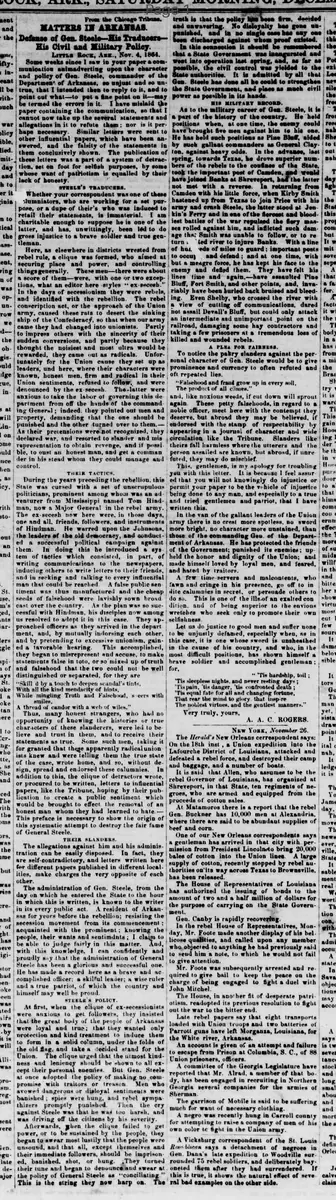
Matters in Arkansas.
Defense of Gen. Steele – His Traducers – His Civil and Military Policy.
Little Rock, Ark., Nov. 4, 1864.
Some weeks since I saw in your paper a communication animadverting upon the character and policy of Gen. Steele, commander of the Department of Arkansas, so unjust and so untrue, that I intended then to reply to it, and to point out what – to put a fine point on it – may be termed the errors in it. I have mislaid the paper containing the communication, so that I cannot now take up the several statements and allegations in it to refute them; nor is it perhaps necessary. Similar letters were sent to other influential papers, which have been answered, and the falsity of the statements in them conclusively shown. The publication of these letters was a part of a system of detraction, set on foot for selfish purposes, by some whose want of patriotism is equalled by their lack of honesty.
Steele's Traducers.
Whether your correspondent was one of these instigators, who are working for a set purpose, or a dupe of theirs who was induced to retail their statements, is immaterial. I am charitable enough to suppose he is one of the latter, and has, unwittingly, been led to do gross injustice to a brave soldier and true gentleman.
Here, as elsewhere in districts wrested from rebel rule, a clique was formed, who aimed at securing place and power, and controlling things generally. These men – there were about a score of them – were, with one or two exceptions, what an editor here styles 'ex-secesh.' In the days of secessionism they were rebels and identified with the rebellion. The rebel conscription act, or the approach of the Union army, caused these rats to desert the sinking ship of the Confederacy, so that when our army came they had changed into unionists. Partly to impress others with the sincerity of their sudden conversions, and partly because they thought the noisiest and most ultra would be rewarded, they came out as radicals. Unfortunately for the Union cause they set up as leaders, and here, where their characters were known, honest men, firm and radical in their Union sentiments, refused to follow, and were denounced by the ex-secesh. The latter were anxious to take the labor of governing this department from off the hands of the commanding General; indeed, they pointed out men and property, demanding that the one should be punished and the other turned over to them. As their pretensions were not recognized, they declared war, and resorted to slander and misrepresentation to obtain revenge, and if possible, to oust an honest man, and get a commander in his stead whom they could manage and control.
Their Tactics.
During the years preceding the rebellion, this State was cursed with a set of unscrupulous politicians, prominent among whom was an adventurer from Mississippi named Tom Hindman, now a Major General in the rebel army. The ex-secesh now here were, in those days, one and all, friends, followers, and instruments of Hindman. He warred upon the Johnsons, the leaders of the old democracy, and conducted a successful political campaign against them. In doing this he introduced a system of tactics which consisted, in part, of writing communications to the newspapers, inducing others to write letters to their friends, and in seeking and talking to every influential man that could be reached. A false public sentiment was thus manufactured and the cheap seeds of falsehood were lavishly sown broadcast over the country. As the plan was so successful with Hindman, his disciples now among us resolved to adopt it in this case. They approached officers as they arrived in the department, and, by mutually endorsing each other and by pretending to excessive unionism, gained a favorable hearing. This accomplished, they began to misrepresent and accuse, to make statements false in toto, or so mixed up of truth and falsehood that the two could not be well distinguished or separated, for they are
'Skill'd by a touch to deepen scandal's tints,
With all the kind mendacity of hints,
While mingling Truth and Falsehood, severs with smiles,
A thread of candor with a web of wiles.'
Thus many honest strangers, who had no opportunity of knowing the histories or true characters of these slanderers, were led to believe and trust in them, and to receive their statements as true. Some such men, taking it for granted that these apparently radical unionists knew and were telling the true state of the case, wrote home, and so, without design, spread and endorsed these calumnies. In addition to this, the clique of detractors wrote, or procured to be written, letters to influential papers, like the Tribune, hoping by their publication to create a public sentiment which would be brought to bear to effect the removal of an honest man whom they had learned to hate. This preface is necessary to show the origin of this systematic attempt to destroy the fair fame of General Steele.
Their Slanders.
The allegations against him and his administration can be easily disposed. In fact, they are self-contradictory, and letters written here for different papers published in different localities, make charges the very opposite of each other.
The administration of Gen. Steele, from the day on which he entered the State to the hour in which this is written, is known to the writer in its every public act. A resident of Arkansas for years before the rebellion; resisting the secession movement from its commencement; acquainted with the prominent; knowing the people, their wants and sentiments: I claim to be able to judge fairly in this matter. And, with this knowledge, I can confidently and proudly say that the administration of General Steele has been a glorious and successful one. He has made a record here as a brave and accomplished officer; a skilful leader; a wise ruler and a true patriot, of which the country and himself may well be proud.
Steele's Policy.
At first, when the clique of ex-secessionists were anxious to get followers, they insisted that the great body of the people of Arkansas were loyal and true; that they wanted only protection and kind treatment to induce them to form in a solid column, under the folds of the old flag, and take a decided stand for the Union. The clique urged that the utmost kindness and leniency should be shown to all except their personal enemies. But Gen. Steele at once adopted the policy of making no compromise with traitors or treason. Men who avowed dangerous or disloyal sentiments were banished; spies were hung, and rebel sympathizers promptly punished. Then the cry against Steele was that he was too harsh, and was driving off the citizens by his severity.
Afterwards, when the clique failed to get power, or to be sustained by the people, they began to swear most lustily that the people were unsound, and that all, except themselves and their immediate followers, should be imprisoned, banished, shot, or hung. They turned their tune and began to denounce and swear at the policy of General Steele as 'conciliating.' This is the string they now harp on.
The truth is that the policy has been firm, decided and unwavering. No disloyalty has gone unpunished, and in no single case has any one been discharged against whom proof existed.
In this connection it should be remembered that a State Government was inaugurated and went into operation last spring, and, as far as possible, the civil control was yielded to the State authorities. It is admitted by all that Gen. Steele has done all he could to strengthen the State Government, and place as much civil power as possible in its hands.
His Military Record.
As to the military career of Gen. Steele, it is a part of the history of the country. He held positions when, at one time, the enemy could have brought five men against him to his one. He has held such positions as Pine Bluff, aided by such gallant commanders as General Clayton, against heavy odds. In the advance, last spring, towards Texas, he drove superior numbers of the rebels to the confines of the State, took the important post of Camden, and would have joined Banks at Shreveport, had the latter not met with a reverse. In returning from Camden with his little force, when Kirby Smith hastened up from Texas to join Price with his army and crush Steele, the latter stood at Jenkins' Ferry and in one of the fiercest and bloodiest battles of the war repulsed the fiery masses rolled against him, and inflicted such damage that Smith was unable to follow, or to return up river to injure Banks. With a line of hundreds of miles to guard; important posts to occupy and defend; and at one time, with but a meagre force, he has kept his face to the enemy and defied them. They have felt his lines time and again – have assaulted Pine Bluff, Fort Smith, and other points, and invariably have been hurled back bruised and bleeding. Even Shelby, who crossed the river with a view of cutting off communications, dared not assail Devall's Bluff, but could only attack an intermediate and unimportant point on the railroad, damaging some hay contractors and taking a few prisoners at a tremendous loss of killed and wounded rebels.
A Plea for Fairness.
To notice the paltry slanders against the personal character of Gen. Steele would be to give prominence and currency to oft refuted and oft repeated lies.
'Falsehood and fraud grow up in every soil,
The product of all climes.
And, like noxious weeds, if cut down will sprout again.'
These petty falsehoods, in regard to a noble officer, meet here with the contempt they deserve, but abroad they may be believed, if endorsed with the stamp of respectability by appearing in a journal of character and wide circulation like the Tribune. Slanders like theirs fall harmless where the utterers and the person assailed are known, but abroad, if unrefuted, they may do mischief.
This, gentlemen, is my apology for troubling you with this letter. It is because I feel assured that you will not knowingly do injustice or permit your paper to be the vehicle of injustice being done to any man, and especially to a true and tried gentleman and patriot, that I have written this.
In the van of the gallant leaders of the Union army there is no crest more spotless, no sword more bright, no character more unstained, than those of the commanding Gen. of the Department of Arkansas. He has protected the friend of the Government; punished its enemies; upheld the honor and dignity of the Union; and made himself loved by loyal men, and feared, and hated by traitors.
A few time-servers and malcontents, who fawn and cringe in his presence, go off to indite calumnies in secret, or persuade others to do so. This is one of the ills of an exalted condition, and of being superior to the envious wretches who seek only to promote their own selfishness.
Let us do justice to good men and suffer none to be unjustly defamed, especially when, as in this case, it is one whose sword is unsheathed in the cause of his country, and who, in the most difficult positions, has shown himself a brave soldier and accomplished gentleman:
for,
''Tis hardship, toil:
'Tis sleepless nights, and never resting days;
'Tis pain, 'tis danger, 'tis confronted death;
''Tis equal fate for all and changing fortune
That rear the mind to glory, that inspire
The noblest virtues, and the gentlest manners.'
Very truly, yours,
A. A. C. Rogers.
Defense of Gen. Steele – His Traducers – His Civil and Military Policy.
Little Rock, Ark., Nov. 4, 1864.
Some weeks since I saw in your paper a communication animadverting upon the character and policy of Gen. Steele, commander of the Department of Arkansas, so unjust and so untrue, that I intended then to reply to it, and to point out what – to put a fine point on it – may be termed the errors in it. I have mislaid the paper containing the communication, so that I cannot now take up the several statements and allegations in it to refute them; nor is it perhaps necessary. Similar letters were sent to other influential papers, which have been answered, and the falsity of the statements in them conclusively shown. The publication of these letters was a part of a system of detraction, set on foot for selfish purposes, by some whose want of patriotism is equalled by their lack of honesty.
Steele's Traducers.
Whether your correspondent was one of these instigators, who are working for a set purpose, or a dupe of theirs who was induced to retail their statements, is immaterial. I am charitable enough to suppose he is one of the latter, and has, unwittingly, been led to do gross injustice to a brave soldier and true gentleman.
Here, as elsewhere in districts wrested from rebel rule, a clique was formed, who aimed at securing place and power, and controlling things generally. These men – there were about a score of them – were, with one or two exceptions, what an editor here styles 'ex-secesh.' In the days of secessionism they were rebels and identified with the rebellion. The rebel conscription act, or the approach of the Union army, caused these rats to desert the sinking ship of the Confederacy, so that when our army came they had changed into unionists. Partly to impress others with the sincerity of their sudden conversions, and partly because they thought the noisiest and most ultra would be rewarded, they came out as radicals. Unfortunately for the Union cause they set up as leaders, and here, where their characters were known, honest men, firm and radical in their Union sentiments, refused to follow, and were denounced by the ex-secesh. The latter were anxious to take the labor of governing this department from off the hands of the commanding General; indeed, they pointed out men and property, demanding that the one should be punished and the other turned over to them. As their pretensions were not recognized, they declared war, and resorted to slander and misrepresentation to obtain revenge, and if possible, to oust an honest man, and get a commander in his stead whom they could manage and control.
Their Tactics.
During the years preceding the rebellion, this State was cursed with a set of unscrupulous politicians, prominent among whom was an adventurer from Mississippi named Tom Hindman, now a Major General in the rebel army. The ex-secesh now here were, in those days, one and all, friends, followers, and instruments of Hindman. He warred upon the Johnsons, the leaders of the old democracy, and conducted a successful political campaign against them. In doing this he introduced a system of tactics which consisted, in part, of writing communications to the newspapers, inducing others to write letters to their friends, and in seeking and talking to every influential man that could be reached. A false public sentiment was thus manufactured and the cheap seeds of falsehood were lavishly sown broadcast over the country. As the plan was so successful with Hindman, his disciples now among us resolved to adopt it in this case. They approached officers as they arrived in the department, and, by mutually endorsing each other and by pretending to excessive unionism, gained a favorable hearing. This accomplished, they began to misrepresent and accuse, to make statements false in toto, or so mixed up of truth and falsehood that the two could not be well distinguished or separated, for they are
'Skill'd by a touch to deepen scandal's tints,
With all the kind mendacity of hints,
While mingling Truth and Falsehood, severs with smiles,
A thread of candor with a web of wiles.'
Thus many honest strangers, who had no opportunity of knowing the histories or true characters of these slanderers, were led to believe and trust in them, and to receive their statements as true. Some such men, taking it for granted that these apparently radical unionists knew and were telling the true state of the case, wrote home, and so, without design, spread and endorsed these calumnies. In addition to this, the clique of detractors wrote, or procured to be written, letters to influential papers, like the Tribune, hoping by their publication to create a public sentiment which would be brought to bear to effect the removal of an honest man whom they had learned to hate. This preface is necessary to show the origin of this systematic attempt to destroy the fair fame of General Steele.
Their Slanders.
The allegations against him and his administration can be easily disposed. In fact, they are self-contradictory, and letters written here for different papers published in different localities, make charges the very opposite of each other.
The administration of Gen. Steele, from the day on which he entered the State to the hour in which this is written, is known to the writer in its every public act. A resident of Arkansas for years before the rebellion; resisting the secession movement from its commencement; acquainted with the prominent; knowing the people, their wants and sentiments: I claim to be able to judge fairly in this matter. And, with this knowledge, I can confidently and proudly say that the administration of General Steele has been a glorious and successful one. He has made a record here as a brave and accomplished officer; a skilful leader; a wise ruler and a true patriot, of which the country and himself may well be proud.
Steele's Policy.
At first, when the clique of ex-secessionists were anxious to get followers, they insisted that the great body of the people of Arkansas were loyal and true; that they wanted only protection and kind treatment to induce them to form in a solid column, under the folds of the old flag, and take a decided stand for the Union. The clique urged that the utmost kindness and leniency should be shown to all except their personal enemies. But Gen. Steele at once adopted the policy of making no compromise with traitors or treason. Men who avowed dangerous or disloyal sentiments were banished; spies were hung, and rebel sympathizers promptly punished. Then the cry against Steele was that he was too harsh, and was driving off the citizens by his severity.
Afterwards, when the clique failed to get power, or to be sustained by the people, they began to swear most lustily that the people were unsound, and that all, except themselves and their immediate followers, should be imprisoned, banished, shot, or hung. They turned their tune and began to denounce and swear at the policy of General Steele as 'conciliating.' This is the string they now harp on.
The truth is that the policy has been firm, decided and unwavering. No disloyalty has gone unpunished, and in no single case has any one been discharged against whom proof existed.
In this connection it should be remembered that a State Government was inaugurated and went into operation last spring, and, as far as possible, the civil control was yielded to the State authorities. It is admitted by all that Gen. Steele has done all he could to strengthen the State Government, and place as much civil power as possible in its hands.
His Military Record.
As to the military career of Gen. Steele, it is a part of the history of the country. He held positions when, at one time, the enemy could have brought five men against him to his one. He has held such positions as Pine Bluff, aided by such gallant commanders as General Clayton, against heavy odds. In the advance, last spring, towards Texas, he drove superior numbers of the rebels to the confines of the State, took the important post of Camden, and would have joined Banks at Shreveport, had the latter not met with a reverse. In returning from Camden with his little force, when Kirby Smith hastened up from Texas to join Price with his army and crush Steele, the latter stood at Jenkins' Ferry and in one of the fiercest and bloodiest battles of the war repulsed the fiery masses rolled against him, and inflicted such damage that Smith was unable to follow, or to return up river to injure Banks. With a line of hundreds of miles to guard; important posts to occupy and defend; and at one time, with but a meagre force, he has kept his face to the enemy and defied them. They have felt his lines time and again – have assaulted Pine Bluff, Fort Smith, and other points, and invariably have been hurled back bruised and bleeding. Even Shelby, who crossed the river with a view of cutting off communications, dared not assail Devall's Bluff, but could only attack an intermediate and unimportant point on the railroad, damaging some hay contractors and taking a few prisoners at a tremendous loss of killed and wounded rebels.
A Plea for Fairness.
To notice the paltry slanders against the personal character of Gen. Steele would be to give prominence and currency to oft refuted and oft repeated lies.
'Falsehood and fraud grow up in every soil,
The product of all climes.
And, like noxious weeds, if cut down will sprout again.'
These petty falsehoods, in regard to a noble officer, meet here with the contempt they deserve, but abroad they may be believed, if endorsed with the stamp of respectability by appearing in a journal of character and wide circulation like the Tribune. Slanders like theirs fall harmless where the utterers and the person assailed are known, but abroad, if unrefuted, they may do mischief.
This, gentlemen, is my apology for troubling you with this letter. It is because I feel assured that you will not knowingly do injustice or permit your paper to be the vehicle of injustice being done to any man, and especially to a true and tried gentleman and patriot, that I have written this.
In the van of the gallant leaders of the Union army there is no crest more spotless, no sword more bright, no character more unstained, than those of the commanding Gen. of the Department of Arkansas. He has protected the friend of the Government; punished its enemies; upheld the honor and dignity of the Union; and made himself loved by loyal men, and feared, and hated by traitors.
A few time-servers and malcontents, who fawn and cringe in his presence, go off to indite calumnies in secret, or persuade others to do so. This is one of the ills of an exalted condition, and of being superior to the envious wretches who seek only to promote their own selfishness.
Let us do justice to good men and suffer none to be unjustly defamed, especially when, as in this case, it is one whose sword is unsheathed in the cause of his country, and who, in the most difficult positions, has shown himself a brave soldier and accomplished gentleman:
for,
''Tis hardship, toil:
'Tis sleepless nights, and never resting days;
'Tis pain, 'tis danger, 'tis confronted death;
''Tis equal fate for all and changing fortune
That rear the mind to glory, that inspire
The noblest virtues, and the gentlest manners.'
Very truly, yours,
A. A. C. Rogers.
What sub-type of article is it?
Historical Event
Biography
Military Action
What themes does it cover?
Bravery Heroism
Justice
Moral Virtue
What keywords are associated?
Civil War
Arkansas
Gen Steele
Defense
Slander
Military Policy
Ex Secesh
Union Army
What entities or persons were involved?
Gen. Steele
A. A. C. Rogers
Tom Hindman
Where did it happen?
Arkansas, Little Rock
Story Details
Key Persons
Gen. Steele
A. A. C. Rogers
Tom Hindman
Location
Arkansas, Little Rock
Event Date
Nov. 4, 1864
Story Details
A letter defending General Steele's administration and military record in Arkansas against slanders by ex-secessionists, highlighting his firm policy against disloyalty, successful defenses like Jenkins' Ferry, and support for the state government.