Thank you for visiting SNEWPapers!
Sign up free
Literary
February 8, 1837
The North Carolina Standard
Raleigh, Wake County, North Carolina
What is this article about?
An essay on the disciplined obedience of Russian soldiers, highlighting their passive endurance and duty to superiors regardless of danger. Includes anecdotes: Peter the Great demonstrating a soldier's willingness to jump from a window, and a detachment under Prince Potemkin advancing to certain death.
Clipping
OCR Quality
98%
Excellent
Full Text
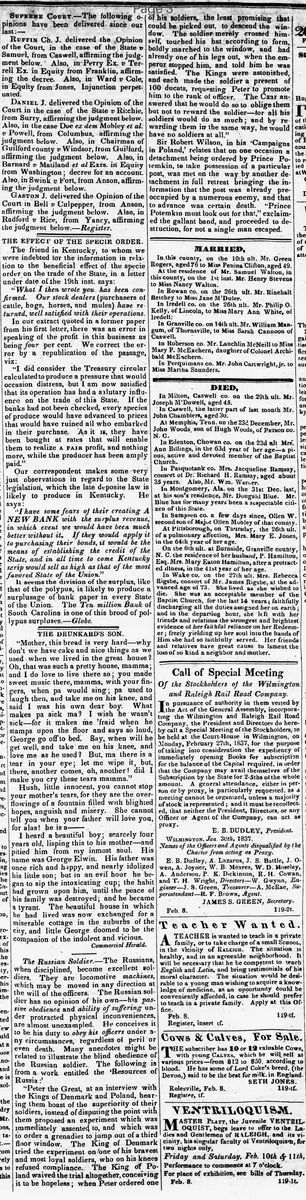
The Russian Soldier.—The Russians, when disciplined, become excellent soldiers. They are locomotive machines, which may be moved in any direction at the will of the officers. The Russian soldier has no opinion of his own—his passive obedience and ability of suffering under protracted physical inconveniences, are almost unexampled. He conceives it to be his duty to obey his officers under any circumstances, regardless of peril even death.
Many anecdotes might be related to illustrate the blind obedience of the Russian soldier. The following is from a work entitled the Resources of Russia:
"Peter the Great, at an interview with the Kings of Denmark and Poland, hearing them boast of the superiority of their soldiers, instead of disputing the point with them proposed an experiment which was immediately assented to, and which was to order a grenadier to jump out of a third floor window. The King of Denmark tried the experiment on one of his bravest and most loyal soldiers, who on his knees refused compliance. The King of Poland waived the trial altogether, conceiving it to be hopeless; when Peter ordered one of his soldiers, the least promising that could be picked out, to descend the window. The soldier merely crossed himself, touched his hat according to form, boldly marched to the window, and had already one of his legs out, when the emperor stopped him, and told him he was satisfied. The Kings were astonished, and each made the soldier a present of 100 ducats, requesting Peter to promote him to the rank of officer. The Czar answered that he would do so to oblige them but not to reward the soldier—for all his soldiers would do as much; and by rewarding them in the same way, he would have no soldiers at all."
Sir Robert Wilson, in his Campaigns in Poland, relates that on one occasion a detachment being ordered by Prince Potemkin, to take possession of a particular post, was met on the way by another detachment in full retreat bringing the information that the post was already pre-occupied by a numerous enemy, and that to advance was certain death. "Prince Potemkin must look out for that," exclaimed the gallant band, and proceeded to destruction, for not a single man escaped.
Many anecdotes might be related to illustrate the blind obedience of the Russian soldier. The following is from a work entitled the Resources of Russia:
"Peter the Great, at an interview with the Kings of Denmark and Poland, hearing them boast of the superiority of their soldiers, instead of disputing the point with them proposed an experiment which was immediately assented to, and which was to order a grenadier to jump out of a third floor window. The King of Denmark tried the experiment on one of his bravest and most loyal soldiers, who on his knees refused compliance. The King of Poland waived the trial altogether, conceiving it to be hopeless; when Peter ordered one of his soldiers, the least promising that could be picked out, to descend the window. The soldier merely crossed himself, touched his hat according to form, boldly marched to the window, and had already one of his legs out, when the emperor stopped him, and told him he was satisfied. The Kings were astonished, and each made the soldier a present of 100 ducats, requesting Peter to promote him to the rank of officer. The Czar answered that he would do so to oblige them but not to reward the soldier—for all his soldiers would do as much; and by rewarding them in the same way, he would have no soldiers at all."
Sir Robert Wilson, in his Campaigns in Poland, relates that on one occasion a detachment being ordered by Prince Potemkin, to take possession of a particular post, was met on the way by another detachment in full retreat bringing the information that the post was already pre-occupied by a numerous enemy, and that to advance was certain death. "Prince Potemkin must look out for that," exclaimed the gallant band, and proceeded to destruction, for not a single man escaped.
What sub-type of article is it?
Essay
What themes does it cover?
War Peace
Moral Virtue
Political
What keywords are associated?
Russian Soldier
Obedience
Peter The Great
Prince Potomkin
Military Discipline
Blind Obedience
Historical Anecdotes
Literary Details
Title
The Russian Soldier.
Subject
On The Obedience Of Russian Soldiers
Form / Style
Prose Essay With Historical Anecdotes
Key Lines
The Russian Soldier Has No Opinion Of His Own—His Passive Obedience And Ability Of Suffering Under Protracted Physical Inconveniences, Are Almost Unexampled.
He Conceives It To Be His Duty To Obey His Officers Under Any Circumstances, Regardless Of Peril Even Death.
"Prince Potemkin Must Look Out For That," Exclaimed The Gallant Band, And Proceeded To Destruction, For Not A Single Man Escaped.