Thank you for visiting SNEWPapers!
Sign up free
Letter to Editor
January 31, 1804
Kentucky Gazette And General Advertiser
Lexington, Fayette County, Kentucky
What is this article about?
In Letter II, the Hibernian Visitor, an Irish emigrant, critiques Kentucky society for imitating European vices and luxuries despite expectations of virtuous simplicity. He observes widespread moral flaws, lack of education, and dissatisfaction among farmers, finding Americans no better or worse than Europeans.
Clipping
OCR Quality
98%
Excellent
Full Text
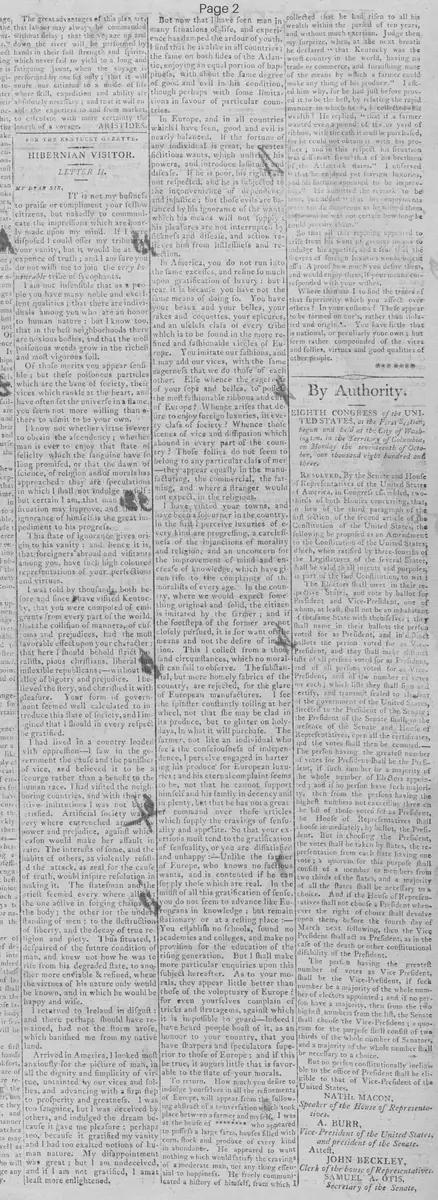
FOR THE KENTUCKY GAZETTE.
HIBERNIAN VISITOR.
LETTER II.
MY DEAR SIR,
IT is not my business to praise or compliment your fellow citizens, but nakedly to communicate the impressions which are hourly made upon my mind. If I were disposed I could offer my tribute to your vanity, but it would be at the expense of truth; and I am sure you do not wish me to join the very honourable tribe of sycophants.
I am not insensible that as a people you have many noble and excellent qualities; that there are individuals among you who are an honor to human nature: but I know too, that in the best neighborhoods there are noxious bodies, and that the most poisonous weeds grow in the richest and most vigorous soil.
Of those merits you appear sensible; but these poisonous particles which are the bane of society, these vices which rankle at the heart, and have often set the universe in a flame, you seem not more willing than others to admit to be your own.
I know not whether virtue is ever to obtain the ascendency; whether man is ever to enjoy that state of felicity which the sanguine have so long promised, or that the dawn of science, of religion and of morals has approached: they are speculations in which I shall not indulge myself: but certain I am, that man in every situation may improve, and that his ignorance of himself is the great impediment to his progress.
This state of ignorance gives origin to his vanity: and hence it is, that foreigners abroad and visitants among you, have such high coloured representations of your perfections and virtues.
I was told by thousands, both before and since I have visited Kentucky, that you were composed of emigrants from every part of the world, that the collision of manners, of customs and prejudices, had the most favorable effect upon your character: that here I should behold strict naturalists, pious Christians, liberal but inflexible republicans;—without the alloy of bigotry and prejudice. I believed the story, and cherished it with pleasure. Your form of government seemed well calculated to introduce this state of society, and I imagined that I should in every respect be gratified.
I had lived in a country loaded with oppression—I saw in the government the cause and the punisher of vice, and believed it to be a scourge rather than a benefit to the human race. I had visited the neighboring countries, and with their positive institutions I was not better satisfied. Artificial society was every where entrenched around by power and prejudice, against which reason would make her assault in vain. The interests of some, and the habits of others, as violently resisted the attack, as zeal for the cause of truth, would inspire resolution in making it. The statesman and the priest seemed every where allied: the one active in forging chains for the body; the other for the understanding of men; to the destruction of liberty, and the decay of true religion and piety. Thus situated, I despaired of the future condition of man, and knew not how he was to rise from his degraded state, to another more enviable & refined, where the virtues of his nature only would be known, and in which he would be happy and wise.
I returned to Ireland in disgust: and there perhaps should have remained, had not the storm arose, which banished me from my native land.
Arrived in America, I looked most anxiously for the picture of man, in all the dignity and simplicity of virtue, untainted by our vices and follies, and advancing with a firm step to prosperity and greatness. I was too sanguine, but I was deceived by others, and indulged the dream because it gave me pleasure: perhaps too, because it gratified my vanity and I had too exalted notions of human nature. My disappointment was great; but I am undeceived. and if I am not gratified, I am at least more enlightened.
But now that I have seen man in many situations of life, and experience has damped the ardour of youth, I find that he is alike in all countries; the same on both sides of the Atlantic, enjoying an equal portion of happiness, with about the same degree of good and evil in his condition, though perhaps with some limitations in favour of particular countries.
In Europe, and in all countries which I have seen, good and evil is nearly balanced. If the fortune of any individual is great, he creates fictitious wants, which unstring his powers, and introduce lassitude and disease. If he is poor, his rights are not respected, and he is subjected to the inconvenience of dependence and injustice; but those evils are balanced by his ignorance of the wants which his means will not supply: his pleasures are not interrupted by sickness and disease, and action relieves him from listlessness and reflection.
In America, you do not run into the same excesses, and refine so much upon gratification of luxury: but I fear it is because you have not the same means of doing so. You have your beaux and your belles, your rakes and coquettes, your epicures, and an useless class of every tribe which is to be found in the more refined and fashionable circles of Europe. You imitate our fashions, and I may add our vices, with the same eagerness that we do those of each other. Else whence the eagerness of your fops and belles, to possess the most fashionable ribbons and cuts of Europe? Whence arises that desire to enjoy foreign luxuries, in every class of society? Whence those scenes of vice and dissipation which abound in every part of the country? Those follies do not seem to belong to any particular class of men—they appear equally in the manufacturing, the commercial, the farming, and where a stranger would not expect, in the religious.
I have visited your towns, and have been a sojourner in the country. In the first I perceive luxuries of every kind are progressing, a carelessness of the injunctions of morality and religion, and an unconcern for the improvement of mind and increase of knowledge, which have given rise to the complaints of the moralists of every age. In the country, where we would expect something original and solid, the citizen is imitated by the farmer; and if the footsteps of the former are not closely pursued, it is for want of the means and not the desire of imitation. This I collect from a thousand circumstances, which no moralist can fail to observe. The substantial, but more homely fabrics of the country, are rejected, for the glare of European manufactures. I see the spinster constantly toiling at her wheel, not that she may be clad in its produce, but to glitter on holy-days, in what it will purchase. The farmer, not like an individual who feels the consciousness of independence, I perceive engaged in bartering his produce for European luxuries; and his eternal complaint seems to be, not that he cannot support himself and his family in decency and in plenty, but that he has not a great command over those articles which supply the cravings of sensuality and appetite. So that your exertions must tend to the gratification of sensuality, or you are dissatisfied and unhappy:—Unlike the farmer of Europe, who knows no factitious wants, and is contented if he can supply those which are real. In the midst of all this gratification of sense, you do not seem to advance like Europeans in knowledge; but remain stationary or at a resting place:— You establish no schools, found no academies and colleges, and make no provision for the education of the rising generation. But I shall make more particular enquiries upon this subject hereafter. As to your morals, they appear little better than those of the voluptuary of Europe for even yourselves complain of tricks and stratagems, against which it is impossible to guard—indeed have heard people boast of it, as an honour to your country, that you have sharpers and speculators superior to those of Europe: and if this be true, it augurs little that is favourable to the state of your morals.
To return. How much you desire to indulge yourselves in all the refinements of Europe, will appear from the following abstract of a conversation which took place between a farmer and myself, I was at the house of *o****** who appeared to possess a large farm, houses filled with corn, stock and produce of every kind in abundance. He appeared to want nothing which would satisfy the cravings of a moderate man, nor any thing essential to happiness. He freely communicated a history of himself, from which I collected that he had risen to all his wealth within the period of ten years, and without much exertion. Judge then my surprise, when, at the next breath he declared "that Kentucky was the worst country in the world, having no trade or commerce, and furnishing none of the means by which a farmer could make any thing of his produce." I asked him why, for he had just before proved it to be the best, by relating the rapid manner in which he had collected his wealth? He replied, "that if a farmer wanted even a pound of tea or yard of ribbon, with the cash it must be purchased, for he could not obtain it with his produce; and in this respect his situation was different from that of his brethren of the Atlantic states." I observed that he enjoyed yet foreign luxuries, and his fortune appeared to be improving." He admitted the remark to be true, but added "that his enjoyments were not so numerous as he wished them to be nor was he certain how long he could procure them."
So that all this repining appeared to arise from his want of sufficient means to indulge his appetite, and a fear that the sources of foreign luxuries would be cut off: A proof how much you desire them, and would enjoy them, if your means corresponded with your wishes.
Where then am I to find the traces of that superiority which you affect over others? In your customs? These appear to be formed on ours, rather than isolated and original. You have little that is national, or peculiarly your own: but seem rather compounded of the vices and follies, virtues and good qualities of other people.
HIBERNIAN VISITOR.
LETTER II.
MY DEAR SIR,
IT is not my business to praise or compliment your fellow citizens, but nakedly to communicate the impressions which are hourly made upon my mind. If I were disposed I could offer my tribute to your vanity, but it would be at the expense of truth; and I am sure you do not wish me to join the very honourable tribe of sycophants.
I am not insensible that as a people you have many noble and excellent qualities; that there are individuals among you who are an honor to human nature: but I know too, that in the best neighborhoods there are noxious bodies, and that the most poisonous weeds grow in the richest and most vigorous soil.
Of those merits you appear sensible; but these poisonous particles which are the bane of society, these vices which rankle at the heart, and have often set the universe in a flame, you seem not more willing than others to admit to be your own.
I know not whether virtue is ever to obtain the ascendency; whether man is ever to enjoy that state of felicity which the sanguine have so long promised, or that the dawn of science, of religion and of morals has approached: they are speculations in which I shall not indulge myself: but certain I am, that man in every situation may improve, and that his ignorance of himself is the great impediment to his progress.
This state of ignorance gives origin to his vanity: and hence it is, that foreigners abroad and visitants among you, have such high coloured representations of your perfections and virtues.
I was told by thousands, both before and since I have visited Kentucky, that you were composed of emigrants from every part of the world, that the collision of manners, of customs and prejudices, had the most favorable effect upon your character: that here I should behold strict naturalists, pious Christians, liberal but inflexible republicans;—without the alloy of bigotry and prejudice. I believed the story, and cherished it with pleasure. Your form of government seemed well calculated to introduce this state of society, and I imagined that I should in every respect be gratified.
I had lived in a country loaded with oppression—I saw in the government the cause and the punisher of vice, and believed it to be a scourge rather than a benefit to the human race. I had visited the neighboring countries, and with their positive institutions I was not better satisfied. Artificial society was every where entrenched around by power and prejudice, against which reason would make her assault in vain. The interests of some, and the habits of others, as violently resisted the attack, as zeal for the cause of truth, would inspire resolution in making it. The statesman and the priest seemed every where allied: the one active in forging chains for the body; the other for the understanding of men; to the destruction of liberty, and the decay of true religion and piety. Thus situated, I despaired of the future condition of man, and knew not how he was to rise from his degraded state, to another more enviable & refined, where the virtues of his nature only would be known, and in which he would be happy and wise.
I returned to Ireland in disgust: and there perhaps should have remained, had not the storm arose, which banished me from my native land.
Arrived in America, I looked most anxiously for the picture of man, in all the dignity and simplicity of virtue, untainted by our vices and follies, and advancing with a firm step to prosperity and greatness. I was too sanguine, but I was deceived by others, and indulged the dream because it gave me pleasure: perhaps too, because it gratified my vanity and I had too exalted notions of human nature. My disappointment was great; but I am undeceived. and if I am not gratified, I am at least more enlightened.
But now that I have seen man in many situations of life, and experience has damped the ardour of youth, I find that he is alike in all countries; the same on both sides of the Atlantic, enjoying an equal portion of happiness, with about the same degree of good and evil in his condition, though perhaps with some limitations in favour of particular countries.
In Europe, and in all countries which I have seen, good and evil is nearly balanced. If the fortune of any individual is great, he creates fictitious wants, which unstring his powers, and introduce lassitude and disease. If he is poor, his rights are not respected, and he is subjected to the inconvenience of dependence and injustice; but those evils are balanced by his ignorance of the wants which his means will not supply: his pleasures are not interrupted by sickness and disease, and action relieves him from listlessness and reflection.
In America, you do not run into the same excesses, and refine so much upon gratification of luxury: but I fear it is because you have not the same means of doing so. You have your beaux and your belles, your rakes and coquettes, your epicures, and an useless class of every tribe which is to be found in the more refined and fashionable circles of Europe. You imitate our fashions, and I may add our vices, with the same eagerness that we do those of each other. Else whence the eagerness of your fops and belles, to possess the most fashionable ribbons and cuts of Europe? Whence arises that desire to enjoy foreign luxuries, in every class of society? Whence those scenes of vice and dissipation which abound in every part of the country? Those follies do not seem to belong to any particular class of men—they appear equally in the manufacturing, the commercial, the farming, and where a stranger would not expect, in the religious.
I have visited your towns, and have been a sojourner in the country. In the first I perceive luxuries of every kind are progressing, a carelessness of the injunctions of morality and religion, and an unconcern for the improvement of mind and increase of knowledge, which have given rise to the complaints of the moralists of every age. In the country, where we would expect something original and solid, the citizen is imitated by the farmer; and if the footsteps of the former are not closely pursued, it is for want of the means and not the desire of imitation. This I collect from a thousand circumstances, which no moralist can fail to observe. The substantial, but more homely fabrics of the country, are rejected, for the glare of European manufactures. I see the spinster constantly toiling at her wheel, not that she may be clad in its produce, but to glitter on holy-days, in what it will purchase. The farmer, not like an individual who feels the consciousness of independence, I perceive engaged in bartering his produce for European luxuries; and his eternal complaint seems to be, not that he cannot support himself and his family in decency and in plenty, but that he has not a great command over those articles which supply the cravings of sensuality and appetite. So that your exertions must tend to the gratification of sensuality, or you are dissatisfied and unhappy:—Unlike the farmer of Europe, who knows no factitious wants, and is contented if he can supply those which are real. In the midst of all this gratification of sense, you do not seem to advance like Europeans in knowledge; but remain stationary or at a resting place:— You establish no schools, found no academies and colleges, and make no provision for the education of the rising generation. But I shall make more particular enquiries upon this subject hereafter. As to your morals, they appear little better than those of the voluptuary of Europe for even yourselves complain of tricks and stratagems, against which it is impossible to guard—indeed have heard people boast of it, as an honour to your country, that you have sharpers and speculators superior to those of Europe: and if this be true, it augurs little that is favourable to the state of your morals.
To return. How much you desire to indulge yourselves in all the refinements of Europe, will appear from the following abstract of a conversation which took place between a farmer and myself, I was at the house of *o****** who appeared to possess a large farm, houses filled with corn, stock and produce of every kind in abundance. He appeared to want nothing which would satisfy the cravings of a moderate man, nor any thing essential to happiness. He freely communicated a history of himself, from which I collected that he had risen to all his wealth within the period of ten years, and without much exertion. Judge then my surprise, when, at the next breath he declared "that Kentucky was the worst country in the world, having no trade or commerce, and furnishing none of the means by which a farmer could make any thing of his produce." I asked him why, for he had just before proved it to be the best, by relating the rapid manner in which he had collected his wealth? He replied, "that if a farmer wanted even a pound of tea or yard of ribbon, with the cash it must be purchased, for he could not obtain it with his produce; and in this respect his situation was different from that of his brethren of the Atlantic states." I observed that he enjoyed yet foreign luxuries, and his fortune appeared to be improving." He admitted the remark to be true, but added "that his enjoyments were not so numerous as he wished them to be nor was he certain how long he could procure them."
So that all this repining appeared to arise from his want of sufficient means to indulge his appetite, and a fear that the sources of foreign luxuries would be cut off: A proof how much you desire them, and would enjoy them, if your means corresponded with your wishes.
Where then am I to find the traces of that superiority which you affect over others? In your customs? These appear to be formed on ours, rather than isolated and original. You have little that is national, or peculiarly your own: but seem rather compounded of the vices and follies, virtues and good qualities of other people.
What sub-type of article is it?
Reflective
Philosophical
Social Critique
What themes does it cover?
Social Issues
Morality
Education
What keywords are associated?
Kentucky Society
European Vices
Foreign Luxuries
Moral Critique
Education Neglect
Human Nature
Social Imitation
What entities or persons were involved?
Hibernian Visitor
My Dear Sir
Letter to Editor Details
Author
Hibernian Visitor
Recipient
My Dear Sir
Main Argument
the author, disappointed by kentucky society, finds it mimicking european vices, luxuries, and follies rather than embodying the virtuous, original simplicity expected in america, with widespread moral flaws and neglect of education hindering progress.
Notable Details
References To Irish Oppression And Banishment
Conversation With Prosperous Farmer Complaining About Lack Of Trade For Luxuries
Critique Of Imitation Of European Fashions And Vices Across Classes