Thank you for visiting SNEWPapers!
Sign up free
Editorial
February 26, 1808
Berkeley And Jefferson Intelligencer
Martinsburg, Berkeley County, Virginia
What is this article about?
An editorial from the Alexandria Daily Advertiser argues that the United States should maintain peace with Britain to counter Napoleon's tyrannical expansion in Europe, preserve American liberty and commerce, and avoid war with either France or England, emphasizing virtuous independence.
Clipping
OCR Quality
95%
Excellent
Full Text
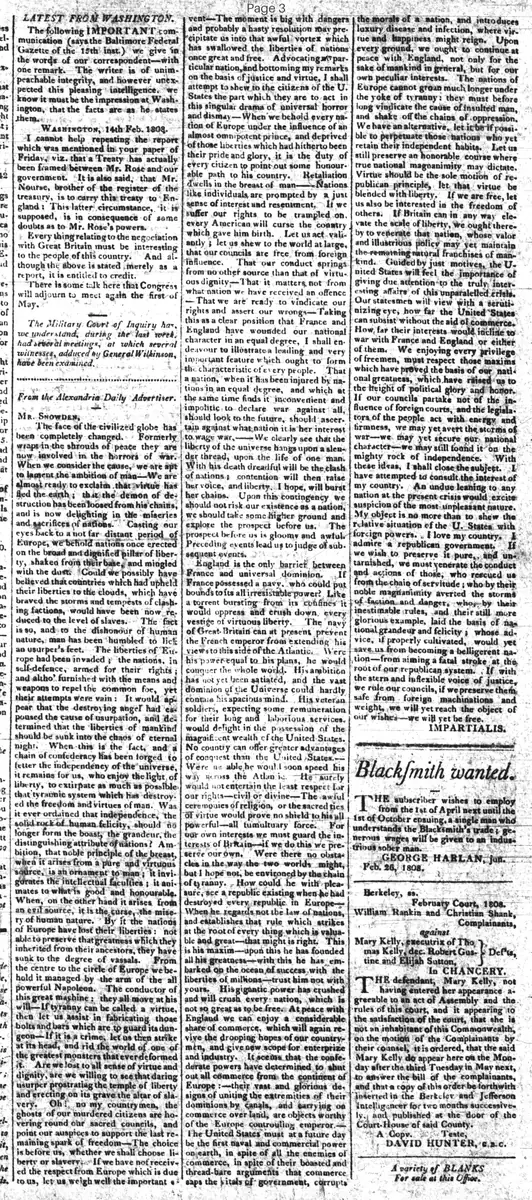
From the Alexandria Daily Advertiser.
Mr. SNOWDEN
The face of this civilized globe has been completely changed. Formerly wrapt in the shrouds of peace they are now involved in the horrors of war.
When we consider the cause, we are apt to lament the ambition of man. We are almost ready to exclaim, that virtue has fled the earth; that the demon of destruction has been loosed from his chains, and is now delighting in the miseries and sacrifices of nations. Casting our eyes back to a not far distant period of Europe, we behold nations once erected on the broad and dignified pillar of liberty, shaken from their base, and mingled with the dust. Could we possibly have believed that countries which had upheld their liberties to the clouds, which have braved the storms and tempests of clashing factions, would have been now reduced to the level of slaves. The fact is so, and to the dishonour of human nature, man has been humbled to lick a usurper's feet. The liberties of Europe had been invaded; the nations, in self-defence, armed for their rights; and altho' furnished with the means and weapons to repel the common foe, yet their attempts were vain: It would appear that the destroying angel had espoused the cause of usurpation, and determined that the liberties of mankind should sink into the chaos of eternal night. When this is the fact, and a chain of confederacy has been forged to fetter the independency of the universe, it remains for us, who enjoy the light of liberty, to extirpate as much as possible that tyrannic system which has destroyed the freedom and virtues of man. Was it ever ordained that independence, the solid rock of human felicity, should no longer form the boast, the grandeur, the distinguishing attribute of nations? Ambition, that noble principle of the breast, when it arises from a pure and virtuous source, is an ornament to man: it invigorates the intellectual faculties; it animates to what is good and honourable.
When, on the other hand it arises from an evil source, it is the curse, the misery of human nature. By it the nations of Europe have lost their liberties: not able to preserve that greatness which they inherited from their ancestors, they have sunk to the degree of vassals. From the centre to the circle of Europe we behold it managed by the arm of the all powerful Napoleon. The conductor of this great machine: they all move at his will. If tyranny can be called a virtue, then let us assist in fabricating those bolts and bars which are to guard its dungeon. If it is a crime, let us then strike at its head, and rid the world of one of the greatest monsters that ever deformed it. Are we lost to all sense of virtue and dignity, are we willing to see that daring usurper prostrating the temple of liberty and erecting on its grave the altar of slavery. Oh! no my countrymen, the ghosts of our murdered citizens are hovering round our sacred councils, and point our auspices to support the last remaining spark of freedom. The choice is before us, whether we shall choose liberty or slavery. If we have not received the respect from Europe which is due to us, let us weigh well the important event. The moment is big with dangers and probably a hasty resolution may precipitate us into that awful vortex which has swallowed the liberties of nations once great and free. Advocating no particular nation, and bottoming my remarks on the basis of justice and virtue, I shall attempt to shew to the citizens of the U. States the part which they are to act in this singular drama of universal horror and dismay. When we behold every nation of Europe under the influence of an almost omnipotent prince, and deprived of those liberties which had hitherto been their pride and glory, it is the duty of every citizen to point out some honourable path to his country. Retaliation dwells in the breast of man. Nations like individuals are prompted by a just sense of interest and resentment. If we suffer our rights to be trampled on, every American will curse the country which gave him birth. Let us act valiantly; let us shew to the world at large, that our councils are free from foreign influence. That our conduct springs from no other source than that of virtuous dignity. That it matters not from what nation we have received an offence. That we are ready to vindicate our rights and assert our wrongs. Taking this as a clear position that France and England have wounded our national character in an equal degree, I shall endeavour to illustrate a leading and very important feature which ought to form the characteristic of every people. That a nation, when it has been injured by nations in an equal degree, and which at the same time finds it inconvenient and impolitic, to declare war against all, should look to the future, should ascertain against what nation it is her interest to wage war. We clearly see that the liberty of the universe hangs upon a slender thread, upon the life of one man. With his death dreadful will be the clash of nations; contention will then raise her voice, and liberty, I hope, will burst her chains. Upon this contingency we should not risk our existence as a nation, we should take some higher ground and explore the prospect before us. The prospect before us is gloomy and awful. Preceding events lead us to judge of subsequent events.
England is the only barrier between France and universal dominion. If France possessed a navy, who could put bounds to its all-irresistable power? Like a torrent bursting from its confines it would oppress and crush down, every vestige of virtuous liberty. The navy of Great-Britain can at present prevent the French emperor from extending his views to this side of the Atlantic. Were his power equal to his plans, he would conquer the whole world. His ambition has not yet been satiated, and the vast dominion of the Universe could hardly contain his spacious mind. His veteran soldiers, expecting some remuneration for their long and laborious services, would delight in the possession of the magnificent wealth of the United States.
No country can offer greater advantages of conquest than the United States. Were he able he would soon speed his way across the Atlantic. He surely would not entertain the least respect for our rights—civil or divine. The awful ceremonies of religion, or the sacred ties of virtue would prove no shield to his all powerful—all tumultuous force. For our own interests we must guard the interests of Britain; if we do this we preserve our own. Were there no obstacles in the way the two worlds might, but I hope not, be environed by the chain of tyranny. How could he with pleasure see a republic existing when he had destroyed every republic in Europe. When he regards not the law of nations, and establishes that rule which strikes at the root of every thing which is valuable and great—that might is right. This is his maxim—upon this he has founded all his greatness—with this he has embarked on the ocean of success with the liberties of millions—trust him not with yours. His gigantic power has crushed and will crush every nation, which is not so great as to be free. At peace with England we can enjoy a considerable share of commerce, which will again revive the drooping hopes of our countrymen, and give new scope for enterprize and industry. It seems that the confederate powers have determined to shut out all commerce from the continent of Europe: their vast and glorious designs of uniting the extremities of their dominions by canals, and carrying on commerce over land, are objects worthy of the Europe controlling emperor.
The United States must at a future day be the first naval and commercial power on earth, in spite of all the enemies of commerce, in spite of their boasted and thread-bare arguments that commerce saps the vitals of government, corrupts the morals of a nation, and introduces luxury disease and infection, where virtue and happiness might reign. Upon every ground, we ought to continue at peace with England, not only for the sake of mankind in general, but for our own peculiar interests. The nations of Europe cannot groan much longer under the yoke of tyranny: they must before long vindicate the cause of insulted man, and shake off the chains of oppression. We have an alternative, let it be if possible to perpetuate those nations who yet retain their independent habits. Let us still preserve an honorable course where true national magnanimity may dictate. Virtue should be the sole motion of republican principle. Let that virtue be blended with liberty. If we are free, let us also be interested in the freedom of others. If Britain can in any way elevate the scale of liberty, we ought thereby to venerate that nation, whose valor and illustrious policy may yet maintain the remaining natural franchises of mankind. Guided by just motives, the United States will feel the importance of giving due attention to the truly interesting affairs of this unparalelled crisis. Our statesmen will view with a scrutinizing eye, how far the United States can subsist without the aid of commerce. How far their interests would incline to war with France and England or either of them. We enjoying every privilege of freemen, must respect those maxims which have proved the basis of our national greatness, which have raised us to the height of political glory and honor. If our councils partake not of the influence of foreign courts, and the legislators of the people act with energy and firmness, we may yet avert the storms of war—we may yet secure our national character—we may still found it on the mighty rock of independence. With these ideas, I shall close the subject. I have attempted to consult the interest of my country. An undue leaning to any nation at the present crisis would excite suspicion of the most unpleasant nature. My object is no more than to shew the relative situation of the U. States with foreign powers. I love my country. I admire a republican government. If we wish to preserve it pure, and untarnished, we must venerate the conduct and actions of those who rescued us from the chain of servitude; who by their noble magnanimity averted the storms of faction and danger, who, by their inestimable rules, and their still more glorious example, laid the basis of national grandeur and felicity; whose advice, if properly cultivated, would yet save, us from becoming a belligerent nation—from aiming a fatal stroke at the root of our republican system. If with the stern and inflexible voice of justice, we rule our councils, if we preserve them safe from foreign machinations and weight, we will yet reach the object of our wishes—we will yet be free.
IMPARTIALIS.
Mr. SNOWDEN
The face of this civilized globe has been completely changed. Formerly wrapt in the shrouds of peace they are now involved in the horrors of war.
When we consider the cause, we are apt to lament the ambition of man. We are almost ready to exclaim, that virtue has fled the earth; that the demon of destruction has been loosed from his chains, and is now delighting in the miseries and sacrifices of nations. Casting our eyes back to a not far distant period of Europe, we behold nations once erected on the broad and dignified pillar of liberty, shaken from their base, and mingled with the dust. Could we possibly have believed that countries which had upheld their liberties to the clouds, which have braved the storms and tempests of clashing factions, would have been now reduced to the level of slaves. The fact is so, and to the dishonour of human nature, man has been humbled to lick a usurper's feet. The liberties of Europe had been invaded; the nations, in self-defence, armed for their rights; and altho' furnished with the means and weapons to repel the common foe, yet their attempts were vain: It would appear that the destroying angel had espoused the cause of usurpation, and determined that the liberties of mankind should sink into the chaos of eternal night. When this is the fact, and a chain of confederacy has been forged to fetter the independency of the universe, it remains for us, who enjoy the light of liberty, to extirpate as much as possible that tyrannic system which has destroyed the freedom and virtues of man. Was it ever ordained that independence, the solid rock of human felicity, should no longer form the boast, the grandeur, the distinguishing attribute of nations? Ambition, that noble principle of the breast, when it arises from a pure and virtuous source, is an ornament to man: it invigorates the intellectual faculties; it animates to what is good and honourable.
When, on the other hand it arises from an evil source, it is the curse, the misery of human nature. By it the nations of Europe have lost their liberties: not able to preserve that greatness which they inherited from their ancestors, they have sunk to the degree of vassals. From the centre to the circle of Europe we behold it managed by the arm of the all powerful Napoleon. The conductor of this great machine: they all move at his will. If tyranny can be called a virtue, then let us assist in fabricating those bolts and bars which are to guard its dungeon. If it is a crime, let us then strike at its head, and rid the world of one of the greatest monsters that ever deformed it. Are we lost to all sense of virtue and dignity, are we willing to see that daring usurper prostrating the temple of liberty and erecting on its grave the altar of slavery. Oh! no my countrymen, the ghosts of our murdered citizens are hovering round our sacred councils, and point our auspices to support the last remaining spark of freedom. The choice is before us, whether we shall choose liberty or slavery. If we have not received the respect from Europe which is due to us, let us weigh well the important event. The moment is big with dangers and probably a hasty resolution may precipitate us into that awful vortex which has swallowed the liberties of nations once great and free. Advocating no particular nation, and bottoming my remarks on the basis of justice and virtue, I shall attempt to shew to the citizens of the U. States the part which they are to act in this singular drama of universal horror and dismay. When we behold every nation of Europe under the influence of an almost omnipotent prince, and deprived of those liberties which had hitherto been their pride and glory, it is the duty of every citizen to point out some honourable path to his country. Retaliation dwells in the breast of man. Nations like individuals are prompted by a just sense of interest and resentment. If we suffer our rights to be trampled on, every American will curse the country which gave him birth. Let us act valiantly; let us shew to the world at large, that our councils are free from foreign influence. That our conduct springs from no other source than that of virtuous dignity. That it matters not from what nation we have received an offence. That we are ready to vindicate our rights and assert our wrongs. Taking this as a clear position that France and England have wounded our national character in an equal degree, I shall endeavour to illustrate a leading and very important feature which ought to form the characteristic of every people. That a nation, when it has been injured by nations in an equal degree, and which at the same time finds it inconvenient and impolitic, to declare war against all, should look to the future, should ascertain against what nation it is her interest to wage war. We clearly see that the liberty of the universe hangs upon a slender thread, upon the life of one man. With his death dreadful will be the clash of nations; contention will then raise her voice, and liberty, I hope, will burst her chains. Upon this contingency we should not risk our existence as a nation, we should take some higher ground and explore the prospect before us. The prospect before us is gloomy and awful. Preceding events lead us to judge of subsequent events.
England is the only barrier between France and universal dominion. If France possessed a navy, who could put bounds to its all-irresistable power? Like a torrent bursting from its confines it would oppress and crush down, every vestige of virtuous liberty. The navy of Great-Britain can at present prevent the French emperor from extending his views to this side of the Atlantic. Were his power equal to his plans, he would conquer the whole world. His ambition has not yet been satiated, and the vast dominion of the Universe could hardly contain his spacious mind. His veteran soldiers, expecting some remuneration for their long and laborious services, would delight in the possession of the magnificent wealth of the United States.
No country can offer greater advantages of conquest than the United States. Were he able he would soon speed his way across the Atlantic. He surely would not entertain the least respect for our rights—civil or divine. The awful ceremonies of religion, or the sacred ties of virtue would prove no shield to his all powerful—all tumultuous force. For our own interests we must guard the interests of Britain; if we do this we preserve our own. Were there no obstacles in the way the two worlds might, but I hope not, be environed by the chain of tyranny. How could he with pleasure see a republic existing when he had destroyed every republic in Europe. When he regards not the law of nations, and establishes that rule which strikes at the root of every thing which is valuable and great—that might is right. This is his maxim—upon this he has founded all his greatness—with this he has embarked on the ocean of success with the liberties of millions—trust him not with yours. His gigantic power has crushed and will crush every nation, which is not so great as to be free. At peace with England we can enjoy a considerable share of commerce, which will again revive the drooping hopes of our countrymen, and give new scope for enterprize and industry. It seems that the confederate powers have determined to shut out all commerce from the continent of Europe: their vast and glorious designs of uniting the extremities of their dominions by canals, and carrying on commerce over land, are objects worthy of the Europe controlling emperor.
The United States must at a future day be the first naval and commercial power on earth, in spite of all the enemies of commerce, in spite of their boasted and thread-bare arguments that commerce saps the vitals of government, corrupts the morals of a nation, and introduces luxury disease and infection, where virtue and happiness might reign. Upon every ground, we ought to continue at peace with England, not only for the sake of mankind in general, but for our own peculiar interests. The nations of Europe cannot groan much longer under the yoke of tyranny: they must before long vindicate the cause of insulted man, and shake off the chains of oppression. We have an alternative, let it be if possible to perpetuate those nations who yet retain their independent habits. Let us still preserve an honorable course where true national magnanimity may dictate. Virtue should be the sole motion of republican principle. Let that virtue be blended with liberty. If we are free, let us also be interested in the freedom of others. If Britain can in any way elevate the scale of liberty, we ought thereby to venerate that nation, whose valor and illustrious policy may yet maintain the remaining natural franchises of mankind. Guided by just motives, the United States will feel the importance of giving due attention to the truly interesting affairs of this unparalelled crisis. Our statesmen will view with a scrutinizing eye, how far the United States can subsist without the aid of commerce. How far their interests would incline to war with France and England or either of them. We enjoying every privilege of freemen, must respect those maxims which have proved the basis of our national greatness, which have raised us to the height of political glory and honor. If our councils partake not of the influence of foreign courts, and the legislators of the people act with energy and firmness, we may yet avert the storms of war—we may yet secure our national character—we may still found it on the mighty rock of independence. With these ideas, I shall close the subject. I have attempted to consult the interest of my country. An undue leaning to any nation at the present crisis would excite suspicion of the most unpleasant nature. My object is no more than to shew the relative situation of the U. States with foreign powers. I love my country. I admire a republican government. If we wish to preserve it pure, and untarnished, we must venerate the conduct and actions of those who rescued us from the chain of servitude; who by their noble magnanimity averted the storms of faction and danger, who, by their inestimable rules, and their still more glorious example, laid the basis of national grandeur and felicity; whose advice, if properly cultivated, would yet save, us from becoming a belligerent nation—from aiming a fatal stroke at the root of our republican system. If with the stern and inflexible voice of justice, we rule our councils, if we preserve them safe from foreign machinations and weight, we will yet reach the object of our wishes—we will yet be free.
IMPARTIALIS.
What sub-type of article is it?
Foreign Affairs
War Or Peace
What keywords are associated?
Napoleon Tyranny
European Liberties
Us Foreign Policy
Peace With Britain
American Independence
Napoleonic Wars
Commerce Protection
What entities or persons were involved?
Napoleon
France
England
Great Britain
United States
Europe
Editorial Details
Primary Topic
Us Policy Of Peace With Britain To Counter Napoleonic Tyranny
Stance / Tone
Patriotic Exhortation Against French Imperialism, Advocating Alliance With British Liberty
Key Figures
Napoleon
France
England
Great Britain
United States
Europe
Key Arguments
Napoleon's Ambition Has Destroyed European Liberties
Us Must Preserve Its Independence By Opposing Tyranny
England's Navy Is The Barrier Against French Dominion
Peace With England Secures Us Commerce And Security
Avoid War With Both France And England; Focus On Virtuous Neutrality
France And England Have Equally Offended Us, But Future Interests Favor Britain
Us Should Act From Justice, Not Foreign Influence
Commerce Is Vital For Us Future Power
Venerate Republican Founders To Avoid Belligerence