Thank you for visiting SNEWPapers!
Sign up free
Vermont Telegraph
Brandon, Rutland County, Vermont
What is this article about?
U.S. Congressional proceedings from January 7-11, 1839, including Senate and House debates on the Graduation Land Bill with amendments favoring new states and settlers, handling of slavery-related petitions and resolutions from various states, passage of Texas boundary bill, appropriations for railroads and dry docks, and investigations into defalcations.
Merged-components note: Sequential congressional proceedings reports from Jan 7-11; all under 'CONGRESSIONAL' heading, domestic political news
Clipping
OCR Quality
Full Text
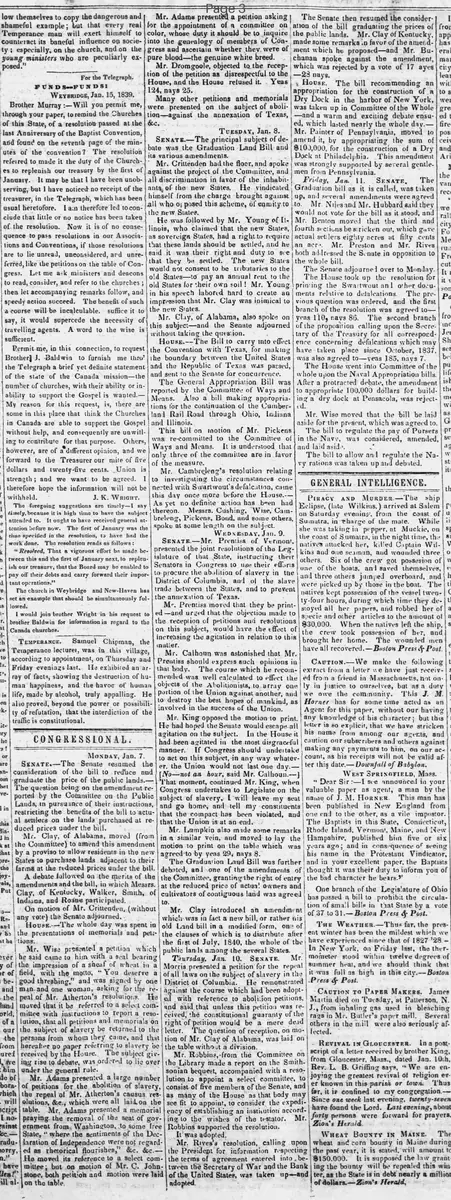
MONDAY, Jan. 7.
SENATE.-The Senate resumed the consideration of the bill to reduce and graduate the price of the public lands.- The question being on the amendment reported by the Committee on the Public Lands, in pursuance of their instructions, restricting the benefits of the bill to actual settlers on the lands purchased at reduced prices under the bill. -Mr. Clay, of Alabama, moved (from the Committee) to amend this amendment by a proviso to allow residents in the new States to purchase lands adjacent to their farms at the reduced prices under the bill.
A debate followed on the merits of the amendments and the bill, in which Messrs. Clay, of Kentucky, Walker, Smith, of Indiana, and Roane participated. On motion of Mr. Crittenden, (without any vote) the Senate adjourned.
House.-The whole day was spent in the presentations of memorials and petitions. Mr. Wise presented a petition which he said came to him with a seal bearing the impression of a sheaf of wheat in a field, with the motto, "You deserve a good threshing." and was signed by one man and one woman, asking for the repeal of Mr. Atherton's resolutions. He moved that it be referred to a select committee with instructions to report a resolution, that all petitions and memorials on the subject of slavery be returned to the persons from whom they came, and that hereafter no paper referring to slavery be received by the House. The subject giving rise to debate, was ordered to lie over under the general rule. Mr. Adams presented a large number of petitions for the abolition of slavery, the repeal of Mr. Atherton's caucus resolutions, &c., which were all laid on the table. Mr. Adams presented a memorial praying the removal of the seat of government from Washington, to some free State, "where the sentiments of the Declaration of Independence were not regarded as rhetorical flourishes," &c. &c.- He moved its reference to a select committee; but on motion of Mr. C. Johnstone, both petition and motion were laid on the table.
Mr. Adams presented a petition asking for the appointment of a committee on color, whose duty it should be to inquire into the genealogy of members of Congress and ascertain whether they were of pure blood--the genuine white breed. Mr. Dromgoole, objected to the reception of the petition as disrespectful to the House, and the House refused it. Yeas 124, nays 25. Many other petitions and memorials were presented on the subject of abolition--against the annexation of Texas, &c.
TUESDAY, Jan. 8.
Senate.--The principal subject of debate was the Graduation Land Bill and its various amendments. Mr. Crittenden had the floor, and spoke against the project of the Committee, and all discrimination in favor of the inhabitants of the new States. He vindicated himself from the charge brought against all who opposed this scheme, of enmity to the new States. He was followed by Mr. Young of Illinois, who claimed that the new States, as sovereign States, had a right to require that these lands should be settled, and he said it was their right and duty to see that they be settled. The new States would not consent to be tributaries to the old States--to pay an annual rent to the old States for their own soil! Mr. Young in his speech labored hard to create an impression that Mr. Clay was inimical to the new States. Mr. Clay, of Alabama, also spoke on this subject--and the Senate adjourned without taking the question.
House.--The Bill to carry into effect the Convention with Texas, for making the boundary between the United States and the Republic of Texas was passed, and sent to the Senate for concurrence.
The General Appropriation Bill was reported by the Committee of Ways and Means. Also a bill making appropriations for the continuation of the Cumberland Rail Road through Ohio, Indiana and Illinois. This bill on motion of Mr. Pickens was re-committed to the Committee of Ways and Means. It is understood that only three of the committee are in favor of the measure. Mr. Cambreleng's resolution relating to investigating the circumstances connected with Swartwout's defalcation, came this day once more before the House.-- As yet no definite action has been had thereon. Messrs. Cushing, Wise, Cambreleng, Pickens, Bond, and some others, spoke at some length on the subject.
WEDNESDAY, Jan. 9.
Senate.-Mr. Prentiss of Vermont, presented the joint resolutions of the Legislature of that State, instructing their Senators in Congress to use their efforts to procure the abolition of slavery in the District of Columbia, and of the slave trade between the States, and to prevent the annexation of Texas.
Mr. Prentiss moved that they be printed--and urged that the objection made to the reception of petitions and resolutions on this subject, would have the effect of increasing the agitation in relation to this matter. Mr. Calhoun was astonished that Mr. Prentiss should express such opinions in that body. The course which he recommended was well calculated to effect the objects of the Abolitionists, to array one portion of the Union against another, and to destroy the best hopes of mankind, as involved in the success of the Union. Mr. King opposed the motion to print. He had hoped the Senate would escape all agitation on the subject. In the House it had been agitated in the most disgraceful manner. If Congress should undertake to act on this subject, in any way whatever, the Union would not last one day.-- [No--not an hour, said Mr. Calhoun.--] That moment, continued Mr. King, when Congress undertakes to legislate on the subject of slavery, I will leave my seat and go home, and tell my constituents that the compact has been violated, and that the Union is at an end. Mr. Lumpkin also made some remarks in a similar vein, and moved to lay the motion to print on the table which was agreed to by yeas 29, nays 8.
The Graduation Land Bill was further debated, and one of the amendments of the Committee, granting the right of entry at the reduced price of actual owners and cultivators of contiguous land was agreed to. Mr. Clay introduced an amendment which was in fact a new bill, or rather his old Land bill in a modified form, one of the clauses of which is to distribute after the first of July, 1840, the whole of the public lands among the several States.
Thursday, Jan. 10.
SENATE Mr. Morris presented a petition for the repeal of all laws on the subject of slavery in the District of Columbia. He remonstrated against the course which had been adopted with reference to abolition petitions, and said that unless this petition was received, the constitutional guaranty of the right of petition would be a mere dead letter. The question of reception, on motion of Mr. Clay of Alabama, was laid on the table without a division. Mr. Robbins.--from the Committee on the Library made a report on the Smithsonian bequest, accompanied with a resolution to appoint a select committee, to consist of five members of the Senate, and as many of the House as that body may see fit to appoint, to consider the expediency of establishing an institution according to the wishes of the testator. Mr. Robbins supported the resolution. It was adopted. Mr. Rives's resolution, calling upon the President for information respecting the terms of agreement entered into, between the Secretary of War and the Bank of the United States, was taken up--and adopted.
The Senate then resumed the consideration of the bill graduating the prices of the public lands. Mr. Clay of Kentucky, made some remarks in favor of the amendment which he proposed--and Mr. Buchanan spoke against the amendment, which was rejected by a vote of 17 ayes -28 nays.
House. The bill recommending an appropriation for the construction of a Dry Dock in the harbor of New York, was taken up in Committee of the Whole --and a warm and exciting debate ensued, which lasted nearly the whole day.- Mr. Painter of Pennsylvania, moved to amend it, by appropriating the sum of $100,000, for the construction of a Dry Dock at Philadelphia. This amendment was strongly supported by several gentlemen from Pennsylvania.
Friday, Jan. 11.
Senate. The Graduation bill as it is called, was taken up, and several amendments were agreed to. Mr. Rives and Mr. Hubbard said they would not vote for the bill as it stood, and Mr. Benton moved that the third and fourth sections be stricken out, which gave actual settlers eighty acres at fifty cents an acre. Mr. Preston and Mr. Rives both addressed the Senate in opposition to the whole bill. The Senate adjourned over to Monday.
The House took up the resolution for printing the Swartwout and other documents relative to defalcations. The previous question was ordered, and the first branch of the resolution was agreed to-- yeas 110, nays 86. The second branch of the proposition calling upon the Secretary of the Treasury for all correspondence concerning defalcations which may have taken place since October, 1837, was also agreed to-- yeas 185, nays 7. The House went into Committee of the whole upon the Naval Appropriation bills. After a protracted debate, the amendment to appropriate 100,000 dollars for building a dry dock at Pensacola, was rejected. Mr. Wise moved that the bill be laid aside for the present, which was agreed to. The bill to regulate the pay of Pursers in the Navy, was considered, amended, and laid aside. The bill to allow and regulate the Navy rations was taken up and debated.
What sub-type of article is it?
What keywords are associated?
What entities or persons were involved?
Where did it happen?
Domestic News Details
Primary Location
Washington
Event Date
Jan. 7 11
Key Persons
Outcome
various bills debated and amended; texas boundary bill passed house; vermont resolutions laid on table; smithsonian committee appointed; swartwout investigation resolutions agreed; dry dock amendments debated.
Event Details
Daily proceedings in U.S. Senate and House of Representatives from January 7 to 11, focusing on Graduation Land Bill debates and amendments, presentations and receptions of slavery abolition petitions and resolutions, passage of Texas boundary convention bill, appropriations for railroads and dry docks, and resolutions on defalcations and Smithsonian bequest.